Alain Daniélou on Sanskrit
← Back to Alain Daniélou Profile
“Sanskrit was a complete success and became the language of all cultured people in India and in countries under Indian influence. All scientific, philosophical, historical works were henceforth written in Sanskrit, and important texts existing in other languages were translated and adapted into Sanskrit. For this reason, very few ancient literary, religious, or philosophical documents exits in India in other languages. The sheer volume of Sanskrit literature is immense, and it remains largely unexplored. .... Sanskrit is constructed like geometry and follows a rigorous logic. It is theoretically possible to explain the meaning of the words according to the combined sense of the relative letters, syllables and roots. Sanskrit has no meanings by connotations and consequently does not age. Panini's language is in no way different from that of Hindu scholars conferring in Sanskrit today.”
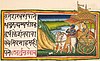
“The creation of Sanskrit, the “refined” language, was a prodigious work on a grand scale. Grammarians and semanticists of genius undertook to create a perfect language, artificial and permanent, belonging to no one, that was to become the language of the entire culture. Sanskrit is built on a basis of Vedic and the Prakrits, but has a much more complex grammar, established according to a rigorous logic. It has an immense vocabulary and a very adaptable grammar, so that words can be grouped together to express any nuance of an idea, and verb forms can be found to cover any possibility of tense, such as future intentional in the past, present continuing into the future, and so on. Furthermore, Sanskrit possesses a wealth of abstract nouns, technical and philosophical terms unknown in any other language. Modern Indian scholars of Sanskrit culture have often remarked that many of the new concepts of nuclear physics or modern psychology are easy for them to grasp, since they correspond exactly to familiar notions of Sanskrit terminology.”