Link Copied!
Yagan Quotes (1795-1833)
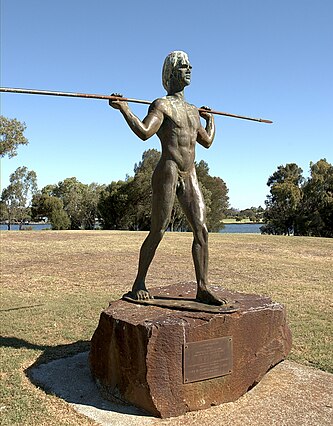
About Yagan
Yagan (c. 1795 – July 11 1833) was a Noongar warrior who played a key part in early indigenous Australian resistance to European settlement and rule in the area of Perth, Western Australia. After he led a series of attacks in which white settlers were killed, a bounty was offered for his capture dead or alive, and he was shot dead by a young settler. Yagan's death has passed into Western Australian folklore as a symbol of the unjust and sometimes brutal treatment of the indigenous peoples of Australia by colonial settlers. Famous throughout Australia, he is considered a hero by the Noongar people.
Yagan Quotes
Shortest
Earliest
Explore our curated collection of the most famous and impactful Yagan quotes.
“You came to our country — you have driven us from our haunts, and disturbed us in our occupations. As we walk in our own country we are fired upon by the white men; why should the white men treat us so?”

Quotes About Yagan
Gain deeper perspective through quotes about Yagan from others.
Diary of on Yagan 3 quotes
“Do you recollect my having mentioned, some time ago, the murder of an outsettler on the Canning River by the natives? One of these, called Ya-gan, identified (on oath by a boy who escaped) as the principal actor, who took the spears from his companions and deliberately drove them one by one into the deceased (who had become entangled in a hedge while trying to escape), has been taken. The Government offered a reward for the apprehension of this Ya-gan, and some days ago he and two others, almost equally concerned, were seized by two boatmen, and brought to Perth: they had been fishing, and were enticed into the boat and there secured; they have been sent to Carnac, where they are to suffer solitary confinement and be taught our language. One of them escaped by swiming and diving across the river, where it is fully a mile in breadth.”
Charles Macfaull on Yagan 3 quotes
“Mr. Norcott we are informed had a narrow escape from that determined villian Yagan a few days ago, he happened to give him more than his share of biscuit, and endeavouring to take it away, when Yagan's ire was aroused, and his spear instantly pointed; this was done in the presence of several persons who restrained him. The reckless daring of this desperado who sets his life at a pin's fee, has been the subject of general observation, and we firmly believe for the most trivial offence even with a loaded musket at his breast, he would take the life of any man who provoked him. He is at the head and front of any mischief; it has been suggested that he should be again confined, but this we believe would only leave an opening for an equally daring successor. The chuckling style in which Yagan gives us to understand the manner in which they effected their escape from Carnac, is highly amusing; but a short time ago, he walked up to the door of the Jail at Fremantle, and after exchanging civilities with his late Keeper, marched off pointing significantly at the Jail, and then Carnac.”
Robert Menli Lyon on Yagan 2 quotes
“I would take the liberty of suggesting to Capt. Ellis, if report speaks truly, the impropriety of allowing Yagan to distribute the bread. The propriety of allowing any of the natives to do this at present, is, perhaps questionable. But the conferring this honor upon Yagan is a gross insult to Yellowgonga, who is the leading Chief on this side of the water.”
Robert Dale on Yagan
“Yagan, whose portrait(by Mr. George Cruikshank) forms the frontispiece, was chief of the tribe of natives inhabiting the banks of the Swan, over whom his remarkable character had acquired an unusual ascendancy. He was strong and active, perfectly fearless, and the best spearsman of his tribe — but passionate, implacable and sullen; in short, a most complete and untameable savage. He very soon made his first essay against the settlers,by decamping with a bag of flour belonging to the commandant: the robbery was discovered, and a native, who gave information, led a party upon his trail with the quickness and sagacity of an Indian, until they found the flour, but not the thief, in a thick swamp. After leading his tribe in an unsuccessful attack upon the barracks at the Canning River — in which, it is said, he performed the romantic feat of burying the head of his spear in a tree from a distance of sixty yards — he was the principal actor in two murders, and a reward was offered by Government for his apprehension. For a considerable time he evaded pursuit, but was at length, with two other natives, enticed into a board by some fishermen, who pushed off into deep water, and, after a desperate resistance, secured him. Being removed for safety to an island off the coast, he made his escape, with his companions, and soon afterwards, accompanied by his own and another tribe, entered Fremantle in the night, and plundered the stores of a merchant, but not without the loss of one killed, and several who were wounded by the inhabitants, who fired on the marauders. To revenge this death, Yagan immediately proceeded to the Canning, and, having laid an ambuscade, killed two men who were driving a cart in advance of a party of settlers, who were moving up the river. He was now outlawed, and constantly pursued from place to place for three months. At length two brothers, shepherds, one eighteen the other fourteen, met him in the woods along with Weeip, a mountain chief, and five other natives. The boys instantly armed themselves each with a gun, and the elder, engaging Yagan in conversation until his head was in a line with the muzzle of his gun, shot him. The boys did not both escape; the elder was overtaken and speared. Yagan always shewed an inveterate hostility towards the Europeans. He certainly was a dangerous character, and decided steps were necessary to be taken, nor merely on account of his past behaviour, but also of a determination which he expressed, and would have no doubt carried into effect, of taking the lives of three "white men," in revenge for the death of his father, who had been shot by order of Government, upon being tried and convicted of murder. The justice of his death appears to have been recognised by his tribe; for after have propitiated the shade of their chief by taking — not, as had been their practice when one of their number had been killed by the Europeans, a white man's life, but — the lives of two individuals of an unoffending tribe, all hostility ceased, and a friendly feeling was soon established.”
About Yagan
Yagan (c. 1795 – July 11 1833) was a Noongar warrior who played a key part in early indigenous Australian resistance to European settlement and rule in the area of Perth, Western Australia. After he led a series of attacks in which white settlers were killed, a bounty was offered for his capture dead or alive, and he was shot dead by a young settler. Yagan's death has passed into Western Australian folklore as a symbol of the unjust and sometimes brutal treatment of the indigenous peoples of Australia by colonial settlers. Famous throughout Australia, he is considered a hero by the Noongar people.