Link Copied!
William Tyndale Quotes (1494-1536)
Author, King
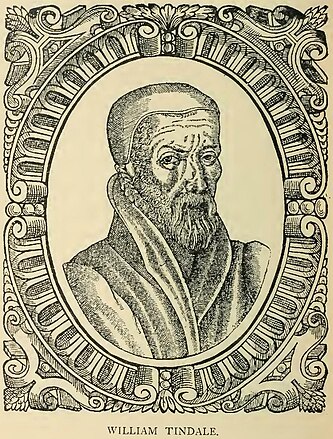

About William Tyndale
William Tyndale (sometimes spelled Tindale, Tindall, Tindill, or Tyndall) (c. 1494 – 1536-09-06) was a 16th-century religious reformer and scholar who translated the Bible into the Early Modern English of his day. On 6 September 1536, he was executed in Belgium by strangulation and then burned at the stake. Much of Tyndale's work eventually found its way to the King James Version (or Authorised Version) of the Bible, published in 1611, which, though the work of 54 independent scholars, is based primarily on Tyndale's translations.
Best William Tyndale Quotes
Shortest
Earliest
Explore our curated collection of the most famous and impactful William Tyndale quotes.
“A law unto themselves.”



“a law unto themselves”


“He threatened me grievously, and reviled me.”
William Tyndale Quotes by Topic
Find exactly what you are looking for by browsing this categorized list of William Tyndale quotes by topic.

Quotes About William Tyndale
Gain deeper perspective through quotes about William Tyndale from others.
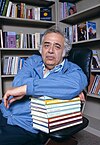
Harold Bloom on William Tyndale
“Except for Geoffrey Chaucer I would think someone who comes closest to being authentically of Shakespeare's greatness, that is William Tyndale...who is the principal translator of [the King James Bible] ... I am not quite sure that I would agree that even Shakespeare could write more powerfully than William Tyndale in Tyndale's Bible, in his version of the story of Joseph. Unfortunately it vanishes in King James even though they use so much of Tyndale. There is a wonderful sentence, "And the Lord was with Joseph and he was a lucky fellow", which is superb and worthy of Shakespeare.”
William A. Clebsch on William Tyndale
“Tyndale founded English Puritanism as the theological, religious, and moral system that univocally regarded scripture as God's law for everyman, binding everyman and God together in a contract that enjoined and rewarded strict morality.”
Patrick Collinson on William Tyndale 2 quotes
“Tyndale, coming out of the remote Forest of Dean, hard by the Welsh border, somehow or other (and it remains a mystery to me how he did it, but it was an achievement comparable to Martin Luther's, in his German Bible) fashioned, in the pages of his New Testament, the English which we still speak and write; an English employing a vocabulary which if not at first universally understood and assimilated soon was; an English partly derived from the word order and sentence structure of the Greek and especially of the Hebrew biblical texts in which Tyndale, a remarkable and precocious classical philologist, was thoroughly proficient. Tyndale had an intuitive and strong sense of the affinity of English with these ancient tongues, an affinity which he believed was not to be found in the Latin language and in the Latin Bible.”
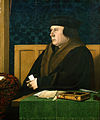
Thomas Cromwell on William Tyndale
“Tyndall (who assuredlie sheweth himself in myn opynyon rather to be replete with venymous envye rancour and malice then with any good lerning vertue knowlage or discression).”
David Daniell on William Tyndale 3 quotes
“William Tyndale gave us our English Bible. The sages assembled by King James to prepare the Authorised Version of 1611...took over Tyndale's work. Nine-tenths of the Authorised Version's New Testament is Tyndale's. The same is true of the first half of the Old Testament... William Tyndale was a most remarkable scholar and linguist, whose eight languages included skill in Greek and Hebrew far above the ordinary for an Englishman of the time... His unsurpassed ability was to work as a translator with the sounds and rhythms as well as the senses of English, to create unforgettable words, phrases, paragraphs and chapters, and to do so in a way that, again unusually for the time, is still, even today, direct and living: newspaper headlines still quote Tyndale, though unknowingly, and he has reached more people than even Shakespeare.”
Geoffrey Elton on William Tyndale
“Most important was Tyndale's Bible translation...which gave currency to Erasmian and Lutheran revisions of such crucial established concepts as ecclesia (church or congregation?) and presbyter (priest or elder?), and which was accompanied by powerfully reformist prefaces and prologues. Tunstall's attempt to stamp out this dangerous New Testament had greatly amused the reformers who financed further operations out of the money the bishop paid over in buying up the offending edition. In 1528 Tyndale also entered the lists as a theorist of politics when in his Obedience of a Christian Man he elaborated Luther's teaching on the subject's duty of submission to his secular ruler in ways highly satisfactory to Henry who read the book with pleasure; next year, however, Tyndale cast himself into outer darkness again by violently attacking the Divorce in a work, The Practice of Prelates, mainly concerned to blast Wolsey and the English hierarchy in general.”
Henry VIII on Tyndale on William Tyndale
Philip Howard on William Tyndale
“[H]is writing is the bedrock of English language and literature... Tyndale's best memorial is that whenever anyone writes or speaks well in English, she or he echoes the simple but majestic rhythms that Tyndale introduced. He showed that plain English was a mighty tongue. His voice is the forgotten ghost in the language... Tyndale had the revolutionary idea that the English of ordinary folk could be the finest literary language in the world. He was a passionate populist and democrat, as well as a rich scholar... [H]is words are blood and bone of the English language.”
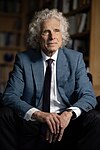
Steven Pinker on William Tyndale
“By sanctifying cruelty, early Christianity set a precedent for more than a millennium of systematic torture in Christian Europe. If you understand the expressions to burn at the stake, to hold his feet to the fire, to break a butterfly on the wheel, to be racked with pain, to be drawn and quartered, to disembowel, to flay, to press, the thumbscrew, the garrote, a slow burn, and the iron maiden (a hollow hinged statue lined with nails, later taken as the name of a heavy-metal rock band), you are familiar with a fraction of the ways that heretics were brutalized during the Middle Ages and early modern period. During the Spanish Inquisition, church officials concluded that the conversions of thousands of former Jews didn’t take. To compel the conversos to confess their hidden apostasy, the inquisitors tied their arms behind their backs, hoisted them by their wrists, and dropped them in a series of violent jerks, rupturing their tendons and pulling their arms out of their sockets. Many others were burned alive, a fate that also befell Michael Servetus for questioning the trinity, Giordano Bruno for believing (among other things) that the earth went around the sun, and William Tyndale for translating the Bible into English. Galileo, perhaps the most famous victim of the Inquisition, got off easy: he was only shown the instruments of torture (in particular, the rack) and was given the opportunity to recant for “having held and believed that the sun is the center of the world and immovable, and that the earth is not the center and moves.””
Misattributed Quotes
Quotes mistakenly credited to William Tyndale
“Resistance to tyranny is obedience to God.”
About William Tyndale
William Tyndale (sometimes spelled Tindale, Tindall, Tindill, or Tyndall) (c. 1494 – 1536-09-06) was a 16th-century religious reformer and scholar who translated the Bible into the Early Modern English of his day. On 6 September 1536, he was executed in Belgium by strangulation and then burned at the stake. Much of Tyndale's work eventually found its way to the King James Version (or Authorised Version) of the Bible, published in 1611, which, though the work of 54 independent scholars, is based primarily on Tyndale's translations.