Link Copied!
Washington Irving Quotes (1783-1859)
Writer















-100px.jpg)





About Washington Irving
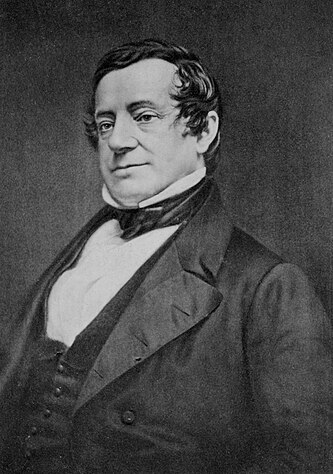
Washington Irving (3 April 1783 – 28 November 1859) was an American short story writer, essayist, biographer, historian, and diplomat of the early 19th century.
Best Washington Irving Quotes
Shortest
Earliest
Explore our curated collection of the most famous and impactful Washington Irving quotes.

“Free-livers on a small scale, who are prodigal within the compass of a guinea.”

“There is an eloquence in true enthusiasm that is not to be doubted.”

“Little minds are tamed and subdued by misfortune; but great minds rise above it.”
“My native country was full of youthful promise; Europe was rich in the accumulated treasures of age.”
“They claim to be the first inventors of those recondite beverages, cocktail, stonefence, and sherry cobbler.”
“Those men are most apt to be obsequious and conciliating abroad, who are under the discipline of shrews at home.”
“His [the author's] renown has been purchased, not by deeds of violence and blood, but by the diligent dispensation of pleasure.”

“Whenever a man's friends begin to compliment him about looking young, he may be sure that they think he is growing old.”
“His wife "ruled the roost," and in governing the governor, governed the province, which might thus be said to be under petticoat government.”

“Thus man passes away; his name perishes from record and recollection; his history is as a tale that is told, and his very monument becomes a ruin.”
“There is in every true woman's heart a spark of heavenly fire, which lies dormant in the broad daylight of prosperity; but which kindles up, and beams, and blazes in the dark hour of adversity.”

“Other men are known to posterity only through the medium of history, which is continually growing faint and obscure; but the intercourse between the author and his fellow-men is ever new, active, and immediate.”
“Who ever hears of fat men heading a riot, or herding together in turbulent mobs? — No — no, ‘tis your lean, hungry men who are continually worrying society, and setting the whole community by the ears.”
“There is a certain relief in change, even though it be from bad to worse! As I have often found in travelling in a stagecoach, that it is often a comfort to shift one’s position, and be bruised in a new place.”
“In his private dealings he was just. He treated friends and strangers, the rich and poor, the powerful and weak, with equity, and was beloved by the common people for the affability with which he received them, and listened to their complaints.[...]”

“The sorrow for the dead is the only sorrow from which we refuse to be divorced. Every other wound we seek to heal — every other affliction to forget: but this wound we consider it a duty to keep open — this affliction we cherish and brood over in solitude.”

“Luxury spreads its ample board before their eyes; but they are excluded from the banquet. Plenty revels over the fields; but they are starving in the midst of its abundance: the whole wilderness has blossomed into a garden; but they feel as reptiles that infest it.”

“How convenient it would be to many of our great men and great families of doubtful origin, could they have the privilege of the heroes of yore, who, whenever their origin was involved in obscurity, modestly announced themselves descended from a god.”
“The almighty dollar, that great object of universal devotion throughout our land, seems to have no genuine devotees in these peculiar villages; and unless some of its missionaries penetrate there, and erect banking houses and other pious shrines, there is no knowing how long the inhabitants may remain in their present state of contented poverty.”

“A woman's whole life is a history of the affections. The heart is her world: it is there her ambition strives for empire; it is there her avarice seeks for hidden treasures. She sends forth her sympathies on adventure; she embarks her whole soul on the traffic of affection; and if shipwrecked, her case is hopeless — for it is a bankruptcy of the heart.”

“The great British Library — an immense collection of volumes of all ages and languages, many of which are now forgotten, and most of which are seldom read: one of these sequestered pools of obsolete literature to which modern authors repair, and draw buckets full of classic lore, or “pure English, undefiled” wherewith to swell their own scanty rills of thought.”

“From the listless repose of the place and the peculiar character of its inhabitants, who are descendants from the original Dutch settlers, this sequestered glen has long been known by the name of SLEEPY HOLLOW, and its rustic lads are called the Sleepy Hollow Boys throughout all the neighboring country. A drowsy, dreamy influence seems to hang over the land and to pervade the very atmosphere.”
“The dominant spirit, however, that haunts this enchanted region, and seems to be commander-in-chief of all the powers of the air, is the apparition of a figure on horseback without a head. It is said by some to be the ghost of a Hessian trooper whose head had been carried away by a cannonball in some nameless battle during the Revolutionary War, and who is ever and anon seen by the country-folk hurrying along in the gloom of night as if on the wings of the wind.”

“There rise authors now and then, who seem proof against the mutability of language, because they have rooted themselves in the unchanging principles of human nature. They are like gigantic trees that we sometimes see on the banks of a stream; which, by their vast and deep roots, penetrating through the mere surface, and laying hold on the very foundations of the earth, preserve the soil around them from being swept away by the ever-flowing current, and hold up many a neighboring plant, and perhaps worthless weed, to perpetuity.”
“His military triumphs awakened no pride nor vain glory, as they would have done had they been effected for selfish purposes. In the time of his greatest power he maintained the same simplicity of manners and appearance as in the days of his adversity. So far from affecting a regal state, he was displeased if, on entering a room, any unusual testimonials of respect were shown to him. If he aimed at a universal dominion, it was the dominion of faith; as to the temporal rule which grew up in his hands, as he used it without ostentation, so he took no step to perpetuate it in his family”
“We feel that we are surrounded by the congregated bones of the great men of past times, who have filled history with their deeds, and the earth with their renown. And yet it almost provokes a smile at the vanity of human ambition to see how they are crowded together and jostled in the dust; what parsimony is observed in doling out a scanty nook, a gloomy corner, a little portion of earth, to those whom, when alive, kingdoms could not satisfy, and how many shapes and forms and artifices are devised to catch the casual notice of the passenger, and save from forgetfulness for a few short years a name which once aspired to occupy ages of the world's thought and admiration.”

“"If I can but reach that bridge," thought Ichabod, "I am safe." Just then he heard the black steed panting and blowing close behind him; he even fancied that he felt his hot breath. Another convulsive kick in the ribs, and old Gunpowder sprang upon the bridge; he thundered over the resounding planks; he gained the opposite side; and now Ichabod cast a look behind to see if his pursuer should vanish, according to rule, in a flash of fire and brimstone. Just then he saw the goblin rising in his stirrups, and in the very act of hurling his head at him. Ichabod endeavored to dodge the horrible missile, but too late. It encountered his cranium with a tremendous crash; he was tumbled headlong into the dust, and Gunpowder, the black steed, and the goblin rider passed by like a whirlwind.”

“Many of the visions and revelations handed down as having been given by him are spurious. The miracles ascribed to him are all fabrications of Moslem zealots. He expressly and repeatedly disclaimed all miracles excepting the Koran ; which, considering its incomparable merit, and the way in which it had come down to him from heaven, he pronounced the greatest of miracles. And here we must indulge a few observations on this famous document. While zealous Moslems and some of the most learned doctors of the faith draw proofs of its divine origin from the inimitable excellence of its style and composition, and the avowed illiteracy of Mahomet, less devout critics have pronounced it a chaos of beauties and defects; without method or arrangement; full of obscurities, incoherencies, repetitions, false versions of scriptural stories, and direct contradictions. The truth is that the Koran as it now exists is not the same Koran delivered by Mahomet to his disciples, but has undergone many corruptions and interpolations.”

“Language gradually varies, and with it fade away the writings of authors who have flourished their allotted time; otherwise, the creative powers of genius would overstock the world, and the mind would be completely bewildered in the endless mazes of literature. Formerly there were some restraints on this excessive multiplication. Works had to be transcribed by hand, which was a slow and laborious operation; they were written either on parchment, which was expensive, so that one work was often erased to make way for another; or on papyrus, which was fragile and extremely perishable. Authorship was a limited and unprofitable craft, pursued chiefly by monks in the leisure and solitude of their cloisters. The accumulation of manuscripts was slow and costly, and confined almost entirely to monasteries. To these circumstances it may, in some measure, be owing that we have not been inundated by the intellect of antiquity; that the fountains of thought have not been broken up, and modern genius drowned in the deluge. But the inventions of paper and the press have put an end to all these restraints. They have made everyone a writer, and enabled every mind to pour itself into print, and diffuse itself over the whole intellectual world. The consequences are alarming. The stream of literature has swollen into a torrent — augmented into a river — expanded into a sea.”
Washington Irving Quotes by Topic
Find exactly what you are looking for by browsing this categorized list of Washington Irving quotes by topic.
Washington Irving on Government 2 quotes
“No sooner does he hear any of his brothers mention reform or retrenchment, than up he jumps.”
Washington Irving on New York City
Washington Irving on Faults
Washington Irving on Poverty
What Washington Irving Said About Others
Discover personal opinions Washington Irving shared regarding contemporaries.
Washington Irving on Women in the United States 10 quotes
“I value this delicious home-feeling as one of the choicest gifts a parent can bestow.”

Washington Irving on Women 3 quotes
“A woman is more considerate in affairs of love than man; because love is more the study and business of her life.”

Washington Irving on Alexander the Great
“We are not in the situation of poor Alexander the Great, who wept, as well indeed he might, because there were no more worlds to conquer; for, to do justice to this queer, odd, rantipole city, and this whimsical country, there is matter enough in them to keep our risible muscles and our pens going until doomsday.”

Washington Irving on Muhammad
“He was sober and abstemious in his diet and a rigorous observer of fasts. He indulged in no magnificence of apparel, the ostentation of a petty mind; neither was his simplicity in dress affected but a result of real disregard for distinction from so trivial a source... In his private dealings he was just. He treated friends and strangers, the rich and poor, the powerful and weak, with equity, and was beloved by the common people for the affability with which he received them, and listened to their complaints... His military triumphs awakened no pride nor vain glory, as they would have done had they been effected for selfish purposes. In the time of his greatest power he maintained the same simplicity of manners and appearance as in the days of his adversity. So far from affecting a regal state, he was displeased if, on entering a room, any unusual testimonials of respect were shown to him. If he aimed at a universal dominion, it was the dominion of faith; as to the temporal rule which grew up in his hands, as he used it without ostentation, so he took no step to perpetuate it in his family.”

Disputed Quotes
Quotes attributed to Washington Irving that are questionable.
“Love is never lost. If not reciprocated, it will flow back and soften and purify the heart.”
About Washington Irving
Washington Irving (3 April 1783 – 28 November 1859) was an American short story writer, essayist, biographer, historian, and diplomat of the early 19th century.