Link Copied!
Tipu Sultan Quotes (1750-1799)
Poet, King
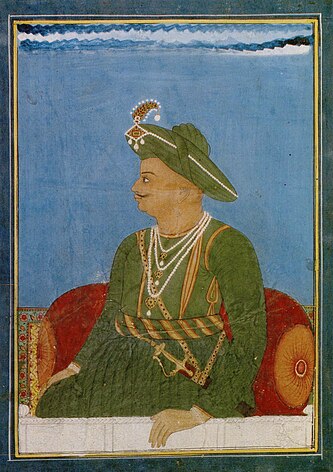


About Tipu Sultan
Sultan Fateh Ali Tipu (20 November 1750 – 4 May 1799), also known as the Tiger of Mysore, was the de facto ruler of the Indian Kingdom of Mysore from 1782 until his death in 1799. He was a scholar, warrior and poet. He is celebrated for his wars against the British.
Best Tipu Sultan Quotes
Shortest
Earliest
Explore our curated collection of the most famous and impactful Tipu Sultan quotes.
“Tipu ordered that ‘40,000 captives, unhappy families of the Koorg country and other parts of the Mallabar Coast are to be circumcised [converted].’”

“In the hills the unbelievers of the land of the enemy have forbidden fasting and prayer; convert them all to Islam, so that the religion of Thy messenger may gain in strength.”
“The temples are under your management; you are therefore to see that offering to the gods and the temple illumination are duly regulated, as directed out of government grants.”

“‘Having circumcised them,’ Tipu ordered, ‘you must enroll them among the faithful [make them Musalmans] . . . if any of those should escape, you will come under our displeasure.”
“242 Nairs are being sent as prisoners. Categorise them according to their social and family status. After honouring them with Islam, sufficient dress materials may be given to the men and their women.”
“In yet another letter, written on the occasion of seizing a part of the Nizam’s calvary at Kadapa, Tipu says: Let the prisoners be strangled, and the horses, after being valued, be taken into Government service.”

“If any person, whether before or after marriage, shall keep a prostitute or a female-slave, you shall, after ascertaining the fact, take the slave for the Government,' and, if any person objects to it, he will be punishable”
“I am sending two of my followers with Mir Hussain Ali. With their assistance, you should capture and kill all Hindus. Those below 20 may be kept in prison and 5,000 from the rest should be killed by hanging from the tree-tops. These are my orders.”
“Looting a conquered enemy enriches a few, impoverishes the nation and dishonors the entire army. Wars must be linked to battlefields. Do not carry them to innocent civilians. Honor their women, respect their religion, and protect their children and the infirm”
“In the whole of the territories of the Balaghat (i.e., in the country below the ghats) most of the Hindu women go about with their breasts and heads uncovered. This is animal-like. No one of these women should hereafter go out without a fuller robe and a veil.”

“With the grace of Prophet Muhammed and Allah, almost all Hindus in Calicut are converted to Islam. Only a few are still not converted on the borders of Cochin State. I am determined to convert them also very soon. I consider this as Jehad to achieve that object.”
“After you have made your arrangements regarding the capital of the Sultanut of Persia, it is my wish that you and I in concert with Zuman Shah should endeavour to regulate and put in order, (divide between them seemingly), the countries of Hindostan, and the Dukhun.”
“In another letter, addressed to an officer in Coorg, Tipu remarks: You are to make a general attack on the Coorgs, and, having put to the sword or made prisoners the whole of them, both the slain and the prisoners, with the women and children, are to be made Musalmans.”
“Your Majesty must doubtless have been informed that my exalted ambition is to wage a Holy War…In the midst of this land of heretics, the Almighty protects this tract of Muhammadan dominion like the Ark of Noah and cuts short the extended arm of the abandoned heretic.”
“To Siyad Abdulla, Dated 18th January 1790. With the grace of God and help from Muhammad, we have almost entirely converted the non-believers. A few are remaining in areas near to Kochi. I have decided to make them too Mohammadans. I have considered this as a religious war.”
“In his letter of February 10, 1799, to the Grand Seignior of Constantinople Tipu claimed that “near five hundred thousand of the infidels of the district of Calicut, Nuzzuraband, Zufferabaud, and Ashrufabaud . . . have been converted at different times” (Martin, 1837, p. 30).”
“To Sheikh Kuttub dated 1st December 1788. I am happy finding the report you have sent. Whoever has come in your hands, all above age of twenty should be hung on trees. If they hide in nooks and corners and forests, to find them out, instruct Dilkhan to split his force in to three.”

“People who have sinned against such a holy place are sure to suffer the consequences of their misdeeds at no distant date in this Kali age in accordance with the verse: Hasadbhih kriyate karma rudadbhir-anubhuyate (People do [evil] deeds smilingly but suffer the consequences crying).”
“To begin the so much desired work of the conversion of the Hindoos and to seize on the Brahmins, ... and make them examples to the other inferior castes, in becoming Mussulmans, by suffering circumcision and being compelled to eat beef: accordingly many Brahmins were seized in or about the month of July 1788...”

“I have the secret information that the Kings of Kodanger and Kadathanad have allied with Bajirayir. Either by deceit or design when you get them in hand, they should be immediately imprisoned and dispatched to hell as expenses. If these dogs come to hands, the above action should be carried out. This is my command.”
“In early 1796, Tipu had dispatched ambassadors, Meer Habibullah and Meer Mohammad Raza, to Zaman Shah with valuable presents, elephants and messages of friendship to pursue the common cause of ‘carrying on the holy war against the infidels and freeing the region of Hindostan from the contamination of the enemies of our religion.’”
“During the same war, he wrote a letter to the head of a regiment, which had laid siege to Naragund: In the event of your being obliged to assault the place, every living creature in it, whether man or woman, old or young, child, dog, cat, or anything else, must be put to the sword, with the single exception of Kala Pandit (the commandant).”
“The imbecility and ruinous condition of the kingdom of Delhi are more obvious than the sun. Delhi, which is one of the seats of the Government of the Muslim faith, has been reduced to this state of ruin so that the infidels altogether prevail; it has become proper and incumbent upon the leaders of the Faithful that uniting together they exterminate the infidels.”

Tipu Sultan Quotes by Topic
Find exactly what you are looking for by browsing this categorized list of Tipu Sultan quotes by topic.
Tipu Sultan on Mysorean invasion of Malabar 4 quotes
“[Tipu Sultan] also boasted about ‘the destruction in the course of this holy war of eight thousand idol temples, many of them roofed with gold, silver, or copper, and all containing treasures buried at the feet of the idol, the whole of which was royal plunder.’”

Tipu Sultan on Jackal
Tipu Sultan on Mysore
Tipu Sultan on Polyandry
“It is the custom with you, for the eldest of five brothers to marry and for the wife of such brother to be common to all five; hence there cannot be the slightest or remotest doubt of your being all bastards and whoresons. This is about the seventh time that you have acted treasonably towards the sircar, and plundered our armies. I have now [therefore] vowed to the true God, that if you ever again conduct yourselves traitorously or wickedly, I will not revile or molest a single individual among you, but making Ahmedies [i.e. Muslims] of the whole of you, transplant you all from this country to some other; by which means, from being illegitimate, your progeny or descendants may become legitimate, and the epithet of whoresons (born of sinful mothers) may no longer belong to your tribe.”

Tipu Sultan on Captivity of Kodavas at Seringapatam
“In 1788, he actually implemented his threat. In a letter to the Nawab of Kurnool Runmust Khan, Tipu gloats about how gloriously he accomplished this vicious task: …the exciters of sedition in the Coorg country, not looking to the consequences [of such conduct]… raised their heads, one and all, in tumult. Immediately on our hearing of this circumstance, we proceeded with the utmost speed, and, at once, made prisoners of forty thousand…Coorgs, who, alarmed at the approach of our victorious army, had slunk into woods, and concealed themselves in lofty mountains, inaccessible even to birds. Then carrying them away from their native country we raised them to the honor of Islam, and incorporated them with our Ahmadi corps. As these happy tidings are calculated, at once, to convey a warning to hypocrites…”

What Tipu Sultan Said About Others
Discover personal opinions Tipu Sultan shared regarding contemporaries.
Tipu Sultan on Zaman Shah Durrani 3 quotes
“He wrote to Zaman Shah, the king of Afghanistan, that "we should come together in carrying on a holy war against the infidels, and for freeing the region of Hindustan from the contamination of the enemies of our religion (Hindus)".”

Tipu Sultan on Dharma Raja
“Don't you know I have achieved a great victory recently in Malabar and over four lakh Hindus were converted to Islam? I am determined to march against that cursed Raman Nair (Rajah of Travancore) very soon. Since I am overjoyed at the prospect of converting him and his subjects to Islam, I have happily abandoned the idea of going back to Srirangapatanam now.”

Tipu Sultan on Nair
“As early as 13 February 1786, just three years into his rule, Tipu Sultan had already congratulated Badr-u-zaman Khan, who was then the Fauzdar of Nagar: ‘Your two letters, with the enclosed memorandum of the Nair captives have been received. You did right in causing a hundred and five of them to be circumcised, and in putting eleven of the youngest of these into the Asad Ilahi class and the remaining ninety-four into the Ahmadi troop.’”
Tipu Sultan on I. M. Muthanna
“Gidwani’s Tipu has a political value today, especially after the Congress Government in 1974, perhaps to oblige the Muslim voters, released a commemoration stamp on Tipu, and described him as a ‘freedom fighter.’…Releasing a 50-Paisa postage stamp commemorating Tipu in July 1974, a minister of Karnataka said that Tipu was ‘a hero’ of Karnataka, ‘the defender of freedom,’ and so on. The chairman of the stamp releasing committee…wanted the writers to ‘present a true and faithful account’ of Tipu. Well… Gidwani has obliged him, rather sneakily, and in the form of a novel.”
Quotes About Tipu Sultan
Gain deeper perspective through quotes about Tipu Sultan from others.
T.W. Arnold on Tipu Sultan
“Tipu Sultan is probably the Muhammadan monarch who most systematically engaged in the work of forcible conversion.... early in 1789 Tipu Sultan prepared to enforce his proclamation (for conversion of Hindus) with an army of more than twenty thousand men.... Thousands of Hindus were accordingly circumcised and made to eat beef... most of the Brahmans and Nayars who had been forcibly converted subsequently disowned their new religion.”
PROF. B. SHEIK ALI on Tipu Sultan
“Tipu was not happy with the social conditions of the day. There was wide disparity between different castes. The rigidity of the caste system was intensely high at the time. As far as land relations were concerned, the jagirdari system was prevalent. In Kerala, for example, there were communities where women did not cover the upper part of their bodies. Tipu was concerned about the inequalities in society. Tipu was in contact with the French during the time of the French Revolution. He was aware of events in Europe and was attracted to the maxims of the revolution, which called for equal rights for everyone in the world: liberty, equality and fraternity. He referred to himself as “Citizen Tipu” and saw himself as a revolutionist. In Srirangapatnam, he had a club consisting of 59 French soldiers and himself. In this club, everyone was equal, including the king. Through his friends among the French, he was aware of social movements in Europe. He was influenced by three European movements: Renaissance [Italy], Reformation [Germany] and Revolution [France]. He wanted to blend the salient features of these movements in his reign. Tipu was aware of the role of the French in the American War of Independence [1775-1783]. The French offered crucial support to the Americans. They went to America, fought the war for American independence and came back. Likewise, Tipu was under the assumption that Napoleon would drive the British out of India and go back. That did not happen. That was the reason for his embassy to Louis XVI in 1787 and the invitation to Napoleon in 1798. Tipu Sultan was the first Indian ruler to envisage state control of trade and industry. He established manufacturing and trade centres in several parts of his kingdom and also in Muscat, Jeddah, Basrah and Pegu. Tipu Sultan conceptualised a system of state capitalism that was far ahead of his times. Mysore silk, which has become a recognised industry in Karnataka, had its roots in Tipu’s success in introducing sericulture. Tipu’s army also had iron-cased rockets that were far more advanced than what the East India Company was equipped with at the time. He is also credited with forming a navy with the intention of fighting sea battles as opposed to the merchant navies that other rulers had. He undertook a series of reforms such as the abolition of the jagirdari system. The English saw Tipu as an impediment to their plans of conquering India. The early British sources on Tipu were the ones written by soldiers who had been imprisoned by him during the Anglo-Mysore Wars. This formed the basis for prejudiced accounts of Tipu’s reign that cast him as a despot. There was a constant campaign against Tipu by the English. No one in India had humiliated and dictated terms to the English as Tipu and Hyder had done. The intensity and hostility had gone to such a level that the English regretted that their language was not copious enough to find sufficient epithets to condemn him with.”
Marinho Avazedo on Tipu Sultan
“From the foregoing it is quite evident that Tipu vouched a decided hatred against the Christians only after the siege of Bangalore because they rendered both active and pecuniary help to the English who were his enemies, and this infuriated Tipu to such an extent that in his frenzy he resorted to savage Persecution and forcible conversion of the Kanara Christian, to be Mohammedan religion and he makes use of religious pretext to justify their captivity at Seringapatna in 1784.”
About Tipu Sultan
Sultan Fateh Ali Tipu (20 November 1750 – 4 May 1799), also known as the Tiger of Mysore, was the de facto ruler of the Indian Kingdom of Mysore from 1782 until his death in 1799. He was a scholar, warrior and poet. He is celebrated for his wars against the British.