Link Copied!
Thomas Schelling Quotes (1921-2016)
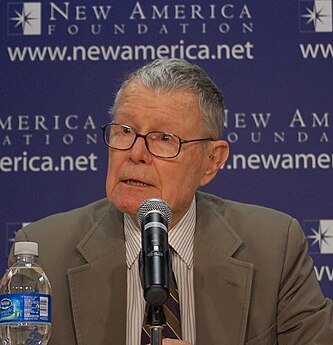
About Thomas Schelling
Thomas Crombie Schelling (born 14 April 1921 - 2016) was an American economist and professor of foreign policy, national security, nuclear strategy, and arms control at the School of Public Policy at University of Maryland, College Park. He is also co-faculty at the New England Complex Systems Institute. He was awarded the 2005 Nobel Memorial Prize in Economic Sciences (shared with Robert Aumann).
Best Thomas Schelling Quotes
Shortest
Earliest
Explore our curated collection of the most famous and impactful Thomas Schelling quotes.
“The most spectacular event of the past half century is one that did not occur. We have enjoyed sixty years without nuclear weapons exploded in anger.”
“By "market" is meant the entire complex of institutions within which people buy and sell and hire and are hired and borrow and lend and trade and contract and shop around to find bargains.”

“Arms control is so often identified with limitations on the possession or deployment of weapons that it is often overlooked that this reciprocated investment in non-nuclear capability was a remarkable instance of unacknowledged but reciprocated arms control.”

“The next possessors of nuclear weapons may be Iran, North Korea, or possibly some terrorist bodies. Is there any hope that they will have absorbed the nearly universal inhibition against the use of nuclear weapons, or will at least be inhibited by the recognition that the taboo enjoys widespread acclaim?”

“The essence of these tactics is some voluntary but irreversible sacrifice of freedom of choice. They rest on the paradox that the power to constrain an adversary may depend on the power to bind oneself; that, in bargaining, weakness is often strength, freedom may be freedom to capitulate, and to burn bridges behind one may suffice to undo an opponent.”

“There is a distinction between an individual life and a statistical life. Let a 6-year-old girl with brown hair need thousands of dollars for an operation that will prolong her life until Christmas, and the post office will be swamped with nickels and dimes to save her. But let it be reported that without a sales tax the hospital facilities of Massachusetts will deteriorate and cause a barely perceptible increase in preventable deaths—not many will drop a tear or reach for their checkbooks.”

“What this book is about is a kind of analysis that is characteristic of a large part of the social sciences, especially the more theoretical part. That kind of analysis explores the relation between the behavior of individuals who compromise some social aggregate, and the characteristics of the aggregate.
These situations, in which people's behavior or people's choices depend on the behavior or choices of other people, are the ones that usually don't permit any simple summation or extrapolation of the aggregates. To make that connection we usually have to look at the system of interaction between individuals and their environment, that is, between individuals and other individuals or between individuals and the collectivity.”
“That means that in the course of twenty years, Americans in the strategic nuclear business have gone from considering the no city strategy a preposterous one to one that is so obvious that it's taken for granted that the Soviets reciprocate the general idea. Whether this is based on any knowledge that the Soviets actually do, I don't know. My own feeling is that this is an idea that made much more sense to the Soviets than to the Americans. I think the Americans typically have rather formal, grand and honorable ideas about warfare and I think Soviet leaders are much more aware of the role of violence, brutality, ugly diplomacy, both in their internal politics and in dealing with other nations, and I don't think they have nearly as much traditional baggage about the way to use military force in war and I think if they saw that it suited their purpose to treat American cities as hostages in order to keep us from attacking their homeland populations, it might appeal to them much more quickly than it would appeal to a typical American.”
About Thomas Schelling
Thomas Crombie Schelling (born 14 April 1921 - 2016) was an American economist and professor of foreign policy, national security, nuclear strategy, and arms control at the School of Public Policy at University of Maryland, College Park. He is also co-faculty at the New England Complex Systems Institute. He was awarded the 2005 Nobel Memorial Prize in Economic Sciences (shared with Robert Aumann).