Link Copied!
Thomas Aquinas Quotes (1225-1274)
Philosopher, Theologian















-100px.png)






-100px.jpg)
About Thomas Aquinas
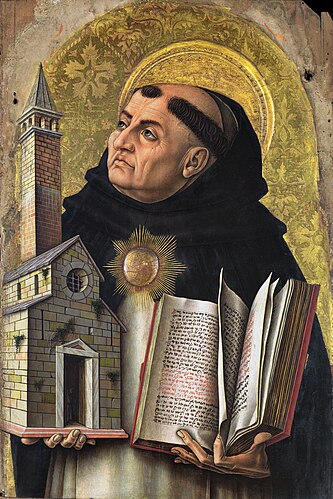
Saint Thomas Aquinas (c. 1225 – 7 March 1274) was an Italian Dominican friar, philosopher, Catholic priest, and Doctor of the Church. An immensely influential philosopher, theologian, and jurist in the tradition of scholasticism, he is also known within the latter as the Doctor Angelicus, the Doctor Communis, and the Doctor Universalis. The name Aquinas identifies his ancestral origins in the county of Aquino in present-day Lazio, Italy. Among other things, he was a prominent proponent of natural theology and the father of a school of thought (encompassing both theology and philosophy) known as Thomism. He argued that God is the source of both the light of natural reason and the light of faith. His influence on Western thought is considerable, and much of modern philosophy is derived from his ideas, particularly in the areas of ethics, natural law, metaphysics, and political theory.
Best Thomas Aquinas Quotes
Shortest
Earliest
Explore our curated collection of the most famous and impactful Thomas Aquinas quotes.
“Anything done against faith or conscience is sinful.”

“Charity, by which God and neighbor are loved, is the most perfect friendship.”

“The highest perfection of human life consists in the mind of man being detached from care, for the sake of God.”
- Thomas Aquinas, Summa contra Gentiles
“The reason, however, why the philosopher may be likened to the poet is this: both are concerned with the marvellous.”
“A hymn is the praise of God with song; a song is the exultation of the mind dwelling on eternal things, bursting forth in the voice.”

English Translation: "Jesus Christ: "You have written well of me, Thomas; what reward therefore will you receive?" Aquinas: "No other, Lord, than yourself.""
Original (Latin): "Jesus Christ: Bene scripsísti de me, Thoma; quam ergo mercédem accípies? Aquinas: Non áliam, Dómine, nisi teípsum."
“Jesus Christ: Bene scripsísti de me, Thoma; quam ergo mercédem accípies? Aquinas: Non áliam, Dómine, nisi teípsum.”
Original (Latin): "Jesus Christ: Bene scripsísti de me, Thoma; quam ergo mercédem accípies? Aquinas: Non áliam, Dómine, nisi teípsum."
English Translation: "An evil action cannot be justified by reference to a good intention."
Original (Latin): "Nullum malum bona intentione factum excusatur.
• Variant translation: An evil action cannot be justified by reference to a good intention."
“Nullum malum bona intentione factum excusatur.
Original (Latin): "Nullum malum bona intentione factum excusatur.
• Variant translation: An evil action cannot be justified by reference to a good intention."
• Variant translation: An evil action cannot be justified by reference to a good intention.”
- Thomas Aquinas, On the Ten Commandments

English Translation: "Sing, my tongue, the mystery of the glorious Body and precious Blood, which the King of the nations, fruit of a noble womb, poured forth as the price of the world."
Original (Latin): "Pange, lingua, gloriosi
Corporis mysterium
Sanguinisque pretiosi,
Quem in mundi pretium
Fructus ventris generosi
Rex effudit gentium."
“Pange, lingua, gloriosiOriginal (Latin): "Pange, lingua, gloriosi
Corporis mysterium
Sanguinisque pretiosi,
Quem in mundi pretium
Fructus ventris generosi
Rex effudit gentium."
Corporis mysterium
Sanguinisque pretiosi,
Quem in mundi pretium
Fructus ventris generosi
Rex effudit gentium.”
Haunted by a profound mystical revelation, Thomas Aquinas refused to resume his unfinished *Summa Theologiae*, dismissing his previous writings as insignificant compared to what he'd experienced.
English Translation: "Raynalde, I cannot, because everything that I have written seems to me chaff. Replying to Reginald of Piperno: They seem to me chaff in respect to those things which I have seen and which have been revealed to me."
Original (Latin): "Raynalde, non possum, quia omnia quae scripsi videntur mihi palae. Replying to Reginald of Piperno: Videntur mihi palae respectu eorum quae vidi et revelata sunt mihi."
“Raynalde, non possum, quia omnia quae scripsi videntur mihi palae. Replying to Reginald of Piperno: Videntur mihi palae respectu eorum quae vidi et revelata sunt mihi.”
Original (Latin): "Raynalde, non possum, quia omnia quae scripsi videntur mihi palae. Replying to Reginald of Piperno: Videntur mihi palae respectu eorum quae vidi et revelata sunt mihi."
Reflecting medieval natural law theory, this passage defines natural law as God-given reason that illuminates moral action, implanted in humanity at creation to guide behavior.
English Translation: "The law of nature [...] is nothing other than the light of understanding instilled in us by God, through which we know what to do and what to avoid. God gave this light and this law to man in creation."
Original (Latin): "Lex naturae […] nihil aliud est nisi lumen intellectis insitum nobis a Deo, per quod cognoscimus quid agendum et quid vitandum. Hoc lumen et hanc legem dedit Deus homini in creatione."
“Lex naturae […] nihil aliud est nisi lumen intellectis insitum nobis a Deo, per quod cognoscimus quid agendum et quid vitandum. Hoc lumen et hanc legem dedit Deus homini in creatione.”
Original (Latin): "Lex naturae […] nihil aliud est nisi lumen intellectis insitum nobis a Deo, per quod cognoscimus quid agendum et quid vitandum. Hoc lumen et hanc legem dedit Deus homini in creatione."
- Thomas Aquinas, On the Ten Commandments
“Down in adoration falling,
Lo! the sacred Host we hail;
Lo! o'er ancient forms departing,
Newer rites of grace prevail;
Faith for all defects supplying,
Where the feeble senses fail.”
Lo! the sacred Host we hail;
Lo! o'er ancient forms departing,
Newer rites of grace prevail;
Faith for all defects supplying,
Where the feeble senses fail.”
“Thus Angels' Bread is made
The Bread of man today:
The Living Bread from Heaven
With figures doth away:
O wondrous gift indeed!
The poor and lowly may
Upon their Lord and Master feed.”
The Bread of man today:
The Living Bread from Heaven
With figures doth away:
O wondrous gift indeed!
The poor and lowly may
Upon their Lord and Master feed.”
“If man of himself could in a perfect manner know all things visible and invisible, it would indeed be foolish to believe what he does not see. But our manner of knowing is so weak that no philosopher could perfectly investigate the nature of even one little fly.”
- Thomas Aquinas, On the Apostles' Creed
“Natural inclinations are present in things from God, who moves all things. So it is impossible for the natural inclinations of a species to be toward evil in itself. But there is in all perfect animals a natural inclination toward carnal union. Therefore it is impossible for carnal union to be evil in itself.”
- Thomas Aquinas, Summa contra Gentiles
Attributed to Thomas Aquinas, the quote emphasizes a tripartite understanding of salvation, requiring intellectual assent, emotional longing, and moral action.
English Translation: "Three things are necessary for the salvation of man: to know what he ought to believe; to know what he ought to desire; and to know what he ought to do."
Original (Latin): "Tria sunt homini necessaria ad salutem: scilicit scientia credendorum, scientia desiderandorum, et scientia operandorum.
• Variant translation: Three things are necessary for the salvation of man: to know what he ought to believe; to know what he ought to desire; and to know what he ought to do."
“Tria sunt homini necessaria ad salutem: scilicit scientia credendorum, scientia desiderandorum, et scientia operandorum.
Original (Latin): "Tria sunt homini necessaria ad salutem: scilicit scientia credendorum, scientia desiderandorum, et scientia operandorum.
• Variant translation: Three things are necessary for the salvation of man: to know what he ought to believe; to know what he ought to desire; and to know what he ought to do."
• Variant translation: Three things are necessary for the salvation of man: to know what he ought to believe; to know what he ought to desire; and to know what he ought to do.”
- Thomas Aquinas, On the Ten Commandments
“The perfection of the effect demonstrates the perfection of the cause, for a greater power brings about a more perfect effect. But God is the most perfect agent. Therefore, things created by Him obtain perfection from Him. So, to detract from the perfection of creatures is to detract from the perfection of divine power.”
- Thomas Aquinas, Summa contra Gentiles
“For creation is not a change, but that dependence of the created existence on the principle from which it is instituted, and thus is of the genus of relation; whence nothing prohibits it being in the created as in the subject. Creation is thus said to be a kind of change, according to the way of understanding, insofar as our intellect accepts one and the same thing as not existing before and afterwards existing.”
- Thomas Aquinas, Summa contra Gentiles

Attributed to Thomas Aquinas, this passage explores the inherent value of self-governance, contrasting the vitality of independent action with the perceived lifelessness of absolute subjugation.
English Translation: "For life is most evident in a thing's moving itself, while what can only be moved by another, seems to be as if dead."
Original (Latin): "Vita enim in hoc maxime manifestatur quod aliquid movet se ipsum; quod autem non potest moveri nisi ab alio, quasi mortuum esse videtur.
• Variant translation: Now slavery has a certain likeness to death, hence it is also called civil death. For life is most evident in a thing's moving itself, while what can only be moved by another, seems to be as if dead. But it is manifest that a slave is not moved by himself, but only at his master's command."
“Vita enim in hoc maxime manifestatur quod aliquid movet se ipsum; quod autem non potest moveri nisi ab alio, quasi mortuum esse videtur.
Original (Latin): "Vita enim in hoc maxime manifestatur quod aliquid movet se ipsum; quod autem non potest moveri nisi ab alio, quasi mortuum esse videtur.
• Variant translation: Now slavery has a certain likeness to death, hence it is also called civil death. For life is most evident in a thing's moving itself, while what can only be moved by another, seems to be as if dead. But it is manifest that a slave is not moved by himself, but only at his master's command."
• Variant translation: Now slavery has a certain likeness to death, hence it is also called civil death. For life is most evident in a thing's moving itself, while what can only be moved by another, seems to be as if dead. But it is manifest that a slave is not moved by himself, but only at his master's command.”
- Thomas Aquinas, On The Perfection of the Spiritual Life

“Suppose a person entering a house were to feel heat on the porch, and going further, were to feel the heat increasing, the more they penetrated within. Doubtless, such a person would believe there was a fire in the house, even though they did not see the fire that must be causing all this heat. A similar thing will happen to anyone who considers this world in detail: one will observe that all things are arranged according to their degrees of beauty and excellence, and that the nearer they are to God, the more beautiful and better they are.”
- Thomas Aquinas, On the Apostles' Creed
“The order of authority derives from God, as the Apostle says [in Romans 13:1-7]. For this reason, the duty of obedience is, for the Christian, a consequence of this derivation of authority from God, and ceases when that ceases. But, as we have already said, authority may fail to derive from God for two reasons: either because of the way in which authority has been obtained, or in consequence of the use which is made of it. There are two ways in which the first may occur. Either because of a defect in the person, if he is unworthy; or because of some defect in the way itself by which power was acquired, if, for example, through violence, or simony or some other illegal method.”
- Thomas Aquinas, Commentary on the Sentences of Peter Lombard

“With regard to the abuse of authority, this also may come about in two ways. First, when what is ordered by an authority is opposed to the object for which that authority was constituted (if, for example, some sinful action is commanded or one which is contrary to virtue, when it is precisely for the protection and fostering of virtue that authority is instituted). In such a case, not only is there no obligation to obey the authority, but one is obliged to disobey it, as did the holy martyrs who suffered death rather than obey the impious commands of tyrants. Secondly, when those who bear such authority command things which exceed the competence of such authority; as, for example, when a master demands payment from a servant which the latter is not bound to make, and other similar cases. In this instance the subject is free to obey or disobey.”
- Thomas Aquinas, Commentary on the Sentences of Peter Lombard
“Muhammad seduced the people by promises of carnal pleasure to which the concupiscence of the flesh goads us. His teaching also contained precepts that were in conformity with his promises, and he gave free rein to carnal pleasure. In all this, as is not unexpected, he was obeyed by carnal men. As for proofs of the truth of his doctrine, he brought forward only such as could be grasped by the natural ability of anyone with a very modest wisdom. Indeed, the truths that he taught he mingled with many fables and with doctrines of the greatest falsity. He did not bring forth any signs produced in a supernatural way, which alone fittingly gives witness to divine inspiration; for a visible action that can be only divine reveals an invisibly inspired teacher of truth. On the contrary, Muhammad said that he was sent in the power of his arms—which are signs not lacking even to robbers and tyrants. What is more, no wise men, men trained in things divine and human, believed in him from the beginning, Those who believed in him were brutal men and desert wanderers, utterly ignorant of all divine teaching, through whose numbers Muhammad forced others to become his followers by the violence of his arms. Nor do divine pronouncements on the part of preceding prophets offer him any witness. On the contrary, he perverts almost all the testimonies of the Old and New Testaments by making them into fabrications of his own, as can be seen by anyone who examines his law. It was, therefore, a shrewd decision on his part to forbid his followers to read the Old and New Testaments, lest these books convict him of falsity. It is thus clear that those who place any faith in his words believe foolishly.”
- Thomas Aquinas, Summa contra Gentiles
Thomas Aquinas Quotes by Topic
Find exactly what you are looking for by browsing this categorized list of Thomas Aquinas quotes by topic.
Thomas Aquinas on Tyranny 3 quotes
“One who liberates his country by killing a tyrant is to be praised and rewarded.”
Thomas Aquinas on Usury 3 quotes
“Now what has been said about the Jews is also to be understood about Cahorsins, and anyone else depending upon the depravity of usury.”
Thomas Aquinas on Love 2 quotes
View all 2 quotes on Love →Thomas Aquinas on Reason 2 quotes
View all 2 quotes on Reason →Thomas Aquinas on Charity 2 quotes
“It must be said that charity can, in no way, exist along with mortal sin.”
Quotes About Thomas Aquinas
Gain deeper perspective through quotes about Thomas Aquinas from others.
Albertus Magnus on Thomas Aquinas
Quote articula on Thomas Aquinas
“Pope John XXII about the Summa Theologiae: As many articles as miracles.”
Gennadios Scholarius on Thomas Aquinas
Gennadios Scholarius, a 15th-century Byzantine scholar, laments that Western influence marred even the brilliant Thomas Aquinas's theology, particularly regarding the Holy Spirit and divine essence.
“O excellent Thomas would that you had not been born in the West such that you would have need to advocate the differences of that [Roman] Church! You were influenced by it with regard to both the procession of the Holy Spirit as well as by the difference with respect to the divine essence and energy. For surely, then, you would have been infallible in your theological doctrines, just as you are so too inerrant in these matters of ethics!”
Carl L. Becker on Thomas Aquinas
“We have, among innumerable other works, the Summa theologica, surely one of the most amazing and stupendous products of the human mind. ...never before or since has the wide world been so neatly boxed and compassed, so completely and confidently understood, every detail of it fitted, with such subtle and loving precision, into a consistent and convincing whole.”

G. K. Chesterton on Thomas Aquinas 3 quotes
“The difficulty of dealing with St. Thomas Aquinas in this brief article is the difficulty of selecting that aspect of a many-sided mind which will best suggest its size or scale. Because of the massive body which carried his massive brain, he was called "The Ox"; but any attempt to boil down such a brain into tabloid literature passes all possible jokes about an ox in a teacup. He was one of the two or three giants; one of the two or three greatest men who ever lived; and I should never be surprised if he turned out, quite apart from sanctity, to be the greatest of all. Another way of putting the problem is to say that proportion alters according to what other men we are at the moment classing him with or pitting him against. We do not get the scale until we come to the few men in history who can be his rivals.”



Disputed Quotes
Quotes attributed to Thomas Aquinas that are questionable.
“It is on account neither of God's weakness nor ignorance that evil comes into the world, but rather it is due to the order of his wisdom and the greatness of his goodness that diverse grades of goodness occur in things, many of which would be lacking if no evil were permitted. Indeed, the good of patience would not exist without the evil of persecution; nor the good of preservation of life in a lion if not for the evil of the destruction of the animals on which it lives.”
“Man reaches the highest point of his knowledge about God when he knows that he knows him not, inasmuch as he knows that that which is God transcends whatsoever he conceives of him.”
“Hominem unius libri timeo
• Variant: "Beware the man of one book."”
• Variant: "Beware the man of one book."”
Misattributed Quotes
Quotes mistakenly credited to Thomas Aquinas
“Prostitution in towns is like the sewer in a palace; take away the sewers and the palace becomes an impure and stinking place.”
About Thomas Aquinas
Saint Thomas Aquinas (c. 1225 – 7 March 1274) was an Italian Dominican friar, philosopher, Catholic priest, and Doctor of the Church. An immensely influential philosopher, theologian, and jurist in the tradition of scholasticism, he is also known within the latter as the Doctor Angelicus, the Doctor Communis, and the Doctor Universalis. The name Aquinas identifies his ancestral origins in the county of Aquino in present-day Lazio, Italy. Among other things, he was a prominent proponent of natural theology and the father of a school of thought (encompassing both theology and philosophy) known as Thomism. He argued that God is the source of both the light of natural reason and the light of faith. His influence on Western thought is considerable, and much of modern philosophy is derived from his ideas, particularly in the areas of ethics, natural law, metaphysics, and political theory.