Link Copied!
Ted Bundy Quotes (1946-1989)
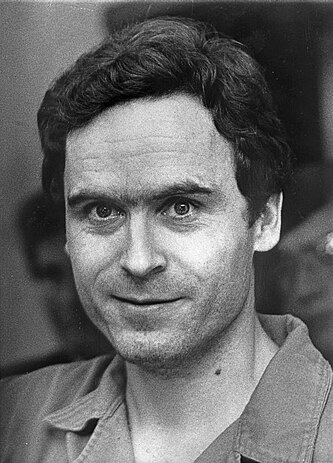


About Ted Bundy
Theodore Robert "Ted" Bundy (born Theodore Robert Cowell; November 24, 1946 – January 24, 1989) was an American serial killer, rapist, kidnapper and necrophile who assaulted and killed numerous young women and girls (from ages 12 - 25) during the 1970s and possibly earlier. He was sentenced to death and was executed by the electric chair in 1989.
Best Ted Bundy Quotes
Shortest
Earliest
Explore our curated collection of the most famous and impactful Ted Bundy quotes.

Facing interrogation after his 1978 arrest, the speaker chillingly proclaimed himself "the most cold-hearted son of a bitch you'll ever meet," hinting at his psychopathic nature.
“I'm the most cold-hearted son of a bitch you'll ever meet.”
“Okay, you've got the indictment, that's all you're gonna get... I'll plead not guilty right now.”
“The ultimate possession was, in fact, the taking of the life. And then … the physical possession of the remains.”
Facing imminent execution for his horrific crimes, Ted Bundy offered a final, seemingly heartfelt message to his loved ones through his attorney and minister.
“Jim [Coleman, his defense attorney] and Fred [Lawrence, his minister], I'd like you to give my love to my family and friends.”

“I don't think anybody doubts whether I've done some bad things. The question is: what, of course, and how and, maybe even most importantly, why?”

“I wanted to become a part of my defense because I am such a part of it. Obviously I'm going to bear the consequences, so why not bear the responsibilities?”
- Ted Bundy, 1977 interview in Pitkin County Prison, Colorado)


In a chilling glimpse into his mindset, Ted Bundy, writing from prison in 1977, rationalized victim selection by claiming some people "invite abuse" through perceived vulnerability.
“I have known people who ... radiate vulnerability .... Their facial expressions say 'I am afraid of you.' These people invite abuse ... By expecting to be hurt, do they subtly encourage it?”

Reflecting on his isolated adolescence, Ted Bundy reveals a profound lack of understanding regarding the fundamental aspects of human connection and social dynamics.
“I didn't know what made things tick. I didn't know what made people want to be friends. I didn't know what made people attractive to one another. I didn't know what underlay social interactions.”
“I don't want to die. I'm not going to kid you. I'll kid you not. I deserve certainly the most extreme punishment society has...I think society deserves to be protected from me and others like me.”
- Ted Bundy, 1989 interview with James Dobson)

Facing execution, Ted Bundy chillingly toys with Detective Keppel, offering a deliberately vague and unsettling clue to the location of Georgann Hawkins' severed head.
“I just said that the Hawkins girl's head was severed and taken up the road about twenty-five to fifty yards and buried in a location about ten yards west of the road, on a rocky hillside. Did you hear that?”
“I'm not looking for anything. I understand now a lot of stuff about myself that I didn't understand then. It makes me realize what was going on. The senselessness of it appalls me although I'm sure not so much as those who were so close to it.”

“Which one do they pick? Do they pick the law student with no criminal background, who was probably even known by some of the prosecutors working the case? Or are they going to go after the types, you know, the guys in the files... the real weirdos?”
“This guy doesn't want to be caught. He doesn't want to play around. He's not Son of Sam and he's not even the LA Hillside Strangler. He doesn't want notoriety. That's why he's going to all these length to dispose of these people in the way that he has.
Ibid pp. 224”
- Ted Bundy, 1984 interview with Detective Robert Keppel
“.....murder is not just a crime of lust or violence. It becomes possession. They are part of you … [the victim] becomes a part of you, and you [two] are forever one … and the grounds where you kill them or leave them become sacred to you, and you will always be drawn back to them.”
“Sure, I get angry. I get very, very angry and indignant. I don't like being locked up for something I didn't do, and I don't like my liberty taken away, and I don't like being treated like an animal, and I don't like people walking around and ogling me like I'm some sort of weirdo, because I'm not.”
- Ted Bundy, 1977 interview in Pitkin County Prison, Colorado)

“...just like anybody else with an obsession, whether it be fishing, bowling or skiing, he has ways he can vicariously satisfy it. Maybe he is going to peep shows and reading detective magazines. I think there's an excellent chance that one way he gets off is by going to look at what they call the slasher films.
Ibid pp. 228”
- Ted Bundy, 1984 interview with Detective Robert Keppel
“I'm not gonna be in this room when that jury walks in. I'm not going through this and you knew that, your honor. You know how far you can push me..... You wanna make a circus? You got a circus. [points to prosecutor] I'll rain on your parade Jack. You'll see a thunderstorm. This will not be the pat little drama you've arranged.”

“It was like coming out of some kind of a horrible trance or dream, I can only liken it to, after, I don't want to dramatize it, but to have been possessed by something so awful and alien, and then to next day wake up from it and remember what happened and realize, basically, in the eyes of the law and certainly the eyes of God that you're responsible.”
- Ted Bundy, 1989 interview with James Dobson)

“Those of use who are, who have been so much influenced by violence in the media, in particular pornographic violence, are not some kinds of inherent monsters. We are your sons and we are your husbands. And we grew up in regular families. And pornography can reach out and snatch a kid out of any house today. It snatched me out of my home twenty, thirty years ago.”
- Ted Bundy, 1989 interview with James Dobson)

“One of the things that makes it a little bit difficult is that at this point she was quite lucid, talking about things. It’s not funny, but it’s odd the kinds of things people will say under those circumstances. And she said that she had a Spanish test the next day, and she thought that I had taken her to help tutor her for her Spanish test. It’s kind of an odd thing to say. Anyway.”
“I don't know all of what you're speaking about Lucky [Severson, reporter interviewing him] it's too broad and I can't get into it in any detail. But I'm satisfied with my blanket statement that I'm innocent. No man is truly innocent. I mean we all have transgressed some way in our lives and as I say, I've been impolite and there are things I regret having done in my life but nothing like the things, I think, that you're referring to.”
- Ted Bundy, 1977 interview in Pitkin County Prison, Colorado)
“Listen, I'm no social scientist and haven't done a survey. I don't pretend to know what John Q citizen thinks about this. But I've lived in prison for a long time now and I've met a lot of men who were motivated to commit violence just like me. And without exception, every one of them was deeply involved in pornography. Without question, without exception. Deeply influenced and consumed by an addiction to pornography.”
- Ted Bundy, 1989 interview with James Dobson)

Ted Bundy, speaking to an FBI agent, ominously compares the pursuit of serial killers to deep-sea fishing, hinting at his unique and dangerous insight into the criminal mind.
“You're like a fisherman who fishes for years and catches a small fish. Sometimes a medium fish. [You] get lucky and get a big fish. But you know that there's a real big fish under there that always gets away. You and your group are going to get a lot of serial killers and they're going to help you. But with the real good ones, the only way you're going to know what goes on under the water is to go under the water. The fisherman drowns going underwater. But I can take you there without drowning. If I trust you. And if I decide.”

“...this guy is responsible for twenty or thirty more deaths at least, and there's a certain aspect of possessiveness in that. I think that's one way of describing it in rather bland terms, a possessiveness where the corpse could easily be as important as the live victim, in some respects. I mean, it's that physical possession and ownership, a taking, if you will, that is just part of the syndrome. I think that sense of power and ownership is one of the reasons why I think in some cases—not all, certainly—is why I think he might be individually intending to return to the scene to either view his victim, or in fact, interact with the body in some way.
Quoted in Keppel, Robert (2005) The Riverman, Ted Bundy and I Hunt for the Green River Killer. Simon and Schuster, pp. 254”
- Ted Bundy, 1984 interview with Detective Robert Keppel

“A factor that is almost indispensable to this kind of behavior [serial killing] is the mobility of contemporary American life. Living in large centers of population, and living with lots of people, you can get used to dealing with strangers. It's the anonymity factor, and it has a twofold effect. First of all if you're among strangers you're less likely to remember them, or care what they're doing or what they should, or should not, be doing. If they should or shouldn't be there. Secondly, you're conditioned almost not to be afraid of strangers. Mobility is very important here. As we've seen...the individual's [himself in third person] modus operandi was moving large distances in an attempt to camouflage what he was doing. Moving these distances, he was able to take advantage of the anonymity factor.”

“But he found himself with this girl who was struggling and screaming. Uh, not screaming, but let’s say just basically arguing with him. There were houses in the vicinity and he was concerned that somebody might hear. And so, in an attempt to stop her from talking or arguing, he placed his hand over her mouth. She stopped and he attempted to remove her clothes and she began to object again. At this point, he was in a state of not just agitation, but something on the order of panic. He was fearing that she would arouse somebody in the vicinity. So, not thinking clearly but still intending not to harm her, let’s say, he placed his hands around her throat… Just to throttle her into unconsciousness so that she wouldn’t scream anymore. She stopped struggling, and it appeared that she was unconscious. But not, in his opinion, to a point where he had killed her... Then let’s say he removed her clothes and raped her and put his own clothes back on. At about that point, he began to notice that the girl wasn’t moving. It appeared, although he wasn’t certain, that he’d done what he had promised himself he wouldn’t do. And he had done it, really, almost inadvertently. Uh, so he took the girl by one of her arms and pulled her to a darkened corner of this little orchard and then, in a fit of panic, fled the scene. He got back in his car and drove back to his house, still not knowing if the girl was alive or dead. But once he returned to the house, upon reflection he began to wonder. He didn’t know if he’d left anything at the crime scene. He hadn’t thought about publicity and physical evidence. So he decided to return to the scene and if the body was there to recover it and take it somewhere else where it wouldn’t be found.”
Ted Bundy Quotes by Topic
Find exactly what you are looking for by browsing this categorized list of Ted Bundy quotes by topic.
Ted Bundy on Pornography 3 quotes
“...well meaning decent people will condemn [the] behavior of a Ted Bundy while they're walking past a magazine rack full of the very kinds of things that send young kids down the road to be Ted Bundys.”
Ted Bundy on Guilt
Ted Bundy on Homicide
“.....murder is not just a crime of lust or violence. It becomes possession. They are part of you … [the victim] becomes a part of you, and you [two] are forever one … and the grounds where you kill them or leave them become sacred to you, and you will always be drawn back to them.”
- Ted Bundy, B)
Ted Bundy on Anonymity
In *The Only Living Witness*, Ted Bundy analyzes the anonymity and mobility of modern American society as key enabling factors in his ability to commit serial murders.
“A factor that is almost indispensable to this kind of behavior [serial killing] is the mobility of contemporary American life. Living in large centers of population, and living with lots of people, you can get used to dealing with strangers. It's the anonymity factor, and it has a twofold effect. First of all if you're among strangers you're less likely to remember them, or care what they're doing or what they should, or should not, be doing. If they should or shouldn't be there. Secondly, you're conditioned almost not to be afraid of strangers. Mobility is very important here. As we've seen...the individual's [himself in third person] modus operandi was moving large distances in an attempt to camouflage what he was doing. Moving these distances, he was able to take advantage of the anonymity factor.”

Quotes About Ted Bundy
Gain deeper perspective through quotes about Ted Bundy from others.
Detective Robert Keppel clip on Ted Bundy
“He's definitely a premier serial killer. He is probably the model. But I don't think there's many of them like him, fortunately.”
Stephen Michaud on Ted Bundy 2 quotes
“Ted did not have any guilt. He did not have any remorse. He did not have a conscience. And so when he talks about being 99% normal and 1% abnormal, its an ugly joke. He was 100% abnormal.”
Ann Rule on Ted Bundy 2 quotes
“Ted was never as handsome, brilliant or charismatic as crime folklore deemed him. But as I said before, infamy became him.”
Joseph Aloi on Ted Bundy
Polly Nelson. on Ted Bundy
“Ted was the very definition of heartless evil.”

About Ted Bundy
Theodore Robert "Ted" Bundy (born Theodore Robert Cowell; November 24, 1946 – January 24, 1989) was an American serial killer, rapist, kidnapper and necrophile who assaulted and killed numerous young women and girls (from ages 12 - 25) during the 1970s and possibly earlier. He was sentenced to death and was executed by the electric chair in 1989.