Link Copied!
Sappho Quotes (-570--581)
Author, Writer, Poet






About Sappho
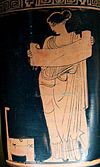
Sappho (Attic Greek: Σαπφώ; Aeolic Greek: Ψάπφα, Ψάπφω) (born c. 630/612 BC; died c. 570 BC - 581 BC) Greek poet; A prolific and much acclaimed writer, she is credited with either eight or nine long books of poetry. Her extant works are preserved in fragments, in citations in the works of classical authors, and on strips of papyrus found in Egypt. Many translators have attempted to fill in the gaps with their own interpretation of Sappho's style, thus a definitive collection is not possible.
Best Sappho Quotes
Shortest
Earliest
Explore our curated collection of the most famous and impactful Sappho quotes.

“The moon has set,
And the Pleiades.
Midnight.
The hour has gone by.
I sleep alone. Fr.168B Voigt”
And the Pleiades.
Midnight.
The hour has gone by.
I sleep alone. Fr.168B Voigt”
“Shimmering,
iridescent,
deathless Aphrodite,
child of Zeus, weaver of wiles,
I beg you,
do not crush my spirit with anguish, Lady,
but come to me now... Fr.1 Voigt”
iridescent,
deathless Aphrodite,
child of Zeus, weaver of wiles,
I beg you,
do not crush my spirit with anguish, Lady,
but come to me now... Fr.1 Voigt”
“Truly, I wish I were dead.
She was weeping when she left me,
and said many things to me, and said this:
"How much we have suffered, Sappho.
Truly, I don't want to leave you." Fr.94 Voigt”
She was weeping when she left me,
and said many things to me, and said this:
"How much we have suffered, Sappho.
Truly, I don't want to leave you." Fr.94 Voigt”

“Of course I am downcast and tremble
with pity for my state
when old age and wrinkles cover me,
when Eros flies about
and I pursue the glorious young.
Pick up your lyre
and sing to us of her who wears
violets on her breasts. Sing especially
of her who is wandering.”
with pity for my state
when old age and wrinkles cover me,
when Eros flies about
and I pursue the glorious young.
Pick up your lyre
and sing to us of her who wears
violets on her breasts. Sing especially
of her who is wandering.”
“O dream on your black wings
you come when I am sleeping.
Sweet is the god but still I am
in agony and far from my strength.
for I had hope (none now) to share
something of the blessed gods,
nor was I so foolish
as to scorn pleasant toys.
Now may I have
all these things.”
you come when I am sleeping.
Sweet is the god but still I am
in agony and far from my strength.
for I had hope (none now) to share
something of the blessed gods,
nor was I so foolish
as to scorn pleasant toys.
Now may I have
all these things.”
“To have beauty is to have only that,
but to have goodness
is to be beautiful
too.http://books.google.com/books?id=btVfAAAAMAAJ&q=%22To+have+beauty+is+to+have+only+that+but+to+have+goodness+is+to+be+beautiful+too%22&pg=PA29#v=onepage”
but to have goodness
is to be beautiful
too.http://books.google.com/books?id=btVfAAAAMAAJ&q=%22To+have+beauty+is+to+have+only+that+but+to+have+goodness+is+to+be+beautiful+too%22&pg=PA29#v=onepage”
“When wrath runs rampage
in your heart
you must hold still
that rambunctious tongue!http://books.google.com/books?id=btVfAAAAMAAJ&q=%22When+wrath+runs+rampage+in+your+heart+you+must+hold+still+that+rambunctious+tongue%22&pg=PA105#v=onepage”
in your heart
you must hold still
that rambunctious tongue!http://books.google.com/books?id=btVfAAAAMAAJ&q=%22When+wrath+runs+rampage+in+your+heart+you+must+hold+still+that+rambunctious+tongue%22&pg=PA105#v=onepage”
“Look at him, just like a god,
that man sitting across from you,
whoever he is,
listening to your
close, sweet voice,
your irresistible laughter
And O yes,
it sets my heart racing—
one glance at you
and I can't get any words out,
my voice cracks,
a thin flame runs under my skin,
my eyes go blind,
my ears ring,
a cold sweat pours down my body,
I tremble all over,
turn paler than grass. Fr.31 Voigt”
“Virginity, virginity, when you leave me, where do you go?
I am gone and never come back to you.
I never return.http://books.google.com/books?id=fwxgAAAAMAAJ&q=%22Virginity+virginity+when+you+leave+me+where+do+you+go+I+am+gone+and+never+come+back+to+you+I+never+return%22&pg=PA57#v=onepage”
I am gone and never come back to you.
I never return.http://books.google.com/books?id=fwxgAAAAMAAJ&q=%22Virginity+virginity+when+you+leave+me+where+do+you+go+I+am+gone+and+never+come+back+to+you+I+never+return%22&pg=PA57#v=onepage”
“Some say cavalry and others claim
infantry or a fleet of long oars
is the supreme sight on the black earth.
I say it is
the one you love. And easily proved.
Didn't Helen, who far surpassed all
mortals in beauty, desert the best
of men, her king,
and sail off to Troy and forget
her daughter and her dear parents? Merely
Aphrodite's gaze made her readily bend
and led her far
from her path. These tales remind me now
of Anaktoria who isn't here,
yet I
for one
would rather see her warm supple step
and the sparkle in her face than watch all
the chariots in Lydia and foot soldiers armored
in glittering bronze.”
Sappho Quotes by Topic
Find exactly what you are looking for by browsing this categorized list of Sappho quotes by topic.
Sappho on Beauty 2 quotes
“Beauty endures only for as long as it can be seen; Goodness, beautiful today, will remain so tomorrow.”
Sappho on Nightingales
“The angel of spring, the mellow-throated nightingale.”

Sappho on Incense
“There were myrrh and cassia with frankincense smoking;”

Sappho on Muses
Sappho on Stars
Sappho on Goodness
Sappho on Immortality
Sappho on Death
Sappho on Thought
Sappho on Song
Sappho on Venus
Sappho on Sky
Sappho on Wreaths
“Weave garlands, maiden, from the strands Of dill, and with soft gentle hands Set the delicious leafage round your head. The Goddess and the happy Graces Love to look on flower-crown’d faces, But turn aside from the ungarlanded.”

What Sappho Said About Others
Discover personal opinions Sappho shared regarding contemporaries.
Sappho on Women
“Like the sweet apple which reddens upon the topmost bough, A-top on the topmost twig,—which the pluckers forgot, somehow,— Forgot it not, nay, but got it not, for none could get it till now. * * * Like the wild hyacinth flower, which on the hills is found, Which the passing feet of the shepherds for ever tear and wound, Until the purple blossom is trodden into the ground.”

Quotes About Sappho
Gain deeper perspective through quotes about Sappho from others.
Joseph Addison on Sappho
“Among the mutilated poets of antiquity, there is none whose fragments are so beautiful as those of Sappho. They give us a taste of her way of writing, which is perfectly conformable with that extraordinary character we find of her in the remarks of those great critics who were conversant with her works when they were entire. One may see, by what is left of them, that she followed nature in all her thoughts, without descending to those little points, conceits, and turns of wit, with which many of our modem lyrics are so miserably infected. Her soul seems to have been made up of love and poetry: she felt the passion in all its warmth, and described it in all its symptoms. She is called by ancient authors the tenth muse; and by Plutarch is compared to Cacus, the son of Vulcan, who breathed out nothing but flame. I do not know, by the character that is given of her works, whether it is not for the benefit of mankind that they are lost. They were filled with such bewitching tenderness and rapture, that it might have been dangerous to have given them a reading.”

Antipater of Sidon on Sappho
“Sappho thou coverest, Æolian land! The Muse who died, Who with the deathless Muses, hand in hand, Sang, side by side! Sappho, at once of Cypris and of Love The child and care; Sappho, that those immortal garlands wove For the Muses’ hair! Sappho, the joy of Hellas, and thy crown,— Ye Sisters dread, Who spin for mortals from the distaff down The threefold thread, Why span ye not for her unending days, Unsetting sun, For her who wrought the imperishable lays Of Helicon?”
Gloria E. Anzaldúa interview on Sappho
“When everybody says "lesbian," a word connected with Sappho and the island of Lesbos, that automatically means that your forefathers and foremothers are European, that George Washington is the father of our country and Columbus discovered America-all false assumptions.”
Bettina Aptheker on Sappho
“When Judy Grahn wrote of the Greek poet Sappho she suggested that she was not the first woman poet in Western civilization, not a solitary female voice rising out of an otherwise barren plain. On the contrary, Grahn said, hers was the surviving voice, the last voice in a long line of women poets and artists-Sappho's works so badly fragmented because they were systematically destroyed. Grahn wrote: “And what was the nature of Sappho's wealth? She praised it often enough: love, beauty, grace, flowers, appropriate behavior to the gods, lovely clothing, intelligence, tenderness. Her poems are filled with the color purple, the color gold, the sun, flowers, especially the violet and the rose, and altars, deer, groves of trees, and the stories of the gods. Love, she said, is a tale-weaver. Wealthy? We own no kind of money that would buy us Sappho's wealth. In her world, women were central to themselves; they had to have been to write as she did. She lived on an island of women, in a company of women, from which she addressed all creation. And oh, how they listened.””

Louise Erdrich on Sappho

Judy Grahn on Sappho
Meleager on Sappho 2 quotes
View all 2 quotes on Meleager →Camille Paglia on Sappho
“Sappho is a great poet because she is a lesbian, which gives her erotic access to the Muse. Sappho and the homosexual-tending Emily Dickinson stand alone above women poets, because poetry's mystical energies are ruled by a hierach requiring the sexual subordination of her petitioners. Women have achieved more as novelists than as poets because the social novel operates outside the ancient marriage of myth and eroticism.”

Marge Piercy "Why Speculate on the Future?" on Sappho
“Poetry changes with every generation, but it does not improve or progress. It just changes its styles, trappings and some of its obsessions, but we can still enjoy Sappho and Homer; they are today's news as much as when they were written or recited.”
Plutarch on Sappho
“Sappho speaks words mingled truly with fire; through her song she communicates the heat of her heart.”

Mary Ritter Beard on Sappho
“One of the earliest- and perhaps the first-rivals of the hymnology of war, hatred, and revenge made immortal by Homer was the poetry of an Aeolian woman called Sappha by her people but uniformly known to later times as Sappho...Much of Sappho's poetry was of a plaintive tenderness but she had a fervid feeling for love as a saving grace. Several of her feminine disciples also sang of the beauty and healing force of love. Solon the law-giver and Plato the philosopher were deeply affected by her hymns to the great idea of a social power unrecognized by "the Bible of the Greeks": Homer. Though Attic poets and playwrights tried to destroy her by attacking her as a courtesan or "Lesbian" pervert, the German classical scholar, Welcker, in his Kleine Schriften, declares that such attacks were sheer calumny. Nor did they succeed in their aim. More than twenty centuries have honored the "sweet singer" of Aeolia.”

About Sappho
Sappho (Attic Greek: Σαπφώ; Aeolic Greek: Ψάπφα, Ψάπφω) (born c. 630/612 BC; died c. 570 BC - 581 BC) Greek poet; A prolific and much acclaimed writer, she is credited with either eight or nine long books of poetry. Her extant works are preserved in fragments, in citations in the works of classical authors, and on strips of papyrus found in Egypt. Many translators have attempted to fill in the gaps with their own interpretation of Sappho's style, thus a definitive collection is not possible.