Robert Service on Herbert Marcuse
← Back to Robert Service Profile
“Marcuse, Sartre, Colletti and Althusser were style-maestros of turgidity and never tried to rise to the flights of Marx and Engels in their inspired moments. Not one of them would choose a monosyllable if a longer word could be discovered or devised. Their Marxism, if not exactly pessimistic, was cramped and cautious. What is more, they were philosophers writing mainly for other philosophers. Only Marcuse became a genuine favourite of the thousands of students who rebelled in 1968 against ‘bourgeois society’ and university discipline, as well as the American war in Vietnam. He and his ideas were accorded a profile in Playboy magazine. (It is hard to imagine another Marxist theorist, except perhaps Marx himself, tolerating this without complaint.) Marcuse had grown popular because of the significance he attached to the students; it also did him no harm that he was willing to discuss the erotic as well as the socio-political.”
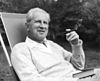
“Another veteran communist calling for the revision of conventional contemporary Marxism was Herbert Marcuse. After emigrating from Nazi Germany in 1933, he took American citizenship and wrote prolifically about the need to graft several intellectual trends of the twentieth century – especially Freudianism and German sociology – on to the tree of the Marxist tradition. Marcuse rejected Stalin’s version of communism as dogmatic, narrow and plain wrong in its interpretation of Marx. He was a freer spirit than Lukács and refused to recognise Lenin as an absolute authority. He insisted that sexual drives as well as economic imperatives help to explain the mechanisms of politics and society. He scorned the Communist Party of the USA and refused to align himself with any organisation. His experiences as a young militant in Europe had eroded his faith in the revolutionary potential of the working class. Marcuse saw well-paid industrial workers as constituting one of the obstacles to humanity’s liberation from oppression. Based on the San Diego campus of the University of California, he counted instead upon the unemployed, the vagabond poor and the Hispanic immigrants; he also had a soft spot for college students. He regarded these groups as living in detachment from ‘bourgeois’ society and ready to overcome the ‘one-dimensional’ aspects of contemporary capitalist existence. Marcuse’s forte was as a philosopher. His preoccupation with epistemology and dialectics was typical of a growing trend among Marxist writers seeking to challenge the Marxism that had been customary since 1917.”