Link Copied!
Richard F. Ericson Quotes (1919-1993)
About Richard F. Ericson
Richard Ferdinand Ericson (1919–1993) was an American organizational theorist, and Professor of Management at the George Washington University in Washington, D.C.
Best Richard F. Ericson Quotes
Shortest
Earliest
Explore our curated collection of the most famous and impactful Richard F. Ericson quotes.
“I deeply believe that this society has now thrust upon it a kind of moral imperative to focus efforts on the utilization of general systems concepts and conceptualizations by policy-forming executives, administrators, and managers in all kinds of large-scale organizations.”
“From society's standpoint, modern science and technology appears Janus-faced : It has given us wealth in one sense, and poverty in another; it has harnessed nature to man's basic needs in ways and to extents undreamed - of only a few decades ago, but it has fostered a continuingly lowered "quality of life".”

“Systems analysis, conceived in a policy sciences framework, is the macro instrument of the systems manager for understanding, evaluating and improving human systems — which are defined as goal oriented interdependent units incorporating people, organization and some form of technology for control, administration or output.”
“Much of philosophy concerns man's search for holistic concepts which will help him see a meaningful pattern in the complexity with which his perceptual world confronts him. What is new is the rapidly growing intensity of the quest, and the modern context of the search. Plato's Republic is from a world quite different from that of Boguslaw's. The New Utopians.”

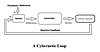
“Perhaps the most important single characteristic of modern organizational cybernetics is this: That in addition to concern with the deleterious impacts of rigidly-imposed notions of what constitutes the application of good "principles of organization and management" the organization is viewed as a subsystem of a larger system(s), and as comprised itself of functionally interdependent subsystems.”
“It follows from this that man's most urgent and pre-emptive need is maximally to utilize cybernetic science and computer technology within a general systems framework, to build a meta-systemic reality which is now only dimly envisaged. Intelligent and purposeful application of rapidly developing telecommunications and teleprocessing technology should make possible a degree of worldwide value consensus heretofore unrealizable.”
“This is a time in human affairs when, In the context of the foregoing analysis, the “radical” point of view is likely to prove to be the “conservative” one: we may well be in the early stages of a “cybernetic revolution” worthy of “1984” and “RUR.” Thus, to accept as potential reality what may seem an alarmist view, may turn out to be the only perspective which secures viable options by promoting mankind's welfare.”

“The essence of cybernetic organizations is that they are self-controlling, self-maintaining, self-realizing. Indeed, cybernetics has been characterized as the “science of effective organization,” in just these terms.
But the word “cybernetics” conjures, in the minds of an apparently great number of people, visions of computerized information networks, closed loop systems, and robotized man-surrogates, such as “artorgas” and “cyborgs.””
But the word “cybernetics” conjures, in the minds of an apparently great number of people, visions of computerized information networks, closed loop systems, and robotized man-surrogates, such as “artorgas” and “cyborgs.””
Richard F. Ericson Quotes by Topic
Find exactly what you are looking for by browsing this categorized list of Richard F. Ericson quotes by topic.
Richard F. Ericson on Cybernetics 2 quotes
“Perhaps the most important single characteristic of modern organizational cybernetics is this: That in addition to concern with the deleterious impacts of rigidly-imposed notions of what constitutes the application of good "principles of organization and management" the organization is viewed as a subsystem of a larger system(s), and as comprised itself of functionally interdependent subsystems.”
Richard F. Ericson on Science
“From society's standpoint, modern science and technology appears Janus-faced : It has given us wealth in one sense, and poverty in another; it has harnessed nature to man's basic needs in ways and to extents undreamed - of only a few decades ago, but it has fostered a continuingly lowered "quality of life".”

Richard F. Ericson on Manager
“Systems analysis, conceived in a policy sciences framework, is the macro instrument of the systems manager for understanding, evaluating and improving human systems — which are defined as goal oriented interdependent units incorporating people, organization and some form of technology for control, administration or output.”

Richard F. Ericson on Holism
“Much of philosophy concerns man's search for holistic concepts which will help him see a meaningful pattern in the complexity with which his perceptual world confronts him. What is new is the rapidly growing intensity of the quest, and the modern context of the search. Plato's Republic is from a world quite different from that of Boguslaw's. The New Utopians.”

Richard F. Ericson on Principles of management
“Perhaps the most important single characteristic of modern organizational cybernetics is this: That in addition to concern with the deleterious impacts of rigidly-imposed notions of what constitutes the application of good "principles of organization and management" the organization is viewed as a subsystem of a larger system(s), and as comprised itself of functionally interdependent subsystems.”

Quotes About Richard F. Ericson
Gain deeper perspective through quotes about Richard F. Ericson from others.
US OTA on Richard F. Ericson
“Geoffrey Vickers and Richard Ericson have articulated the potential of systems and cybernetics (communications and control) concepts to improve the decision-making processes and “steering” mechanisms of government.”
About Richard F. Ericson
Richard Ferdinand Ericson (1919–1993) was an American organizational theorist, and Professor of Management at the George Washington University in Washington, D.C.