Link Copied!
Nicolaus Copernicus Quotes (1473-1543)
Author, Writer, Mathematician

About Nicolaus Copernicus
Nicolaus Copernicus (19 February 1473 – 24 May 1543) was an early modern astronomer and mathematician; proponent of the heliocentric cosmic model. His book, De revolutionibus orbium coelestium On the Revolutions of the Celestial Spheres, is often regarded as the starting point of modern astronomy and the defining epiphany that began the Scientific Revolution.
Best Nicolaus Copernicus Quotes
Shortest
Earliest
Explore our curated collection of the most famous and impactful Nicolaus Copernicus quotes.
“Finally we shall place the Sun himself at the center of the Universe. All this is suggested by the systematic procession of events and the harmony of the whole Universe, if only we face the facts, as they say, "with both eyes open."”

“To know the mighty works of God, to comprehend His wisdom and majesty and power; to appreciate, in degree, the wonderful workings of His laws, surely all this must be a pleasing and acceptable mode of worship to the Most High, to whom ignorance cannot be more grateful than knowledge.”
“For when a ship is floating calmly along, the sailors see its motion mirrored in everything outside, while on the other hand they suppose that they are stationary, together with everything on board. In the same way, the motion of the earth can unquestionably produce the impression that the entire universe is rotating.”

“We are taught all this [the motion of the earth on its axis and around the sun] by the order of succession, in which those phenomena (various planetary happenings) follow each other, and by the harmony of the world, if we will only, as the saying goes, look at the matter with both eyes.”
“Hence I feel no shame in asserting that this whole region engirdled by the moon, and the center of the earth, traverse this grand circle amid the rest of the planets in an annual revolution around the sun. Near the sun is the center of the universe. Moreover, since the sun remains stationary, whatever appears as a motion of the sun is really due rather to the motion of the earth.”

“Neque enim ita mihi mea placent, ut non perpendam, quid alii de illis iudicaturi sint. Et quamvis sciam, hominis philosophi cogitationes esse remotas à iudicio vulgi, propterea quòd illius studium sit veritatem omnibus in rebus, quatenus id à Deo rationi humanæ permissum est, inquirere, tamen alienas prorsus à rectitudine opiniones fugiendas censeo. Itaque cum mecum ipse cogitarem, quàm absurdum ἀκρόαμα existimaturi essent illi, qui multorum seculorum iudiciis hanc opinionem confirmatam norunt, quòd terra immobilis in medio cœli, tanquam centrum illius posita sit, si ego contra assererem terram moveri...”
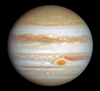
“We find then in this arrangement an admirable harmony of the world, and a dependable, harmonious interconnexion of the motion and the size of the paths, such as otherwise cannot be discovered. For here the penetrating observer can note why the forward and the retrograde movement of Jupiter appears greater than that of Saturn, and smaller than that of Mars, and again greater with Venus than with Mercury; and why such retrogression appears oftener with Saturn than with Jupiter, less often with Mars and Venus than with Mercury. Moreover, why Saturn, Jupiter, and Mars, when they rise in the evening, appear greater than when they disappear and reappear [with the sun] . . . And all this results from the same cause, namely the motion of the earth.”
“Those who devised the eccentrics seen thereby in large measure to have solved the problem of apparent motions with approximate calculations. But meanwhile they introduced a good many ideas which apparently contradict the first principles of uniform motion. Nor could they elicit or deduce from the eccentrics the principal consideration, that is, the structure of the universe and the true symmetry of its parts. On the contrary, their experience was just like someone taking from various places hands, feet, a head, and other pieces, very well depicted it may be, but for the representation of a single person; since these fragments would not belong to one another at all, a monster rather than a man would be put together from them.”

“Nor do I doubt that skilled and scholarly mathematicians will agree with me if, what philosophy requires from the beginning, they will examine and judge, not casually but deeply, what I have gathered together in this book to prove these things. ...Mathematics is written for mathematicians, to whom these my labours, if I am not mistaken, will appear to contribute something. ...What... I may have achieved in this, I leave to the decision of your Holiness especially, and to all other learned mathematicians. ...If perchance there should be foolish speakers who, together with those ignorant of all mathematics, will take it upon themselves to decide concerning these things, and because of some place in the Scriptures wickedly distorted to their purpose, should dare to assail this my work, they are of no importance to me, to such an extent do I despise their judgment as rash.”

“If perchance there should be foolish speakers who, together with those ignorant of all mathematics, will take it upon themselves to decide concerning these things, and because of some place in the Scriptures wickedly distorted to their purpose, should dare to assail this my work, they are of no importance to me, to such an extent do I despise their judgment as rash. For it is not unknown that Lactantius, the writer celebrated in other ways but very little in mathematics, spoke somewhat childishly of the shape of the earth when he derided those who declared the earth had the shape of a ball. So it ought not to surprise students if such should laugh at us also. Mathematics is written for mathematicians to whom these our labors, if I am not mistaken, will appear to contribute something even to the ecclesiastical state the headship of which your Holiness now occupies.(Author's preface to de revolutionibus)”
“At rest, however, in the middle of everything is the sun. For, in this most beautiful temple, who would place this lamp in another or better position than that from which it can light up the whole thing at the same time? For, the sun is not inappropriately called by some people the lantern of the universe, its mind by others, and its ruler by still others. The Thrice Greatest labels it a visible god, and Sophocles' Electra, the all-seeing. Thus indeed, as though seated on a royal throne, the sun governs the family of planets revolving around it.
• Alternate translation: Then in the middle of all stands the sun. For who, in our most beautiful temple, could set this light in another or better place, than that from which it can at once illuminate the whole? Not to speak of the fact that not unfittingly do some call it the light of the world, others the soul, still others the governor. Tremigistus calls it the visible God; Sophocles' Electra, the All-seer. And in fact does the sun, seated on his royal throne, guide his family of planets as they circle round him.”
• Alternate translation: Then in the middle of all stands the sun. For who, in our most beautiful temple, could set this light in another or better place, than that from which it can at once illuminate the whole? Not to speak of the fact that not unfittingly do some call it the light of the world, others the soul, still others the governor. Tremigistus calls it the visible God; Sophocles' Electra, the All-seer. And in fact does the sun, seated on his royal throne, guide his family of planets as they circle round him.”
“The forward and backward arcs appear greater in Jupiter than in Saturn and smaller than in Mars, and on the other hand greater in Venus than in Mercury. This reversal in direction appears more frequently in Saturn than in Jupiter, and also more rarely in Mars and Venus than in Mercury. Moreover, when Saturn, Jupiter, and Mars rise at sunset, they are nearer to the earth than when they set in the evening or appear at a later hour. But Mars in particular, when it shines all night, seems to equal Jupiter in size, being distinguished only by its reddish color. Yet in the other configurations it is found barely among the stars of the second magnitude, being recognized by those who track it with assiduous observations. All these phenomena proceed from the same cause, which is the earth's motion.
Yet none of these phenomena appears in the fixed stars. This proves their immense height, which makes even the sphere of the annual motion, or its reflection, vanish from before our eyes. For, every visible object has some measure of distance beyond which it is no longer seen, as is demonstrated in optics. From Saturn, the highest of the planets, to the sphere of the fixed stars there is an additional gap of the largest size. This is shown by the twinkling lights of the stars. By this token in particular they are distinguished from the planets, for there had to be a very great difference between what moves and what does not move. So vast, without any question, is the divine handiwork of the most excellent Almighty.”
Yet none of these phenomena appears in the fixed stars. This proves their immense height, which makes even the sphere of the annual motion, or its reflection, vanish from before our eyes. For, every visible object has some measure of distance beyond which it is no longer seen, as is demonstrated in optics. From Saturn, the highest of the planets, to the sphere of the fixed stars there is an additional gap of the largest size. This is shown by the twinkling lights of the stars. By this token in particular they are distinguished from the planets, for there had to be a very great difference between what moves and what does not move. So vast, without any question, is the divine handiwork of the most excellent Almighty.”
“When, therefore, I had long considered this uncertainty of traditional mathematics, it began to weary me that no more definite explanation of the movement of the world-machine established in our behalf by the best and most systematic builder of all, existed among the philosophers who had studied so exactly in other respects the minutest details in regard to the sphere. Wherefore I took upon myself the task of re-reading the books of all the philosophers which I could obtain, to seek out whether any one had ever conjectured that the motions of the spheres of the universe were other than they supposed who taught mathematics in the schools. And I found first, that, according to Cicero, Nicetas [assumed by modern editors to mean Hicetas] had thought the earth was moved. Then later I discovered, according to Plutarch, that certain others had held the same opinion. ... When from this, therefore, I had conceived its possibility, I myself also began to meditate upon the mobility of the earth. And although the opinion seemed absurd, yet because I knew the liberty had been accorded to others before me of imagining whatsoever circles they pleased to explain the phenomena of the stars, I thought I also might readily be allowed to experiment whether, by supposing the earth to have some motion, stronger demonstrations than those of the others could be found as to the revolution of the celestial sphere. Thus, supposing these motions which I attribute to the earth later on in this book, I found at length by much and long observation, that if the motions of the other planets were added to the rotation of the earth and calculated as for the revolution of that planet, not only the phenomena of the others followed from this, but also it so bound together both the order and magnitude of all the planets and the spheres and the heaven itself, that in no single part could one thing be altered without confusion among the other parts and in all the universe. Hence for this reason in the course of this work I have followed this system.”
Nicolaus Copernicus Quotes by Topic
Find exactly what you are looking for by browsing this categorized list of Nicolaus Copernicus quotes by topic.
Nicolaus Copernicus on Universe 2 quotes
“We find then in this arrangement an admirable harmony of the world, and a dependable, harmonious interconnexion of the motion and the size of the paths, such as otherwise cannot be discovered. For here the penetrating observer can note why the forward and the retrograde movement of Jupiter appears greater than that of Saturn, and smaller than that of Mars, and again greater with Venus than with Mercury; and why such retrogression appears oftener with Saturn than with Jupiter, less often with Mars and Venus than with Mercury. Moreover, why Saturn, Jupiter, and Mars, when they rise in the evening, appear greater than when they disappear and reappear [with the sun]...And all this results from the same cause, namely the motion of the earth.”
Nicolaus Copernicus on Jupiter 2 quotes
“We find then in this arrangement an admirable harmony of the world, and a dependable, harmonious interconnexion of the motion and the size of the paths, such as otherwise cannot be discovered. For here the penetrating observer can note why the forward and the retrograde movement of Jupiter appears greater than that of Saturn, and smaller than that of Mars, and again greater with Venus than with Mercury; and why such retrogression appears oftener with Saturn than with Jupiter, less often with Mars and Venus than with Mercury. Moreover, why Saturn, Jupiter, and Mars, when they rise in the evening, appear greater than when they disappear and reappear [with the sun]...And all this results from the same cause, namely the motion of the earth.”
Nicolaus Copernicus on Mercury (planet) 2 quotes
“We find then in this arrangement an admirable harmony of the world, and a dependable, harmonious interconnexion of the motion and the size of the paths, such as otherwise cannot be discovered. For here the penetrating observer can note why the forward and the retrograde movement of Jupiter appears greater than that of Saturn, and smaller than that of Mars, and again greater with Venus than with Mercury; and why such retrogression appears oftener with Saturn than with Jupiter, less often with Mars and Venus than with Mercury. Moreover, why Saturn, Jupiter, and Mars, when they rise in the evening, appear greater than when they disappear and reappear [with the sun]...And all this results from the same cause, namely the motion of the earth.”
-100px.jpg)
Nicolaus Copernicus on Saturn 2 quotes
“We find then in this arrangement an admirable harmony of the world, and a dependable, harmonious interconnexion of the motion and the size of the paths, such as otherwise cannot be discovered. For here the penetrating observer can note why the forward and the retrograde movement of Jupiter appears greater than that of Saturn, and smaller than that of Mars, and again greater with Venus than with Mercury; and why such retrogression appears oftener with Saturn than with Jupiter, less often with Mars and Venus than with Mercury. Moreover, why Saturn, Jupiter, and Mars, when they rise in the evening, appear greater than when they disappear and reappear [with the sun]...And all this results from the same cause, namely the motion of the earth.”

Nicolaus Copernicus on Despise
“If perchance there should be foolish speakers who, together with those ignorant of all mathematics, will take it upon themselves to decide concerning these things, and because of some place in the Scriptures wickedly distorted to their purpose, should dare to assail this my work, they are of no importance to me, to such an extent do I despise their judgment as rash.”
Quotes About Nicolaus Copernicus
Gain deeper perspective through quotes about Nicolaus Copernicus from others.
Angus Armitage on Nicolaus Copernicus
“The division of the seamless garment of Christendom into separate nations or sovereign states, which today we accept as a matter of course, was then only beginning. And the idea that people belong to all sorts of different races, with boasts of racial "purity" or "superiority", is something that has come up practically within the memories of people still alive. Hence if the astronomer had been asked concerning his race and nation, he might have replied that he was a loyal son of the Churchhttp://books.google.com/books?as_brr=0&id=plI3AAAAIAAJ&dq=author%3A%22Angus+Armitage%22&q=a+loyal+son+of+the+Church&pgis=1#search, but otherwise would scarcely have understood the questions. Even for us today it is not an easy question to answer. Torun was founded by Germans; its leading citizens, like those of Cracow, were mostly Germans. Hence the astronomer may well have been of German extraction.http://books.google.com/books?as_brr=0&id=plI3AAAAIAAJ&dq=author%3A%22Angus+Armitage%22&q=of+German+extraction&pgis=1#search The possible connection of the family on both sides with Silesia does not prove much either way for its population was a mixed one. On the other hand, the ancestors, especially on the father's side, must have lived for so many generations under allegiance to the King of Poland as to be, for all practical purposes, Poles. And Copernicus followed the family tradition in siding with the Poles against the Germans in times of crisis. In any case, it was Poland, and Cracow above all, that first nourished the youthful genius of Copernicus. And since his death it is chiefly the Poles who have gloriedhttp://books.google.com/books?as_brr=0&id=plI3AAAAIAAJ&dq=author%3A%22Angus+Armitage%22&q=%22Poles+who+have+gloried%22&pgis=1#search in their share in him, and have cherished the renown his achievements have brought to their heroic and ill-starred nation.”
Tycho Brahe on Nicolaus Copernicus
“In our time Nicholas Copernicus may not undeservedly be called a second Ptolemy. Through observations made by himself he discovered certain gaps in Ptolemy, and he concluded that the hypotheses formulated by Ptolemy admit something unsuitable in violation of the axioms of mathematics. Moreover, he found the Alfonsine computations in disagreement with the motions of the heavens. Therefore, with wonderful intellectual acumen he formulated different hypotheses. He restored the science of the heavenly motions in such a way that nobody before him reasoned more accurately about the movements of the heavenly bodies.”
Giordano Bruno on Nicolaus Copernicus
“He was a man of grave and cultivated mind, of rapid and mature intelligence; inferior to no preceding astronomer, unless in order of succession and time ; a man, who in natural ability was far superior to Ptolemy, Hipparchus, Eudoxus, and all those others who followed in their footsteps. What he was, he became through having liberated himself from certain false axioms of the common and vulgar philosophy — I will not say blindness. Nevertheless, he did not depart far from them ; because, studying mathematics rather than Nature, he failed to penetrate and dig deep enough altogether to cut away the roots of incongruous and vain principles, and thus, removing perfectly all opposing difficulties, free himself and others from so many empty investigations into things obvious and unchangeable. In spite of all this, who can sufficiently praise the magnanimity of this Pole, who, having little regard to the foolish multitude, stood firm against the torrent of contrary opinion, and, although well-nigh unarmed with living arguments, resuming those rusty and neglected fragments which antiquity had transmitted to him, polished, repaired, and put them together with reasonings more mathematical than philosophical ; and so rendered that cause formerly contemned and contemptible, honourable, estimable, more probable than its rival, and certainly convenient and expeditious for purposes of theory and calculation ? Thus this Teuton, although with means insufficient to vanquish, overthrow, and suppress falsehood, as well as resist it, nevertheless resolutely determined in his own mind, and openly confessed this final and necessary conclusion : that it is more possible that this globe should move with regard to the universe, than that the innumerable multitude of bodies, many of which are known to be greater and more magnificent than our earth, should be compelled, in spite of Nature and reason, which, by means of motions evident to the senses, proclaim the contrary, to acknowledge this globe as the centre and base of their revolutions and influences. Who then will be so churlish and discourteous towards the efforts of this man, as to cover with oblivion all he has done, by being ordained of the Gods as an Aurora - which was to precede the rising of this Sun of the true, ancient philosophy, buried during so many centuries in the tenebrous caverns of blind, malignant, froward, envious ignorance ; and, taking note only of what he failed to accomplish, rank him amongst the number of the herded multitude, which discourses, guides itself, precipitates to destruction, according to the oral sense of a brutal and ignoble belief, rather than amongst those who, by the use of right reason, have been able to rise up, and resume the true course under the faithful guidance of the eye of divine intelligence.”

Edwin Arthur Burtt on Nicolaus Copernicus 3 quotes
“To follow Ptolemy in ancient times meant merely to reject the cumbrous crystalline spheres. To follow Copernicus was a far more radical step, it meant to reject the whole prevailing conception of the universe.”
Christoph Clavius on Nicolaus Copernicus
“The Copernican theory contains many absurd or erroneous assertions.”




Misattributed Quotes
Quotes mistakenly credited to Nicolaus Copernicus
“Therefore alongside the ancient hypotheses, which are no more probable, let us permit these new hypotheses also to become known, especially since they are admirable as well as simple and bring with them a huge treasure of very skillful observations. So far as hypotheses are concerned, let no one expect anything certain from astronomy, which cannot furnish it, lest he accept as the truth ideas conceived for another purpose, and depart from this study a greater fool than when he entered it.”
About Nicolaus Copernicus
Nicolaus Copernicus (19 February 1473 – 24 May 1543) was an early modern astronomer and mathematician; proponent of the heliocentric cosmic model. His book, De revolutionibus orbium coelestium On the Revolutions of the Celestial Spheres, is often regarded as the starting point of modern astronomy and the defining epiphany that began the Scientific Revolution.