Link Copied!
Molière Quotes (1622-1673)
Actor, Writer, Director
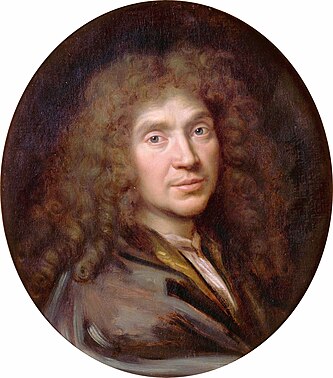

About Molière
Jean-Baptiste Poquelin, more famous as Molière (15 January 1622 – 17 February 1673) was a French theatre writer, director and actor, one of the masters of comic satire.
Best Molière Quotes
Shortest
Earliest
Explore our curated collection of the most famous and impactful Molière quotes.
“Il y a fagots et fagots.”
“Ah! Il n'y a plus d'enfants!”
“Nous avons changé tout cela.”
“Les beaux yeux de ma cassette.”
“Je le soutiendrai devant tout le monde.”

“Une femme a toujours une vengeance prête.”
“Il est de sel attique assaisonné partout.”
“Je l'ai vu, dis-je, de mes propres yeux vu.”

“Vous êtes un sot en trois lettres, mon fils.”
“Que diable allait-il faire dans cette galère?”
“Un sot savant est sot plus qu'un sot ignorant.”
“Tirer les marrons du feu avec la patte du chat.”
“Contre la médisance il n'est point de rempart.”
“Ah, la belle chose que de savoir quelque chose.”
“Jurons, ma belle,
Une ardeur éternelle.”
Une ardeur éternelle.”
“La grammaire qui sait régenter jusqu'aux rois.”
“Le monde, chère Agnès, est une étrange chose.”
“Pour être dévot, je n'en suis pas moins homme.”
“On voit qu'il se travaille à dire de bons mots.”
“On peut être honnête homme et faire mal des vers.”
“On ne meurt qu'une fois; et c'est pour si longtemps!”
“Les doutes sont fâcheux plus que toute autre chose.”

Molière Quotes by Topic
Find exactly what you are looking for by browsing this categorized list of Molière quotes by topic.
Molière on Love 2 quotes
View all 2 quotes on Love →Molière on Death 2 quotes
“On n'a point pour la mort de dispense de Rome.
Rome can give no dispensation from death.”

Molière on Friendship
“My fair one, let us swear an eternal friendship.”

Molière on Quality
Molière on Politics
“Every time I fill a vacant office I make ten malcontents and one ingrate.”

Molière on Childhood
“Ah, il n'y a plus d'enfant.
Translation: Ah, there are no children nowadays.”
Molière on Enjoyment
“Heaven forbids, it is true, certain gratifications, but there are ways and means of compounding such matters.”

Molière on Misanthropy
“My hate is general, I detest all men; Some because they are wicked and do evil, Others because they tolerate the wicked, Refusing them the active vigorous scorn Which vice should stimulate in virtuous minds.”

Molière on Hatred
“My hate is general, I detest all men; Some because they are wicked and do evil, Others because they tolerate the wicked, Refusing them the active vigorous scorn Which vice should stimulate in virtuous minds.”
Molière on Success
“Heaven, when it sent me into the world, did not give me a soul suited to the air of courts. I do not find in myself the virtues necessary to succeed, and make my fortune there. My chief talent is to be frank and sincere.”
Molière on Gratification
“It is true that Heaven forbids certain gratifications, but there are means' of compounding with it upon such matters, and of rectifying the evil of the act by the purity of the intention, We shall be able to initiate you into all those secrets...”

Molière on Sincerity
“The temper I am of requires me to keep away from court. Heaven, when it sent me into the world, did not give me a soul suited to the air of courts. I do not find in myself the virtues necessary to succeed, and make my fortune there. My chief talent is to be frank and sincere.”

Misattributed Quotes
Quotes mistakenly credited to Molière
“Il faut manger pour vivre, et non pas vivre pour manger.
• Firstly, an inaccurate sourcing: in Act III, yes—but in Scene I, no: rather, in Scene V—HARPAGON, VALÈRE, MASTER JACQUES (see, e.g., the Project Gutenberg HTML version of the English translation: http://www.gutenberg.org/files/6923/6923-h/6923-h.htm). Secondly, a misattribution made clear by the Molière text—the character in the play, VAL, obviously points out that the quote refers to a "saying of one of the ancients" (and the quote is precisely written in quotation marks as well), in the full line of dialogue below:”
• Firstly, an inaccurate sourcing: in Act III, yes—but in Scene I, no: rather, in Scene V—HARPAGON, VALÈRE, MASTER JACQUES (see, e.g., the Project Gutenberg HTML version of the English translation: http://www.gutenberg.org/files/6923/6923-h/6923-h.htm). Secondly, a misattribution made clear by the Molière text—the character in the play, VAL, obviously points out that the quote refers to a "saying of one of the ancients" (and the quote is precisely written in quotation marks as well), in the full line of dialogue below:”
About Molière
Jean-Baptiste Poquelin, more famous as Molière (15 January 1622 – 17 February 1673) was a French theatre writer, director and actor, one of the masters of comic satire.