Link Copied!
Michelangelo Quotes (1475-1564)
Poet, Painter
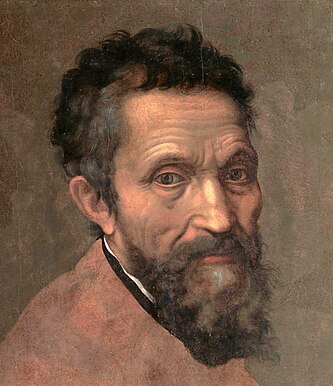


About Michelangelo
Michelangelo di Lodovico Buonarroti Simoni (March 6, 1475 – February 18, 1564), commonly known as Michelangelo, was an Italian sculptor, painter, architect, poet, and engineer of the High Renaissance who exerted an unparalleled influence on the development of Western art.
Best Michelangelo Quotes
Shortest
Earliest
Explore our curated collection of the most famous and impactful Michelangelo quotes.
“Beauty is the purgation of superfluities.”
“As when, O lady mine,
With chiseled touch
The stone unhewn and cold
Becomes a living mold,
The more the marble wastes,
The more the statue grows.”
With chiseled touch
The stone unhewn and cold
Becomes a living mold,
The more the marble wastes,
The more the statue grows.”
“''A quel pietoso fonte, onde siam tutti,
S'assembra ogni beltà che qua si vede,
Più c'altra cosa alle persone accorte;
• Translation:
That fount of mercy, whence we all exist,
Every beauty seen here [on earth] resembles,
More than anything else to knowing persons;”
S'assembra ogni beltà che qua si vede,
Più c'altra cosa alle persone accorte;
• Translation:
That fount of mercy, whence we all exist,
Every beauty seen here [on earth] resembles,
More than anything else to knowing persons;”

“Your lordship, only worldly light in this age of ours, you can never be pleased with another man's work for there is no man who resembles you, nor one to equal you … It grieves me greatly that I cannot recapture my past, so as to longer be at your service. As it is, I can only offer you my future, which is short, for I am too old … That is all I have to say. Read my heart for "the quill cannot express good will."”
Michelangelo Quotes by Topic
Find exactly what you are looking for by browsing this categorized list of Michelangelo quotes by topic.
Michelangelo on Intelligence
Michelangelo on Sculpture
Michelangelo on Stone
Michelangelo on Blow-Up
“The photographer in Blow-Up, who is not a philosopher, wants to see things closer up. But it so happens that, by enlarging too far, the object itself decomposes and disappears. Hence there's a moment in which we grasp reality, but then the moment passes. This was in part the meaning of Blow-Up.”

Michelangelo on University of Bologna
“I didn't like university life much at Bologna. The subjects I studied - economics and business administration - didn't interest me. I wanted to make films. I was glad when I was graduated. Yet it's odd; on graduation day, I was overcome with a terrible sadness. I realized that my youth was over and now the struggle had begun.”

What Michelangelo Said About Others
Discover personal opinions Michelangelo shared regarding contemporaries.
Quotes About Michelangelo
Gain deeper perspective through quotes about Michelangelo from others.
Roxanne Dunbar-Ortiz on Michelangelo
“Italians have such illustrious people they can celebrate, that everyone celebrates — Michelangelo, Vivaldi and, of course, for us on the left, Sacco and Vanzetti.”

Galileo Galilei on Michelangelo
“Do we not say that the judicious discovering of a most lovely Statua in a piece of Marble, hath sublimated the wit of Buonarruotti far above the vulgar wits of other men? And yet this work is onely the imitation of a meer aptitude and disposition of exteriour and superficial members of an immoveable man; but what is it in comparison of a man made by nature, composed of as many exteriour and interiour members, of so many muscles, tendons, nerves, bones, which serve to so many and sundry motions? but what shall we say of the senses, and of the powers of the soul, and lastly, of the understanding? May we not say, and that with reason, that the structure of a Statue falls far short of the formation of a living man, yea more of a contemptible worm?”

Intervistatore on Michelangelo
“Interviewer: The examination of two emotional journeys, namely those concerning the artist's relationships with Tommaso de' Cavalieri and Vittoria Colonna, proved to be very interesting. Graziella Magherini: Buonarroti dedicated some very beautiful sonnets to Tommaso, written in the Neoplatonic style, with a refined sensitivity that was an integral part of Florentine Humanism. However, psychoanalytic observation reveals clear homoerotic feelings, albeit disguised. The comparison with the drawings that the artist gave to the young man is extraordinary. I am referring to The Rape of Ganymede, The Punishment of Titus and The Bacchanalia of the Putti. These are truly eloquent works. There are two versions of ‘Ganymede’: in the first, Ganymede resists Zeus in an ambivalent mix of desire and fear, while in the second he offers himself in sweet abandon, in an attitude pervaded by ecstasy and bliss. In The Punishment of Titus, the protagonist, struck by the eagle, becomes a metaphor for Michelangelo's sense of guilt. But even more extraordinary is the drawing with the Bacchanalia of the Putti. Here we are faced with an expression of regressed levels. Naked children linger in bacchanalia, dragging a dead deer here, carrying a pig there; a child urinates in a wine jug; young people are lost, without dignity... In the lower part of the work, the contrast is striking. There is a naked man sleeping uncovered, in an atmosphere of profound sadness, in a pose that closely resembles, for example, the Drunken Moses in the istine Chapel; and there is a hideous female satyr with flaccid breasts. What emerges clearly is a depressed paternal role on the one hand, and a sense of emptied motherhood on the other, in an almost phallic mother figure that combines the male and female roles. In short, the drawings are direct, sensorial: unlike the sonnets, which, as I mentioned, also contain an underlying materiality of the flesh.”
Johann Wolfgang von Goethe on Michelangelo
“No one who has not seen the Sistine Chapel can have a clear idea of what a human being can achieve. ... The master's inner security and strength, his greatness is beyond all description. ... At the moment I am so engrossed by Michelangelo that even Nature makes no appeal to me, for my vision is so small compared with his. If there were only some means of fixing such pictures in one's soul!”


Disputed Quotes
Quotes attributed to Michelangelo that are questionable.
“Recollect that trifles make perfection, and that perfection is no trifle.”
Misattributed Quotes
Quotes mistakenly credited to Michelangelo
“Ancora Imparo.
• Variant translation: Still I learn!”
• Variant translation: Still I learn!”
About Michelangelo
Michelangelo di Lodovico Buonarroti Simoni (March 6, 1475 – February 18, 1564), commonly known as Michelangelo, was an Italian sculptor, painter, architect, poet, and engineer of the High Renaissance who exerted an unparalleled influence on the development of Western art.