Link Copied!
Michael Faraday Quotes (1791-1867)
Physicist, Philosopher
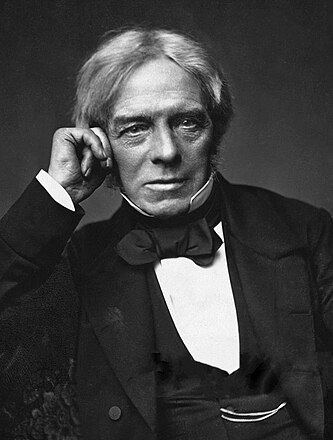





About Michael Faraday
Michael Faraday (22 September 1791 – 25 August 1867) was an English chemist and physicist (or natural philosopher, in the terminology of the time) who contributed to the fields of electromagnetism and electrochemistry.
Best Michael Faraday Quotes
Shortest
Earliest
Explore our curated collection of the most famous and impactful Michael Faraday quotes.
“I am no poet, but if you think for yourselves, as I proceed, the facts will form a poem in your minds.”
“The lecturer should give the audience full reason to believe that all his powers have been exerted for their pleasure and instruction.”

“There is no more open door by which you can enter into the study of natural philosophy than by considering the physical phenomena of a candle.”
“I was at first almost frightened when I saw such mathematical force made to bear upon the subject, and then wondered to see that the subject stood it so well.”
“Speculations? I have none. I am resting on certainties. I know whom I have believed and am persuaded that he is able to keep that which I have committed unto him against that day.”
“No wonder that my remembrance fails me, for I shall complete my 70 years next Sunday (the 22); — and during these 70 years I have had a happy life; which still remains happy because of hope and content.”
“It is the great beauty of our science, chemistry, that advancement in it, whether in a degree great or small, instead of exhausting the subjects of research, opens the doors to further and more abundant knowledge, overflowing with beauty and utility.”
“ALL THIS IS A DREAM. Still examine it by a few experiments. Nothing is too wonderful to be true, if it be consistent with the laws of nature; and in such things as these, experiment is the best test of such consistency.”
“If you would cause your view … to be acknowledged by scientific men; you would do a great service to science. If you would even get them to say yes or no to your conclusions it would help to clear the future progress. I believe some hesitate because they do not like their thoughts disturbed.”
“As when on some secluded branch in forest far and wide sits perched an owl, who, full of self-conceit and self-created wisdom, explains, comments, condemns, ordains and order things not understood, yet full of importance still holds forth to stocks and stones around — so sits and scribbles Mike.”
“Whereas, according to the declaration of that true man of the world Talleyrand, the use of language is to conceal the thoughts; this is to declare in the present instance, when I say I am not able to bear much talking, it means really, and without any mistake, or equivocation, or oblique meaning, or implication, or subterfuge, or omission, that I am not able; being at present rather weak in the head, and able to work no more.”

“I have far more confidence in the one man who works mentally and bodily at a matter than in the six who merely talk about it — and I therefore hope and am fully persuaded that you are working. Nature is our kindest friend and best critic in experimental science if we only allow her intimations to fall unbiased on our minds. Nothing is so good as an experiment which, whilst it sets an error right, gives us (as a reward for our humility in being reproved) an absolute advancement in knowledge.”
“A man who makes assertions, or draws conclusions, regarding any given case, ought to be competent to investigate it. He has no right to throw the onus on others, declaring it their duly to prove him right or wrong. His duty is to demonstrate the truth of that which he asserts, or to cease from asserting. The men he calls upon to consider and judge have enough to do with themselves, in the examination, correction, or verification of their own views. The world little knows how many of the thoughts and theories which have passed through the mind of a scientific investigator have been crushed in silence and secrecy by his own severe criticism and adverse examination; that in the most successful instances not a tenth of the suggestions, the hopes, the wishes, the preliminary conclusions have been realized.”
“I am, I hope, very thankful that in the withdrawal of the powers and things of life, the good hope is left with me, which makes the contemplation of death a comfort — not a fear. Such peace is alone the gift of God, and as it is He who gives it, why should we be afraid? His unspeakable gift in His beloved Son is the ground of no doubtful hope, and there is the rest for those who (like you and me) are drawing near the latter end of our terms here below. I do not know, however why I should join you with me in years. I forget your age, but this I know (and feel as well) that next Sabbath day (the 22nd) I shall complete my 70th year. '''I can hardly think myself so old as I write to you — so much of cheerful spirit, ease and general health is left to me, and if my memory fails, why it causes that I forget troubles as well as pleasure and the end is, I am happy and content.”

“I have not been at work except in turning the tables upon table turners – nor should I have done that but that so many enquiries poured in upon me that I thought it better to stop the inpouring flood by letting all know at once what my views and thoughts were. What a weak credulous, incredulous, unbelieving superstitious, bold, frightened, what a ridiculous world ours is, as far as concerns the mind of man. How full of inconsistencies, contradictions and absurdities it is. I declare that taking the average of many minds that have recently come before me (and apart from that spirit which God has placed in each) and accepting for a moment that average as a standard, I should far prefer the obedience affections and instinct of a dog before it. Do not whisper this however to others. There is one above who worketh in all things and who governs even in the midst of that misrule to which the tendencies and powers of man are so easily perverted.”
“Bacon in his instruction tells us that the scientific student ought not to be as the ant, who gathers merely, nor as the spider who spins from her own bowels, but rather as the bee who both gathers and produces. All this is true of the teaching afforded by any part of physical science. Electricity is often called wonderful, beautiful; but it is so only in common with the other forces of nature. The beauty of electricity or of any other force is not that the power is mysterious, and unexpected, touching every sense at unawares in turn, but that it is under law, and that the taught intellect can even now govern it largely. The human mind is placed above, and not beneath it, and it is in such a point of view that the mental education afforded by science is rendered super-eminent in dignity, in practical application and utility; for by enabling the mind to apply the natural power through law, it conveys the gifts of God to man.”
“Among those points of self-education which take up the form of mental discipline, there is one of great importance, and, moreover, difficult to deal with, because it involves an internal conflict, and equally touches our vanity and our ease. It consists in the tendency to deceive ourselves regarding all we wish for, and the necessity of resistance to these desires. It is impossible for any one who has not been constrained, by the course of his occupation and thoughts, to a habit of continual self-correction, to be aware of the amount of error in relation to judgment arising from this tendency. The force of the temptation which urges us to seek for such evidence and appearances as are in favour of our desires, and to disregard those which oppose them, is wonderfully great. In this respect we are all, more or less, active promoters of error. In place of practising wholesome self-abnegation, we ever make the wish the father to the thought: we receive as friendly that which agrees with, we resist with dislike that which opposes us; whereas the very reverse is required by every dictate of common sense.”
“We learn by such results as these, what is the kind of education that science offers to man. It teaches us to be neglectful of nothing, not to despise the small beginnings — they precede of necessity all great things. Vesicles make clouds; they are trifles light as air, but then they make drops, and drops make showers, rain makes torrents and rivers, and these can alter the face of a country, and even keep the ocean to its proper fulness and use. It teaches a continual comparison of the small and great, and that under differences almost approaching the infinite, for the small as often contains the great in principle, as the great does the small; and thus the mind becomes comprehensive. It teaches to deduce principles carefully, to hold them firmly, or to suspend the judgment, to discover and obey law, and by it to be bold in applying to the greatest what we know of the smallest. It teaches us first by tutors and books, to learn that which is already known to others, and then by the light and methods which belong to science to learn for ourselves and for others; so making a fruitful return to man in the future for that which we have obtained from the men of the past.”

Michael Faraday Quotes by Topic
Find exactly what you are looking for by browsing this categorized list of Michael Faraday quotes by topic.
Michael Faraday on Poetry
“I am no poet, but if you think for yourselves, as I proceed, the facts will form a poem in your minds.”

Michael Faraday on Poets
“I am no poet, but if you think for yourselves, as I proceed, the facts will form a poem in your minds.”

Michael Faraday on Discrimination
“The five essential entrepreneurial skills for success: Concentration, Discrimination, Organization, Innovation and Communication.”

Michael Faraday on Dreams
“All this is a dream. Still examine it by a few experiments. Nothing is too wonderful to be true, if it be consistent with the laws of nature; and in such things as these experiment is the best test of such consistency.”
Quotes About Michael Faraday
Gain deeper perspective through quotes about Michael Faraday from others.
Jim Baggot on Michael Faraday
“Faraday found no conflict between his religious beliefs and his activities as a scientist and philosopher. He viewed his discoveries of nature's laws as part of the continual process of "reading the book of nature", no different in principle from the process of reading the Bible to discover God's laws. A strong sense of the unity of God and nature pervaded Faraday's life and work.”
A. D'Abro on Michael Faraday
“Faraday was the first scientist to realise the enormous importance of the electromagnetic field. He saw in it a reality of a new category differing from matter. It was capable of transmitting effects from place to place, and was not to be likened to a mere mathematical fiction such as the gravitational field was then assumed to be. In his opinion, the phenomena of electricity and magnetism should be approached via the field rather than via the charged bodies and currents. In other words, according to Faraday, when a current was flowing along a wire, the most important aspect of the phenomenon lay not in the current itself but in the fields of electric and magnetic force distributed throughout space in the current's vicinity. It is this elevation of the field to a position of preeminence that is often called the pure physics of the field. Faraday was not a mathematician and was unable to co-ordinate the phenomena he foresaw in a mathematical way, and derive the full benefit from his ideas. Before dying, however, he entrusted this task to his colleague Maxwell; and one of the most astonishing theories of science, eclipsed only in recent years by Einstein's theory of relativity, was the outcome.”
Albert Einstein on Michael Faraday 2 quotes
“If the idea of physical reality had ceased to be purely atomic, it still remained for the time being purely mechanistic; people still tried to explain all events as the motion of inert masses; indeed no other way of looking at things seemed conceivable. Then came the great change, which will be associated for all time with the names of Faraday, Clerk Maxwell, and Hertz.”

Richard Feynman on Michael Faraday
“With the realization that electric currents make magnetic fields, people immediately suggested that, somehow or other, magnets might also make electric fields. Various experiments were tried. For example, two wires were placed parallel to each other and a current was passed through one of them in the hope of finding a current in the other. The thought was that the magnetic field might in some way drag the electrons along in the second wire, giving some such law as "likes prefer to move alike." With the largest available current and the most sensitive galvanometer to detect any current, the result was negative. Large magnets next to wires also produced no observed effects. Finally, Faraday discovered in 1840 the essential feature that had been missed—that electric effects exist only when there is something changing. If one of a pair of wires has a changing current, a current is induced in the other, or if a magnet is moved near an electric circuit, there is a current. We say that currents are induced. This was the induction effect discovered by Faraday. It transformed the rather dull subject of static fields into a very exciting dynamic subject with an enormous range of wonderful phenomena.”

John Hall Gladstone on Michael Faraday
“When his faculties were fading fast, he would sit long at the western window, watching the glories of the sunset; and one day, when his wife drew his attention to a beautiful rainbow that spanned the sky, he looked beyond the falling shower and the many-colored arch, and observed, "He hath set his testimony in the heavens." On August 25, 1867, quietly, almost imperceptively, came the release. There was a philosopher less on earth, and a saint more in heaven.”


Disputed Quotes
Quotes attributed to Michael Faraday that are questionable.
“An intimate friend of Faraday once described to me how, when Faraday was endeavouring to explain to Gladstone and several others an important new discovery in science Gladstone's only commentary was “but, after all, what use is it?” “Why, sir,” replied Faraday, “there is every probability that you will soon be able to tax it!””
About Michael Faraday
Michael Faraday (22 September 1791 – 25 August 1867) was an English chemist and physicist (or natural philosopher, in the terminology of the time) who contributed to the fields of electromagnetism and electrochemistry.