Link Copied!
Maxwell D. Taylor Quotes (1901-1987)
President, Author



About Maxwell D. Taylor
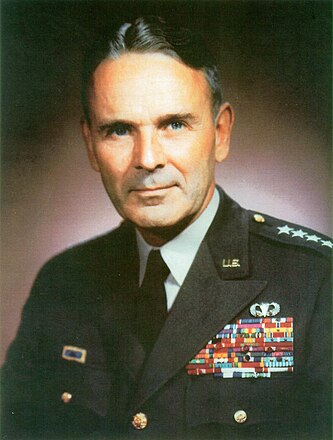
Maxwell Davenport "Max" Taylor (August 26, 1901 – April 19, 1987) was a senior United States Army officer and U.S. diplomat of the mid-20th century, who served as the fifth Chairman of the Joint Chiefs of Staff after having been appointed by President John F. Kennedy. He is the father of military historian and author Thomas Happer Taylor.
Best Maxwell D. Taylor Quotes
Shortest
Earliest
Explore our curated collection of the most famous and impactful Maxwell D. Taylor quotes.
“To Diddy, The Best Taylor Soldier”
Unsourced — Primary work/page citation not yet verified in the QuotesCosmos archive. Per our Unnamed Sources & Verification Policy, quotes without confirmed primary editions are explicitly marked Unsourced while under editorial review.
“Give me three days and three nights of hard fighting, and you will be relieved.”

Unsourced — Primary work/page citation not yet verified in the QuotesCosmos archive. Per our Unnamed Sources & Verification Policy, quotes without confirmed primary editions are explicitly marked Unsourced while under editorial review.
“For if the trumpet give an uncertain sound, who shall prepare himself to the battle?”
Unsourced — Primary work/page citation not yet verified in the QuotesCosmos archive. Per our Unnamed Sources & Verification Policy, quotes without confirmed primary editions are explicitly marked Unsourced while under editorial review.
“It was one thing to decide to go to West Point, another to get there.”

Unsourced — Primary work/page citation not yet verified in the QuotesCosmos archive. Per our Unnamed Sources & Verification Policy, quotes without confirmed primary editions are explicitly marked Unsourced while under editorial review.
“We all have a share in it, and none of it is good. There are no heroes, just bums. I include myself in that.”
Unsourced — Primary work/page citation not yet verified in the QuotesCosmos archive. Per our Unnamed Sources & Verification Policy, quotes without confirmed primary editions are explicitly marked Unsourced while under editorial review.
“As we learned on the American frontier, it is impossible to plant corn outside the stockade until the Indians are driven away.”

Unsourced — Primary work/page citation not yet verified in the QuotesCosmos archive. Per our Unnamed Sources & Verification Policy, quotes without confirmed primary editions are explicitly marked Unsourced while under editorial review.
“It seems clear that if we are to avoid the pitfalls of overcommitment and the traps of those who would deplete our strength, we will need realistic, hard-boiled leaders in Washington, capable of discerning our vital interests and then of rallying our friends in their support.”
Unsourced — Primary work/page citation not yet verified in the QuotesCosmos archive. Per our Unnamed Sources & Verification Policy, quotes without confirmed primary editions are explicitly marked Unsourced while under editorial review.
“When the Armistice came back no one took time to tell us about it; November 11 was just another day of drilling on the Plain. I found out that the war was over only by courtesy of our "barrack policemen", the janitor who looked after the division of the old South Barracks where my "beast" company was quartered, who reported the war's end a couple of days after the fact.”
Unsourced — Primary work/page citation not yet verified in the QuotesCosmos archive. Per our Unnamed Sources & Verification Policy, quotes without confirmed primary editions are explicitly marked Unsourced while under editorial review.
“As we jumped from our plane, as far as one could see were parachutes of many colors floating gently to earth in the warm afternoon sunshine. In contrast to the scattered drop in Normandy, there were no lonely officers roaming about looking for their units- the fields were alive with American soldiers assembling their equipment and hurrying to the rendezvous points of their companies.”
Unsourced — Primary work/page citation not yet verified in the QuotesCosmos archive. Per our Unnamed Sources & Verification Policy, quotes without confirmed primary editions are explicitly marked Unsourced while under editorial review.
“First, we didn't know ourselves. We thought we were going into another Korean war, but this was a different country. Secondly, we didn't know our South Vietnamese allies. We never understood them, and that was another surprise. And we knew even less about North Vietnam. Who was Ho Chi Minh? Nobody really knew. So, until we know the enemy and know our allies and know ourselves, we'd better keep out of this dirty kind of business. It's very dangerous.”
Unsourced — Primary work/page citation not yet verified in the QuotesCosmos archive. Per our Unnamed Sources & Verification Policy, quotes without confirmed primary editions are explicitly marked Unsourced while under editorial review.
“Of course, the media did not have to manufacture dissent and antiwar feeling in the United States; there was enough of the real article to provide them with legitimate subject matter. Every war critic capable of producing a headline contributed, in proportion to his eminence, some comfort if not aid to the enemy. Unfortunately, from 1967 onward there was no shortage of eminent figures among the opponents of the war willing to make this contribution.”

Unsourced — Primary work/page citation not yet verified in the QuotesCosmos archive. Per our Unnamed Sources & Verification Policy, quotes without confirmed primary editions are explicitly marked Unsourced while under editorial review.
“Upon assuming command, I received no special instructions or guidance from my military superiors in Washington other than an expression of strong interest on the part of General Eisenhower in the maintenance of the Honor System and in the improvement of the teaching of military leadership. Throughout my tour, I was allowed to conduct the affairs of the Academy with minimum official interference so that, if things went wrong, I had only myself to blame.”

Unsourced — Primary work/page citation not yet verified in the QuotesCosmos archive. Per our Unnamed Sources & Verification Policy, quotes without confirmed primary editions are explicitly marked Unsourced while under editorial review.
“Standing in the door ready to jump behind Cassidy, I saw the plane on our wing hit by ground fire and flames start licking back from the engine under the fuselage. Cassidy was so fascinated by the sight that I had to nudge him to remind him that the jump signal was on. Later I learned that the Air Force pilots of the burning plane never wavered in their steady course to the drop zone where the parachutists jumped to safety while the pilots crashed to their deaths.”
Unsourced — Primary work/page citation not yet verified in the QuotesCosmos archive. Per our Unnamed Sources & Verification Policy, quotes without confirmed primary editions are explicitly marked Unsourced while under editorial review.
“During my cadet years, West Point was still a military cloister, linked tenuously to the outside world by the West Shore Railway, the excursion boats on the Hudson, and a winding road leading westward into New Jersey. A cadet normally entered the Academy in July and never left it on vacation until his second Christmas. In the meantime, he led a completely regimented life, arising at six, going to bed at ten and rarely having a moment without a duty to occupy it.”
Unsourced — Primary work/page citation not yet verified in the QuotesCosmos archive. Per our Unnamed Sources & Verification Policy, quotes without confirmed primary editions are explicitly marked Unsourced while under editorial review.
“Our adversaries have a determination which has existed since at least 1954 to absorb South Vietnam into a Communist state against the will of the vast majority of the people in the South and to rule that state from Hanoi. It is a simple, straightforward objective, no ifs or ands about it. They also have collateral objectives which in the long run may be equally as important to us, such as their desire to demonstrate the invincibility of the "War of Liberation" and in the end to evict the United States from Southeast Asia.”

Unsourced — Primary work/page citation not yet verified in the QuotesCosmos archive. Per our Unnamed Sources & Verification Policy, quotes without confirmed primary editions are explicitly marked Unsourced while under editorial review.
“I have been among the officers who have said that a large land war in Asia is the last thing we should undertake. Most of us, when we use that term, are thinking about getting into a land war against Red China. That's the only power in Asia which would require us to use forces in very large numbers. I was slow in joining with those who recommended the introduction of ground forces in South Vietnam. But it became perfectly clear that because of the rate of infiltration from North Vietnam to South Vietnam something had to be done.”

Unsourced — Primary work/page citation not yet verified in the QuotesCosmos archive. Per our Unnamed Sources & Verification Policy, quotes without confirmed primary editions are explicitly marked Unsourced while under editorial review.
“When the sergeant had finally got his rounds on target and I had commended to him a thorough review of the mortar manual, I climbed down the ladder and into the courtyard just in time to rendezvous with a small German shell which exploded a few yards away, raising a cloud of dust and sending me rolling with a small fragment lodged in the sitzplatz. When I opened my eyes, there was my bug-eyed sergeant hanging out the window of the belfry calling to his radio operator, "Joe, I think the Krauts got the old man in the tail." That is how I got my Purple Heart.”

Unsourced — Primary work/page citation not yet verified in the QuotesCosmos archive. Per our Unnamed Sources & Verification Policy, quotes without confirmed primary editions are explicitly marked Unsourced while under editorial review.
“The atomic explosions over Hiroshima and Nagasaki provided a new case for the decisive character of strategic bombing. The atomic bomb offered air power a new weapon with tremendously increased destructiveness and encouraged once more the belief that an ultimate weapon was in the hands of our Air Force which would allow the United States to impose a sort of Pax Americana on the world. The corollary to this belief was that conventional military forces would have little or no value in the new era.”
Unsourced — Primary work/page citation not yet verified in the QuotesCosmos archive. Per our Unnamed Sources & Verification Policy, quotes without confirmed primary editions are explicitly marked Unsourced while under editorial review.
“The ultimate guide to decision should be our estimate at the time of the nature and extent of the American interest. There may be good reasons to use our resources to resist a troublemaking power which commits aggression against a weak and friendly state if the subversion of that state would be a significant gain to the troublemaker or a significant loss to us. Even then, we should have a reasonably accurate and encouraging estimate of the chances of success before we act. We cannot afford to stake our world standing on a lost cause or on one with unduly high risks of failure.”
Unsourced — Primary work/page citation not yet verified in the QuotesCosmos archive. Per our Unnamed Sources & Verification Policy, quotes without confirmed primary editions are explicitly marked Unsourced while under editorial review.
“So I asked him why he had poled one of his fields and not the other of his small farm. His reply showed the folly of assuming rationality in human behavior. "The Germans told us farmers to pole all our fields by June 15. My cow never liked that west field so I poled it first." In this case, the whim of a French cow was the controlling factor, not the plans of the German General Staff. As I was about to go, the farmer asked me to wait a moment, went back into the house and returned with a clip of World War I rifle ammunition. He gave it to me with the injunction "Allez me tuer un Boche." ("Go kill me a German.")”
Unsourced — Primary work/page citation not yet verified in the QuotesCosmos archive. Per our Unnamed Sources & Verification Policy, quotes without confirmed primary editions are explicitly marked Unsourced while under editorial review.
“Both of these alternatives would have the disadvantage of depriving Congress of responsible military advice needed to discharge its constitutional responsibilities toward the armed forces. Each year the matters of national security are becoming increasingly complicated and technical, yet the members of Congress must legislate wisely with respect to them. To whom can they turn other than to the Chiefs of Staff, who are responsible for our national defense? To deprive them of access to the views of the Chiefs of Staff would inevitably force them to seek irresponsible sources of advice, to the probable detriment of their legislative actions.”
Unsourced — Primary work/page citation not yet verified in the QuotesCosmos archive. Per our Unnamed Sources & Verification Policy, quotes without confirmed primary editions are explicitly marked Unsourced while under editorial review.
“My days in Europe with the 101st were nearly at an end. I suddenly received orders relieving me from the Division and assigning me as Superintendent of West Point. On August 22 I took an emotion-laden leave of my troops in a division review at Auxerre. For all their hard-boiled reputation, generals can be terribly sentimental about their units and their men. Standing bareheaded at the foot of the reviewing stand, I received the last salute of these gallant soldiers, their ribbons and streamers recalling our battles together. They had put stars on my shoulders and medals on my chest. I owed my future to them, and I was grateful.”
Unsourced — Primary work/page citation not yet verified in the QuotesCosmos archive. Per our Unnamed Sources & Verification Policy, quotes without confirmed primary editions are explicitly marked Unsourced while under editorial review.
“All these actions will require sacrifice on the part of every one of us if we are to get over this dangerous period without intolerable risk. The simplest form of this sacrifice would be the payment of more taxes to support a larger defense budget. It is difficult to estimate how much money will be required to close the gap of our inferiority at the maximum possible rate, but I would suggest that we are talking in terms of a budget between $50 and $55 billion a year for the next five years. Once the gap is closed, subsequent budgets will not need be so high. This requirement for a bigger budget will exist regardless of any transitory shift in Soviet attitude and behavior. There is no living with communism as an inferior.”

Unsourced — Primary work/page citation not yet verified in the QuotesCosmos archive. Per our Unnamed Sources & Verification Policy, quotes without confirmed primary editions are explicitly marked Unsourced while under editorial review.
“Our military behavior must be visibly consistent with our conduct in the political, economic, and international fields. Our strategic readjustments should not be mistaken for a new spurt in an armament race with the USSR. Any serious imbalance in military power between East and West is an encouragement to war- if it favors the Communist dictatorship. Actions to correct an imbalance of power and to replace the concept of Massive Retaliation by one of Flexible Response are measures conducive not to war but to world peace. Such are the notes to be sounded by confident leaders who know what they are doing and why. Then we can prepare ourselves calmly to the battle, knowing that if it is properly prepared, the odds are high for peace.”
Unsourced — Primary work/page citation not yet verified in the QuotesCosmos archive. Per our Unnamed Sources & Verification Policy, quotes without confirmed primary editions are explicitly marked Unsourced while under editorial review.
“When President Kennedy sounded me out about becoming Chairman, I was of course pleased to be considered but, at the same time, felt a certain depression at the thought of returning to the bear pit of the Pentagon where I spent four less-than-happy years as Army Chief of Staff. However, I recognized that the atmosphere had changed and that the strategic heresy of Flexible Response which I had advocated to little avail had become the orthodoxy of the Kennedy Administration. Also, I had gotten to know Secretary McNamara and, in spite of the occasional differences of view, had a high regard for him as a man of decision who tackled fearlessly the tough problems of defense and refuse to yield to the temptation to sweep them under the rug.”
Unsourced — Primary work/page citation not yet verified in the QuotesCosmos archive. Per our Unnamed Sources & Verification Policy, quotes without confirmed primary editions are explicitly marked Unsourced while under editorial review.
“In such a postwar climate, it was probably natural for the U.S. to do most of its defense spending for air power and atomic weapon systems. It is true that current events, such as the Communist-led civil war in Greece, the Communist coup in Czechoslovakia and the Russian blockade of Berlin, should have been reminders of the need to meet challenges to which the Atomic bomb would be no reply. However, the lesson, if perceived, was not effective and conventional forces were sacrificed to the needs of atomic power.”

Unsourced — Primary work/page citation not yet verified in the QuotesCosmos archive. Per our Unnamed Sources & Verification Policy, quotes without confirmed primary editions are explicitly marked Unsourced while under editorial review.
“It is hard to suggest a remedy for this situation, which is one no military man enjoys. One alternative would be to refuse to permit military officers to appear before Congress and leave the defense of military matters to the civilian secretaries. This is the solution followed in Great Britain and many European countries. I doubt that it will ever be accepted in the United States, where the COngress wants to hear the facts from military men who presumably are without political motivation. A second alternative would be to take the position that the advice of the Chiefs of Staff to their civilian superiors is privileged and not to be revealed under Congressional interrogation. Thus far the Executive authority has not seen fit to raise the storm such a stand would create.”
Unsourced — Primary work/page citation not yet verified in the QuotesCosmos archive. Per our Unnamed Sources & Verification Policy, quotes without confirmed primary editions are explicitly marked Unsourced while under editorial review.
“We are carrying into the next decade many unresolved problems raised by Vietnam. How can a democracy such as ours defend its interests at acceptable cost and continue to enjoy the freedom of speech and behavior to which we are accustomed in time of peace? To a Communist enemy the Cold War is a total, unending conflict with the United States and its allies- without formal military hostilities, to be sure- but conducted with the same discipline and determination as a formal war. Unless we can learn to exercise some degree of self-discipline, to accept and enforce some reasonable standard of responsible civic conduct, and to remove the many self-created obstacles to the use of our power, we will be unable to meet the hard competition waiting for us in the decade of the 1970s.”
Unsourced — Primary work/page citation not yet verified in the QuotesCosmos archive. Per our Unnamed Sources & Verification Policy, quotes without confirmed primary editions are explicitly marked Unsourced while under editorial review.
“Elements of the information media contributed to prolonging the war by their manner of reporting the news. It required only selective reporting, not deliberate fabrication, to create the impression that we Americans were the prime aggressors bent on expanding the war to avoid impending defeat, and that our alleged successes were really defeats which officials were trying to hide from the American public. Biased reporters found no good to say about our Vietnamese allies, whom they held up to scorn in a way which led the American people to believe that our allies were not worth the sacrifices we were making in their behalf. Such selective and slanted reporting spread defeatism among the tender-minded at home and provided enormous encouragement for Hanoi to hold fast and concede nothing.”
Unsourced — Primary work/page citation not yet verified in the QuotesCosmos archive. Per our Unnamed Sources & Verification Policy, quotes without confirmed primary editions are explicitly marked Unsourced while under editorial review.
“Market-Garden was the biggest airborne operation of World War II, which is to say of all time. The D-day assault included 20,000 parachutists, some 1,500 transport planes, and about 500 gliders, and was protected by over 1,000 Allied fighters. In this D-day landing the 101st had over 400 C-47 transport aircraft and 70 gliders carrying nearly 7,000 officers and men. The remainder of the division arrived progressively by air and ship over the next six days. Our initial mission was to secure fifteen miles of highway extending from Eindhoven to Veghel and to seize and hold the bridges in the area for use of the spearhead units of the British Second Army advancing from the south. Although our objectives were scattered, I insisted on putting all the troops arriving the first day into a compact area between Zon and Veghel in order to have them within supporting distance of each other at the outset.”
Unsourced — Primary work/page citation not yet verified in the QuotesCosmos archive. Per our Unnamed Sources & Verification Policy, quotes without confirmed primary editions are explicitly marked Unsourced while under editorial review.
“The Army which I joined in 1922 was drab and unexhilarating after West Point. Most of our citizens assumed that World War I had ended all wars and hence regarded a standing army as useful as "a chimney in summer," to use an old English phrase. Promotion was strictly by seniority, and a large bloc of contemporary officrs taken into the Regular Army at the end of the war constituted a discouraging "hump" in the promotion list just ahead of my contemporaries and me. As a result it took me thirteen years to become a captain, and such distinguished officers as Generals Gruenther, McAuliffe, Palmer, and Wedemeyer, who graduated a few years before me, took seventeen years. Under such conditions of stagnation, many of the most promising officers resigned and sought their fortune in civil life. But for some unaccountable reason a remarkable number stayed in the service to become the military leaders of World War II.”
Unsourced — Primary work/page citation not yet verified in the QuotesCosmos archive. Per our Unnamed Sources & Verification Policy, quotes without confirmed primary editions are explicitly marked Unsourced while under editorial review.
“But the problem of a Chief of Staff in Washington is not that simple. In the military service, an officer is not hailed before an outside authority and therefore required to indicate the advice which he had originally given his commanding general and to explain his reasons therefore. This is the position of the Chief of Staff before a Congressional committee. No sooner has he read his prepared statement supporting the position of the Defense Department than he must face a battery of interrogators bent on bringing forth his original views and contrasting them with the ultimate position of the Secretary of Defense and of the President. Very shortly a Chief of Staff will find himself in the position either of appearing to oppose his civilian superiors or of withholding facts from the Congress. Personally, I have found no way of coping with the situation other than by replying frankly to questions and letting the chips fall where they may.”
Unsourced — Primary work/page citation not yet verified in the QuotesCosmos archive. Per our Unnamed Sources & Verification Policy, quotes without confirmed primary editions are explicitly marked Unsourced while under editorial review.
“A recruit arriving in a new unit feels lonely, homesick, and insecure. Someone has to welcome him when he arrives and make him understand that he is truly wanted. That responsibility is shared by every officer in the channel of command, beginning with the division commander. I made it a point to try to meet every new soldier joining the Division, usually assembling them in small groups for a handshake and an informal talk. A standard question for a new man was why he had volunteered for parachuting and whether he enjoyed it. On one occasion, a bright-eyed recruit startled me by replying to the latter question with a resounding "No, sir." "Why, then, if you don't like jumping did you volunteer to be a parachutist?" I asked. "Sir, I like to be with people who do like to jump," was the reply. I shook his hand vigorously and assured him that there were at least two of us of the same mind in the Division.”

Unsourced — Primary work/page citation not yet verified in the QuotesCosmos archive. Per our Unnamed Sources & Verification Policy, quotes without confirmed primary editions are explicitly marked Unsourced while under editorial review.
“With the opportunity to observe the problems of the President at closer range, I have come to understand the importance of an intimate, easy relationship, born of friendship and mutual regard, between the President and the Chiefs. It is particularly important in the case of the Chairman, who works more closely with the President and Secretary of Defense than do the service chiefs. The Chairman should be a true believer in the foreign policy and military strategy of the administration he serves, or, at least, feel that he and his colleagues are assured an attentive hearing those matters for which the Joint Chiefs have a responsibility. These considerations have led me to conclude that an incoming President is well advised to change the Chiefs, not with one sweep of the new broom, but progressively as he gets a chance to know the senior officers qualified for consideration and to evaluate their compatibility with his ways of thinking and acting.”

Unsourced — Primary work/page citation not yet verified in the QuotesCosmos archive. Per our Unnamed Sources & Verification Policy, quotes without confirmed primary editions are explicitly marked Unsourced while under editorial review.
“Ridgway and I climbed a ladder inside the tower to the belfry, spoke to the sergeant observer there, and looked over the landscape on the German side of the river. Then Ridgway turned to the sergeant and at length asked him to put a mortar concentration on a point of woods a few hundred yards away on the German side. The sergeant, unperturbed, cranked his field telephone and spoke to someone at the mortar position in the fields behind the church. "Joe," he said, "remember the dead horse we used as an aiming point yesterday? This target is about fifty over and 100 left. Ten rounds when you're ready." The rounds were in the air almost at once, and their accuracy was impeccable; but I was far from happy about the way my sergeant had shortcut the standard methods of adjusting fire as prescribed in the mortar manual. Although an artilleryman and not the expert on infantry weapons which Ridgway was, I was sure the "dead horse" method of adjustment was not in the book.”
Unsourced — Primary work/page citation not yet verified in the QuotesCosmos archive. Per our Unnamed Sources & Verification Policy, quotes without confirmed primary editions are explicitly marked Unsourced while under editorial review.
“The acceptance of the legitimacy of the overt use of power comes hard in some segments of our citizenship. In some of the expressions of concern over our behavior in Vietnam, we are seeing curious aspects of our national character in this regard. They often contain a note of reluctance or of regret over the use of the vast power represented by the resources of the United States at home and abroad. In some quarters there seems to even be what amounts to a certain feeling of guilt arising from our possession of this power and an uneasiness about the morality of our conduct. One consequence of this attitude in the Vietnam situation is that our government must constantly defend its actions to critics and, in so doing, is often obliged to disclose its plans and purposes to a degree which must be vastly helpful to our opponents. Inevitably in a situation such as Vietnam, where we are using limited means to gain limited ends, it is essential to keep the adversary in doubt with regard to the full scope of our intentions.”
Unsourced — Primary work/page citation not yet verified in the QuotesCosmos archive. Per our Unnamed Sources & Verification Policy, quotes without confirmed primary editions are explicitly marked Unsourced while under editorial review.
“I graduated on June 13, number 4 in a class of 102. General MacArthur gave me my diploma and his "Congratulations, Mr. Taylor" was the last time I heard his voice until, as the new Chief of Staff of the Army, I called on him in the Waldorf Towers in 1956. Although he had done much for the Corps of Cadets during his superintendency, oddly enough he had never made an effort to impress his personality on the cadets through direct communication with them. I do not ever recall his having made a speech to us and only a few cadets were ever asked to his house. Certainly no graduate has left greater evidence of deep affection for West Point and the Corps than MacArthur, but the cadets saw little of this during his superintendency. Upon graduation I had my choice of branch of service, and I took the engineers for two unrelated but, for me, compelling reasons. The first was that Robert E. Lee had been an engineer, and the second was that the Engineer School at Camp Humphreys, Virginia, now Fort Belvoir, was conveniently near Washington where Miss Happer lived. It became the first of the long list of Army stations at which I was to serve.”
Unsourced — Primary work/page citation not yet verified in the QuotesCosmos archive. Per our Unnamed Sources & Verification Policy, quotes without confirmed primary editions are explicitly marked Unsourced while under editorial review.
“Nuclear weapons began to exert an important influence on military policy immediately following World War II, although their capabilities, limitations, and political implications were only vaguely understood. But it seemed clear they they represented destructiveness at a cheap price. This point was important because of the need to replace the armed forces demobilized so thoroughly and wastefully at the end of World War II in the furor to "bring the boys home." To have rebuilt similar forces in the succeeding years would have been costly both in dollars and in political "face." Neither the Truman administration nor the American people were prepared to foot such a bill, particularly that part of the program which would have been a tacit admission of lack of foresight. Under such circumstances, it is not surprising that the idea of relying on nuclear weapons and strategic bombing for national defense had great appeal. Such a military program appeared to offer us a way out of fighting dirty, costly wars with Communist masses on the ground. It was a way to meet manpower with mechanical power. Its apparent cheapness gave rise to the slogan, "More bang for a buck." But this reliance on Massive Retaliation overlooked the fact that atomic bangs could eventually be bought for rubles as well as dollars.”
Unsourced — Primary work/page citation not yet verified in the QuotesCosmos archive. Per our Unnamed Sources & Verification Policy, quotes without confirmed primary editions are explicitly marked Unsourced while under editorial review.
“So the future depends not only on what we do but on what other powers do. Will they join in the nuclear arms race or save their resources for later, more renumerative uses? Will they increase their productivity while we succumb to inflation and its social and economic consequences? Will they live in harmony at home while we remain riven by factionalism and terrorized by crime? Most important of all, will they choose their goals wisely and pursue them relentlessly while we flounder in aimlessness or exhaust ourselves in internecine struggles? These matters are quite as important as the decline of absolute American power in determining the equilibrium of international relations in the 1970s. One thing is sure: the international challenge tends to merge more and more with the domestic challenge until the two become virtually indistinguishable. The threats from both sources are directed at the same sources of national power which provide strength both for our national security and for our domestic welfare. It is clear, I believe, that we cannot overcome abroad and fail at home, or succeed at home and succumb abroad. To progress toward the goals of our security and welfare we must advance concurrently on both foreign and domestic fronts by means of integrated national power responsive to a unified national will.”
Unsourced — Primary work/page citation not yet verified in the QuotesCosmos archive. Per our Unnamed Sources & Verification Policy, quotes without confirmed primary editions are explicitly marked Unsourced while under editorial review.
“My family and I left Yokohoma in June, 1939, in time for me to enter the Army War College in what turned out to be the last class before the school closed for World War II. As we left Japan, I would have said that war between the two countries was certainly possible but I had no premonition that it was only two years away. On the opening day of the war college, a number of senior officers from the War Department attended to welcome the new class. The first man to speak I had never seen before, but he was just as impressive at first glance as he remained in my eyes in later life- George Marshall, the new Army Chief of Staff. What he said that day I do not remember, but the way he said it, I do. General Marshall never spoke anywhere without receiving the undivided attention of every listener to the words of a man who obviously knew what he was talking about. One could never imagine questioning the accuracy of his facts or challenging the soundness of his conclusions on any subject he undertook to discuss. He did not give the impression of great brilliance of mind, as General MacArthur did, but of calm strength and unshakeable will. I was to owe much to him- my service on his staff at the outbreak of the war, later the command of a division in Europe, and assignment as the Superintendent of West Point following the war. Bu my greatest privilege was the opportunity to see General Marshall in action at close range at the outbreak of World War II.”
Unsourced — Primary work/page citation not yet verified in the QuotesCosmos archive. Per our Unnamed Sources & Verification Policy, quotes without confirmed primary editions are explicitly marked Unsourced while under editorial review.
Maxwell D. Taylor Quotes by Topic
Find exactly what you are looking for by browsing this categorized list of Maxwell D. Taylor quotes by topic.
Maxwell D. Taylor on United States Military Academy 3 quotes
“It was one thing to decide to go to West Point, another to get there.”

Unsourced — Primary work/page citation not yet verified in the QuotesCosmos archive. Per our Unnamed Sources & Verification Policy, quotes without confirmed primary editions are explicitly marked Unsourced while under editorial review.
Maxwell D. Taylor on 101st Airborne Division 2 quotes
“My days in Europe with the 101st were nearly at an end. I suddenly received orders relieving me from the Division and assigning me as Superintendent of West Point. On August 22 I took an emotion-laden leave of my troops in a division review at Auxerre. For all their hard-boiled reputation, generals can be terribly sentimental about their units and their men. Standing bareheaded at the foot of the reviewing stand, I received the last salute of these gallant soldiers, their ribbons and streamers recalling our battles together. They had put stars on my shoulders and medals on my chest. I owed my future to them, and I was grateful.”

Unsourced — Primary work/page citation not yet verified in the QuotesCosmos archive. Per our Unnamed Sources & Verification Policy, quotes without confirmed primary editions are explicitly marked Unsourced while under editorial review.
Maxwell D. Taylor on 1970s 2 quotes
“We are carrying into the next decade many unresolved problems raised by Vietnam. How can a democracy such as ours defend its interests at acceptable cost and continue to enjoy the freedom of speech and behavior to which we are accustomed in time of peace? To a Communist enemy the Cold War is a total, unending conflict with the United States and its allies- without formal military hostilities, to be sure- but conducted with the same discipline and determination as a formal war. Unless we can learn to exercise some degree of self-discipline, to accept and enforce some reasonable standard of responsible civic conduct, and to remove the many self-created obstacles to the use of our power, we will be unable to meet the hard competition waiting for us in the decade of the 1970s.”

Unsourced — Primary work/page citation not yet verified in the QuotesCosmos archive. Per our Unnamed Sources & Verification Policy, quotes without confirmed primary editions are explicitly marked Unsourced while under editorial review.
What Maxwell D. Taylor Said About Others
Discover personal opinions Maxwell D. Taylor shared regarding contemporaries.
Maxwell D. Taylor on Douglas MacArthur
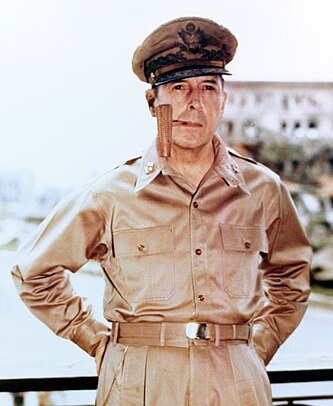
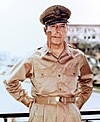
“I graduated on June 13, number 4 in a class of 102. General MacArthur gave me my diploma and his "Congratulations, Mr. Taylor" was the last time I heard his voice until, as the new Chief of Staff of the Army, I called on him in the Waldorf Towers in 1956. Although he had done much for the Corps of Cadets during his superintendency, oddly enough he had never made an effort to impress his personality on the cadets through direct communication with them. I do not ever recall his having made a speech to us and only a few cadets were ever asked to his house. Certainly no graduate has left greater evidence of deep affection for West Point and the Corps than MacArthur, but the cadets saw little of this during his superintendency.”
Unsourced — Primary work/page citation not yet verified in the QuotesCosmos archive. Per our Unnamed Sources & Verification Policy, quotes without confirmed primary editions are explicitly marked Unsourced while under editorial review.
Quotes About Maxwell D. Taylor
Gain deeper perspective through quotes about Maxwell D. Taylor from others.
Stephen E. Ambrose on Maxwell D. Taylor
“On Christmas Day, the Germans attacked again, but fortunately for E Company on the other side of Bastogne. The following day, Patton's Third Army, spearheaded by Lt. Col. Creighton Abrams of the 37th Tank Battalion, broke through the German lines. The 101st was no longer surrounded; it now had ground communications with the American supply dumps. Soon trucks were bringing in adequate supplies of food, medicine, and ammunition. The wounded were evacuated to the rear. General Taylor returned. He inspected the front lines, according to Winters, "very briskly. His instructions before leaving us were, 'Watch those woods in front of you!' What the hell did he think we had been doing while he was in Washington?" (Winters has a thing about Taylor. In one interview he remarked, "And now you have General Taylor coming back from his Christmas vacation in Washington..." I interrupted to say, "That's not quite fair." "Isn't it?" "Well, he was ordered back to testify..." Winters cut me off: "I don't want to be fair.")”
Unsourced — Primary work/page citation not yet verified in the QuotesCosmos archive. Per our Unnamed Sources & Verification Policy, quotes without confirmed primary editions are explicitly marked Unsourced while under editorial review.
Frances FitzGerald on Maxwell D. Taylor
“Taylor exhibited his imperial drive toward the client in the South in an even more obvious way than he suggested toward the enemy in the North. In an extraordinary example of imperial language, Taylor, reprimanding the Young Turks in Saigon- Ky, Thieu, Thi, and Cang- for attempting a coup in December 1964, told them: "Do all of you understand English? (Vietnamese officials indicating they did, although the understanding of General Thi was known to be weak.) I told all of you clearly at General Westmoreland's dinner, we Americans are tired of coups. Apparently, I wasted my words. Maybe this is because something is wrong with my French because you evidently did not understand. I made it clear that all military plans which I know you would like to carry out are dependent on government stability. Now you have made a real mess. We cannot carry you forever if you do things like this. Who speaks for the group? Do you have a spokesman?"”
Unsourced — Primary work/page citation not yet verified in the QuotesCosmos archive. Per our Unnamed Sources & Verification Policy, quotes without confirmed primary editions are explicitly marked Unsourced while under editorial review.
Edward "Babe" Heffron on Maxwell D. Taylor
“After Christmas, General Taylor came back and took over as commander, but nobody wanted to see Taylor. Here, the guy's the commander of the 101st Airborne, and he took time off to go and have Christmas dinner in Virginia. When we found out he was in Virginia, we couldn't believe our general had left us in a spot like that, and we didn't want to hear no excuses. The guys resented it. Oh, they did, too! Nobody liked Taylor after that.”
Unsourced — Primary work/page citation not yet verified in the QuotesCosmos archive. Per our Unnamed Sources & Verification Policy, quotes without confirmed primary editions are explicitly marked Unsourced while under editorial review.
Douglas Kinnard on Maxwell D. Taylor 2 quotes
“From late May to late June, when home on R and R, Taylor had learned that the 101st would be shifted to the war in the Pacific. On rejoining the division, he toured individual units to muster support for the move. He ended one speech with: "We've licked the best that Hitler had in France and Holland and Germany. Now where do we want to go?" It inspired the only mass incident of insubordination, although jocular, faced by Maxwell Taylor as commander. His beloved Screaming Eagles screamed, "Home!"- no doubt punctuated by a few catcalls and Bronx cheers.”
Unsourced — Primary work/page citation not yet verified in the QuotesCosmos archive. Per our Unnamed Sources & Verification Policy, quotes without confirmed primary editions are explicitly marked Unsourced while under editorial review.
Lam Quang Thi on Maxwell D. Taylor 2 quotes
“On June 23, 1964, President Johnson announced the appointment of Gen. Maxwell Taylor as U.S. ambassador to Viet Nam. General Taylor was a former Chairman of the U.S. Joint Chiefs of Staff and military advisor to President Kennedy. General Taylor's appointment underscored the importance of the U.S. government attached to the military situation in South Viet Nam. This also meant that the U.S. would apply a new strategy in the fight against the Viet Cong. General Taylor, in fact, wrote a book, The Uncertain Trumpet, in which he developed what was called the strategy of "Graduated Response." This strategy would allow the U.S. to respond in kind to Communist aggression without resorting to nuclear warfare. The flexibility of this strategy would provide the U.S. with the option at any time to "proceed or not, to escalate or not, and to quicken the pace or not." General Taylor also saw Viet Nam as a welcome opportunity to test his concept of limited war. This concept was adopted by President Kennedy. Based on this concept, President Kennedy created the famous Special Forces for the specific purpose of helping Third World countries fight against what was called brush fire or unconventional warfare against Communist insurgencies.”
Unsourced — Primary work/page citation not yet verified in the QuotesCosmos archive. Per our Unnamed Sources & Verification Policy, quotes without confirmed primary editions are explicitly marked Unsourced while under editorial review.


About Maxwell D. Taylor
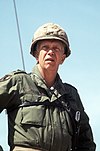
Maxwell Davenport "Max" Taylor (August 26, 1901 – April 19, 1987) was a senior United States Army officer and U.S. diplomat of the mid-20th century, who served as the fifth Chairman of the Joint Chiefs of Staff after having been appointed by President John F. Kennedy. He is the father of military historian and author Thomas Happer Taylor.