Link Copied!
Malcolm X Quotes (1925-1965)
Activist
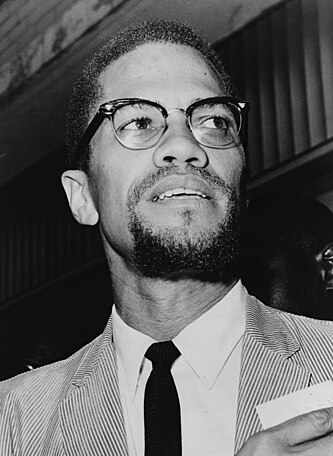
-100px.jpg)

















-100px.png)


















About Malcolm X
El-Hajj Malik El-Shabazz, or Malcolm X, born Malcolm Little (19 May 1925 – 21 February 1965) was an American Muslim minister and a human rights activist. For many years, he was a major proponent of the Nation of Islam, espousing black supremacy, the separation of black and white Americans, and scoffing at the civil rights movement's emphasis on racial integration. By March 1964, he had grown disillusioned with the Nation of Islam and ultimately repudiated its teachings, embracing Sunni Islam; while continuing to emphasize Pan-Africanism, black self-determination, and black self-defense, disavowing racism. In February 1965, he was assassinated by three men, all of whom were affiliated with the Nation of Islam. The Autobiography of Malcolm X, published shortly after his death, is considered one of the most influential non-fiction books of the 20th century.
Best Malcolm X Quotes
Shortest
Earliest
Explore our curated collection of the most famous and impactful Malcolm X quotes.
“Any time you see someone more successful than you are, they are doing something you aren't.”
- Malcolm X, 1965, The Autobiography of Malcolm X

“If you're not ready to die for it, take the word "freedom" out of your vocabulary.”

“Power in defense of freedom is greater than power in behalf of tyranny and oppression.”
- Malcolm X, 1965, Malcolm X Speaks

“The only true world solution today is governments guided by true religion — of the spirit.”
- Malcolm X, 1965, The Autobiography of Malcolm X

“The political philosophy of black nationalism means: we must control the politics and the politicians of our community.”
- Malcolm X, 1965, Malcolm X Speaks

“Concerning non-violence: it is criminal to teach a man not to defend himself when he is the constant victim of brutal attacks.”
- Malcolm X, 1965, Malcolm X Speaks
“It's impossible for a white person to believe in capitalism and not believe in racism. You can't have capitalism without racism.”
- Malcolm X, 1965, Malcolm X Speaks

“As I say, if we bring up religion we'll have differences; we'll have arguments; and we'll never be able to get together.”
- Malcolm X, 1964, Speech in Detroit, Michigan

“You're not to be so blind with patriotism that you can't face reality. Wrong is wrong, no matter who does it or says it.”

“I have no mercy or compassion in me for a society that will crush people, and then penalize them for not being able to stand up under the weight.”
- Malcolm X, 1965, The Autobiography of Malcolm X

“To me the earth's most explosive and pernicious evil is racism, the inability of God's creatures to live as One, especially in the Western world.”
- Malcolm X, 1965, The Autobiography of Malcolm X
“I for one will join with anyone—I don't care what color you are—as long as you want to change the miserable condition that exists on this earth.”
- Malcolm X, By Any Means Necessary
“It is a time for martyrs now, and if I am to be one, it will be for the cause of brotherhood. That's the only thing that can save this country.”

Maya Angelou frequently cited this empathetic call for understanding, urging listeners to remember their own learning journeys before judging others' perspectives.
“Don't be in such a hurry to condemn a person because he doesn't do what you do, or think as you think or as fast. There was a time when you didn't know what you know today.”
“It'll be the ballot or it'll be the bullet. It'll be liberty or it'll be death. And if you're not ready to pay that price don't use the word freedom in your vocabulary.”
- Malcolm X, 1964, Speech in Detroit, Michigan


“The question tonight, as I understand it, is "The Negro Revolt, and Where Do We Go From Here? or What Next?" In my little humble way of understanding it, it points toward either the ballot or the bullet.”
- Malcolm X, 1964, Speech in Cleveland, Ohio

“I want Dr. King to know that I didn't come to Selma to make his job difficult. I really did come thinking I could make it easier. If the white people realize what the alternative is, perhaps they will be more willing to hear Dr. King.”

“They [America] don't practice what they preach, whereas South Africa preaches and practices the same thing. I have more respect for a man who lets me know where he stands, even if he's wrong, than the one who comes up like an angel and is nothing but a devil.”
- Malcolm X, 1964)
“I've had enough of someone else's propaganda. I'm for truth, no matter who tells it. I'm for justice, no matter who it's for or against. I'm a human being first and foremost, and as such I am for whoever and whatever benefits humanity as a whole.”
- Malcolm X, 1965, The Autobiography of Malcolm X

“Armed with the knowledge of our past, we can with confidence charter a course for our future. Culture is an indispensable weapon in the freedom struggle. We must take hold of it and forge the future with the past.”
- Malcolm X, By Any Means Necessary

“There is nothing in our book, the Qur'an, that teaches us to suffer peacefully. Our religion teaches us to be intelligent. Be peaceful, be courteous, obey the law, respect everyone; but if someone lays a hand on you, send him to the cemetery. That's a good religion.”
- Malcolm X, 1965, Malcolm X Speaks
“I don't believe in any form of unjustified extremism! But when a man is exercising extremism — a human being is exercising extremism — in defense of liberty for human beings it's no vice, and when one is moderate in the pursuit of justice for human beings I say he is a sinner.”
- Malcolm X, 1964)

“I believe in the brotherhood of man, all men, but I don't believe in brotherhood with anybody who doesn't want brotherhood with me. I believe in treating people right, but I'm not going to waste my time trying to treat somebody right who doesn't know how to return the treatment.”
“Zionist Israel's occupation of Arab Palestine has forced the Arab world to waste billions of precious dollars on armaments, making it impossible for these newly independent Arab nations to concentrate on strengthening the economies of their countries and elevate the living standard of their people.”
- Malcolm X, 1964, Malcolm X on Zionism
“If you stick a knife in my back nine inches and pull it out six inches, there's no progress. If you pull it all the way out that's not progress. Progress is healing the wound that the blow made. And they haven't even pulled the knife out much less heal the wound. They won't even admit the knife is there.”
- Malcolm X, 1964)

“Whether we are Christians or Muslims or nationalists or agnostics or atheists, we must first learn to forget our differences. If we have differences, let us differ in the closet; when we come out in front, let us not have anything to argue about until we get finished arguing with the man.”
- Malcolm X, 1964, Speech in Cleveland, Ohio
“Education is an important element in the struggle for human rights. It is the means to help our children and our people rediscover their identity and thereby increase their self respect. Education is our passport to the future, for tomorrow belongs only to the people who prepare for it today.”
- Malcolm X, By Any Means Necessary

“You and I, 22 million African-Americans — that's what we are — Africans who are in America. You're nothing but Africans. Nothing but Africans. In fact, you'd get farther calling yourself African instead of Negro. Africans don't catch hell. You're the only one catching hell. They don't have to pass civil-rights bills for Africans.”
- Malcolm X, 1964, Speech in Cleveland, Ohio
“I believe in recognizing every human being as a human being, neither white, black, brown nor red. When you are dealing with humanity as one family, there's no question of integration or intermarriage. It's just one human being marrying another human being, or one human being living around and with another human being.”

“Black people are fed up with the dillydallying, pussyfooting, compromising approach that we've been using toward getting our freedom. We want freedom now, but we're not going to get it saying "We Shall Overcome". We've got to fight until we overcome.”
- Malcolm X, 1964, Speech in Cleveland, Ohio
“I do believe that there will be a clash between East and West. I believe that there will be a clash between those who want freedom, justice and equality for everyone and those who want to continue the systems of exploitation. I believe that there will be that kind of clash, but I don't think that it will be based upon the color of the skin....”
- Malcolm X, 1965, Malcolm X Speaks
“We must understand the politics of our community and we must know what politics is supposed to produce. We must know what part politics play in our lives. And until we become politically mature we will always be mislead, lead astray, or deceived or maneuvered into supporting someone politically who doesn't have the good of our community at heart.”
- Malcolm X, 1964, Speech in Detroit, Michigan

“Anybody that gives even a just criticism of the Jew is instantly labeled antisemite. The Jew cries louder than anybody else if anybody criticizes him. You can tell the truth about any minority in America, but make a true observation about the Jew, and if it doesn't pat him on the back, then he uses his grip on the news media to label you anti-Semite.”
- Malcolm X, 1963)
“The problem facing our people here in America is bigger than all other personal or organizational differences. Therefore as leaders, we must stop worrying about the threat we seem to think we pose to each other's personal prestige; and concentrate our united efforts towards solving the unending hurt that is being done daily to our people here in America.”
- Malcolm X, 1965, Malcolm X Speaks
“I am surprised that the trouble has been contained to the degree it has. Until two years ago, New York City used wiser methods than any other city to deal with racial problems. Now it is a case of outright scare tactics. This won't work, because the Negro is not afraid. If the tactics are not changed, this could escalate into something very, very serious.”
- Malcolm X, 1964)
“By the way, right at that time Birmingham had exploded, and the Negroes in Birmingham—remember, they also exploded. They began to stab the crackers in the back and bust them up 'side their head—yes, they did. That's when Kennedy sent in the troops, down in Birmingham. So, and right after that, Kennedy got on the television and said "this is a moral issue."”
- Malcolm X, 1963, Message to the Grass Roots
“On that same plantation, there was the field Negro. The field Negroes — those were the masses. There were always more Negroes in the field than there were Negroes in the house. The Negro in the field caught hell. He ate leftovers. In the house they ate high up on the hog. The Negro in the field didn't get anything but what was left of the insides of the hog.”
- Malcolm X, 1965, Malcolm X Speaks
“I believe in the brotherhood of all men, but I don't believe in wasting brotherhood on anyone who doesn't want to practice it with me. Brotherhood is a two-way street.http://malcolmxfiles.blogspot.com/2013/07/harvard-law-school-forum-december-16.html”
- Malcolm X, 1964)
“If it doesn't take senators and congressmen and presidential proclamations to give freedom to the white man, it is not necessary for legislation or proclamation or Supreme Court decisions to give freedom to the Black man. You let that white man know, if this is a country of freedom, let it be a country of freedom; and if it's not a country of freedom, change it.”
- Malcolm X, 1964, Speech in Cleveland, Ohio
“It takes heart to be a guerrilla warrior because you're on your own. In conventional warfare you have tanks and a whole lot of other people with you to back you up—planes over your head and all that kind of stuff. But a guerrilla is on his own. All you have is a rifle, some sneakers and a bowl of rice, and that's all you need—and a lot of heart.”
- Malcolm X, 1964, Speech in Cleveland, Ohio

“A fox and a wolf are both canine, both belong to the dog family. Now you take your choice. You going to choose a Northern dog or a Southern dog? Because either dog you choose, I guarantee you'll still be in the dog house. This is why I say it's the ballot or the bullet. It's liberty or it's death. It's freedom for everybody or freedom for nobody.”
- Malcolm X, 1964, Speech in Detroit, Michigan
“If a dog is biting a black man, the black man should kill the dog, whether the dog is a police dog or a hound dog or any kind of dog. If a dog is fixed on a black man when that black man is doing nothing but trying to take advantage of what the government says is supposed to be his, then that black man should kill that dog or any two-legged dog who sets the dog on him.”
“I don't usually deal with those big words because I don't usually deal with big people. I deal with small people. I find you can get a whole lot of small people and whip hell out of a whole lot of big people. They haven't got anything to lose, and they've got every thing to gain. And they'll let you know in a minute: "It takes two to tango; when I go, you go."”
- Malcolm X, 1964, Speech in Cleveland, Ohio
“In the past, yes, I have made sweeping indictments of all white people. I will never be guilty of that again — as I know now that some white people are truly sincere, that some truly are capable of being brotherly toward a black man. The true Islam has shown me that a blanket indictment of all white people is as wrong as when whites make blanket indictments against blacks.”

“Ignorance of each other is what has made unity impossible in the past. Therefore we need enlightenment. We need more light about each other. Light creates understanding, understanding creates love, love creates patience, and patience creates unity. Once we have more knowledge (light) about each other, we will stop condemning each other and a United front will be brought about.”
- Malcolm X, Date unverified)

“Since I learned the truth in Mecca, my dearest friends have come to include all kinds — some Christians, Jews, Buddhists, Hindus, agnostics, and even atheists! I have friends who are called capitalists, Socialists, and Communists! Some of my friends are moderates, conservatives, extremists — some are even Uncle Toms! My friends today are black, brown, red, yellow, and white!”
- Malcolm X, 1965, The Autobiography of Malcolm X
“There can be no black-white unity until there is first some black unity. There can be no workers' solidarity until there is first some racial solidarity. We cannot think of uniting with others, until after we have first united among ourselves. We cannot think of being acceptable to others until we have first proven acceptable to ourselves. One can't unite bananas with scattered leaves.”
- Malcolm X, 1964)
“I told the Englishman that my alma mater was books, a good library. Every time I catch a plane, I have with me a book that I want to read—and that's a lot of books these days. If I weren't out here every day battling the white man, I could spend the rest of my life reading, just satisfying my curiosity—because you can hardly mention anything I'm not curious about.”
- Malcolm X, 1965, The Autobiography of Malcolm X

“Historically, revolutions are bloody. Oh, yes, they are. They haven't never had a bloodless revolution, or a nonviolent revolution. That don't happen even in Hollywood. You don't have a revolution in which you love your enemy, and you don't have a revolution in which you are begging the system of exploitation to integrate you into it. Revolutions overturn systems. Revolutions destroy systems.”
- Malcolm X, 1964, Speech in Detroit, Michigan

“The political, the economic philosophy of Black Nationalism only means that we have to become involved in a program of re-education to educate our people into the importance of knowing that when you spend your dollar out of the community in which you live, the community in which you spend your money becomes richer and richer; the community out of which you take your money becomes poorer and poorer.”
- Malcolm X, 1964, Speech in Detroit, Michigan

“In Asia or the Arab world or in Africa, where the Muslims are, if you find one who says he's white, all he's doing is using an adjective to describe something that is incidental about him.... There is nothing else to it. He's just white. But when you get the white man over here in America and he says he's white, he means something else. You can listen to the sound of his voice when he says he's white. He means he's boss.”
- Malcolm X, 1965, Malcolm X Speaks
“Usually, when people are sad, they don't do anything. They just cry over their condition. But when they get angry, they bring about a change. When they get angry, they aren't interested in logic, aren't interested in odds, aren't interested in consequences. When they get angry, they realize the condition that they're in- that their suffering is unjust... and that anything they do to correct it... they're justified.”
- Malcolm X, 1965, Malcolm X Speaks
“Once you change your philosophy, you change your thought pattern. Once you change your thought pattern, you change your — your attitude. Once you change your attitude, it changes your behavior pattern and then you go on into some action. As long as you gotta sit-down philosophy, you’ll have a sit-down thought pattern, and as long as you think that old sit-down thought you’ll be in some kind of sit-down action.”
- Malcolm X, 1964, Speech in Detroit, Michigan

“Usually the black racist has been produced by the white racist. In most cases where you see it, it is the reaction to white racism, and if you analyze it closely, it's not really black racism... If we react to white racism with a violent reaction, to me that's not black racism. If you come to put a rope around my neck and I hang you for it, to me that's not racism. Yours is racism, but my reaction has nothing to do with racism...”
- Malcolm X, 1965, Malcolm X Speaks
“If violence is wrong in America, violence is wrong abroad. If it's wrong to be violent defending black women and black children and black babies and black men, then it's wrong for America to draft us and make us violent abroad in defense of her. And if it is right for America to draft us, and teach us how to be violent in defense of her, then it is right for you and me to do whatever is necessary to defend our own people right here in this country.”
- Malcolm X, 1965, Malcolm X Speaks
“If violence is wrong in America, violence is wrong abroad. If it is wrong to be violent defending black women and black children and black babies and black men, then it is wrong for America to draft us and make us violent abroad in defense of her. And if it is right for America to draft us, and teach us how to be violent in defense of her, then it is right for you and me to do whatever is necessary to defend our own people right here in this country.”
- Malcolm X, 1963, Message to the Grass Roots
“I say again that I'm not a racist, I don't believe in any form of segregation or anything like that. I'm for the brotherhood of everybody, but I don't believe in forcing brotherhood upon people who don't want it. Long as we practice brotherhood among ourselves, and then others who want to practice brotherhood with us, we practice it with them also, we're for that. But I don't think that we should run around trying to love somebody who doesn't love us.”
- Malcolm X, 1965)
“The next day I was in my car driving along the freeway when at a red light another car pulled alongside. A white woman was driving and on the passenger's side, next to me, was a white man. "Malcolm X!" he called out-and when I looked, he stuck his hand out of his car, across at me, grinning. "Do you mind shaking hands with a white man?" Imagine that! Just as the traffic light turned green, I told him, "I don't mind shaking hands with human beings. Are you one?"”
- Malcolm X, 1965, The Autobiography of Malcolm X
“Whether you are a Christian, or a Muslim, or a Nationalist, we all have the same problem. They don't hang you because you're a Baptist; they hang you ‘cause you’re black. They don’t attack me because I’m a Muslim; they attack me ‘cause I’m black. They attack all of us for the same reason -- all of us catch hell from the same enemy. We’re all in the same bag, in the same boat. We suffer political oppression, economic exploitation, and social degradation all of them from the same enemy.”
- Malcolm X, 1964, Speech in Detroit, Michigan

“The political philosophy of black nationalism means that the black man should control the politics and the politicians in his own community; no more. The black man in the black community has to be re-educated into the science of politics so he will know what politics is supposed to bring him in return. Don't be throwing out any ballots. A ballot is like a bullet. You don't throw your ballots until you see a target, and if that target is not within your reach, keep your ballot in your pocket.”
- Malcolm X, 1964, Speech in Cleveland, Ohio
“No, I'm not an American. I'm one of the 22 million black people who are the victims of Americanism. One of the 22 million black people who are the victims of democracy, nothing but disguised hypocrisy. So, I'm not standing here speaking to you as an American, or a patriot, or a flag-saluter, or a flag-waver—no, not I. I'm speaking as a victim of this American system. And I see America through the eyes of the victim. I don't see any American dream; I see an American nightmare.”
- Malcolm X, 1964, Speech in Cleveland, Ohio
“If Martin Luther King, Roy Wilkins or any of these compromising Negros who say exactly what the white man wants to hear is interviewed anywhere in the country you don't get anybody to offset what they say. But whenever a black man stands up and says something that white people don't like then the first thing that man does is run around to try and find somebody to say something to offset what has just been said. This is natural but it is done.”
- Malcolm X, Date unverified)

“I'm not going to sit at your table and watch you eat, with nothing on my plate, and call myself a diner. Sitting at the table doesn't make you a diner, unless you eat some of what's on that plate. Being here in America doesn't make you an American. Being born here in America doesn't make you an American. Why, if birth made you American, you wouldn't need any legislation; you wouldn't need any amendments to the Constitution; you wouldn't be faced with civil-rights filibustering in Washington, D.C., right now.”
- Malcolm X, 1964, Speech in Cleveland, Ohio
“When you take your case to Washington, D.C., you're taking it to the criminal who's responsible; it's like running from the wolf to the fox. They're all in cahoots together. They all work political chicanery and make you look like a chump before the eyes of the world. Here you are walking around in America, getting ready to be drafted and sent abroad, like a tin soldier, and when you get over there, people ask you what are you fighting for, and you have to stick your tongue in your cheek. No, take Uncle Sam to court, take him before the world.”
- Malcolm X, 1964, Speech in Cleveland, Ohio

“The modern 20th century weapon of neo-imperialism is "dollarism." The Zionists have mastered the science of dollarism: the ability to come posing as a friend and benefactor, bearing gifts and all other forms of economic aid and offers of technical assistance. Thus, the power and influence of Zionist Israel in many of the newly "independent" African nations has fast-become even more unshakeable than that of the 18th century European colonialists... and this new kind of Zionist colonialism differs only in form and method, but never in motive or objective.”
- Malcolm X, 1964, Malcolm X on Zionism
“A vote for a Democrat is a vote for a Dixiecrat. That's why, in 1964, it's time now for you and me to become more politically mature and realize what the ballot is for; what we're supposed to get when we cast a ballot; and that if we don't cast a ballot, it's going to end up in a situation where we're going to have to cast a bullet. It's either a ballot or a bullet.”
- Malcolm X, 1964, Speech in Cleveland, Ohio
Malcolm X criticized President Kennedy's civil rights actions as motivated by political expediency and international image, rather than genuine moral conviction.
“President Kennedy did not send troops to Alabama when dogs were biting black babies. He waited three weeks until the situation exploded. He then sent troops after the Negroes had demonstrated their ability to defend themselves. In his talk with Alabama editors Kennedy did not urge that Negroes be treated right because it is the right thing to do. Instead, he said that if the Negroes aren't well treated the Muslims would become a threat. He urged a change not because it is right but because the world is watching this country. Kennedy is wrong because his motivation is wrong.”
- Malcolm X, 1963)
“It is impossible for capitalism to survive, primarily because the system of capitalism needs some blood to suck. Capitalism used to be like an eagle, but now it's more like a vulture. It used to be strong enough to go and suck anybody's blood whether they were strong or not. But now it has become more cowardly, like the vulture, and it can only suck the blood of the helpless. As the nations of the world free themselves, capitalism has less victims, less to suck, and it becomes weaker and weaker. It's only a matter of time in my opinion before it will collapse completely....”
- Malcolm X, 1965, Malcolm X Speaks
“So those of us whose political, and economic, and social philosophy is black nationalism have become involved in the civil rights struggle. We have injected ourselves into the civil rights struggle, and we intend to expand it from the level of civil rights to the level of human rights. As long as you're fighting on the level of civil rights, you're under Uncle Sam's jurisdiction. You're going to his court expecting him to correct the problem. He created the problem. He's the criminal. You don't take your case to the criminal; you take your criminal to court.”
- Malcolm X, 1964, Speech in Detroit, Michigan

“Did the Zionists have the legal or moral right to invade Arab Palestine, uproot its Arab citizens from their homes and seize all Arab property for themselves just based on the "religious" claim that their forefathers lived there thousands of years ago? Only a thousand years ago the Moors lived in Spain. Would this give the Moors of today the legal and moral right to invade the Iberian Peninsula, drive out its Spanish citizens, and then set up a new Moroccan nation ... where Spain used to be, as the European zionists have done to our Arab brothers and sisters in Palestine?...”
- Malcolm X, 1964, Malcolm X on Zionism

“We are African, and we happened to be in America. We're not American. We are people who formerly were Africans who were kidnapped and brought to America. Our forefathers weren't the Pilgrims. We didn't land on Plymouth Rock. The rock was landed on us. We were brought here against our will. We were not brought here to be made citizens. We were not brought here to enjoy the constitutional gifts that they speak so beautifully about today.”
- Malcolm X, 1964)
“The field Negro was beaten from morning to night; he lived in a shack, in a hut; he wore old, castoff clothes. He hated his master. I say he hated his master. He was intelligent. That house Negro loved his master, but that field Negro — remember, they were in the majority, and they hated the master. When the house caught on fire, he didn't try to put it out; that field Negro prayed for a wind, for a breeze. When the master got sick, the field Negro prayed that he'd die. If someone came to the field Negro and said, "Let's separate, let's run," he didn't say, "Where we going?" He'd say, "Any place is better than here."”
- Malcolm X, 1965, Malcolm X Speaks
“If I take the wages of everyone here, individually it means nothing, but collectively all of the earning power or wages that you earned in one week would make me wealthy. And if I could collect it for a year, I'd be rich beyond dreams. Now, when you see this, and then you stop and consider the wages that were kept back from millions of Black people, not for one year but for 310 years, you'll see how this country got so rich so fast. And what made the economy as strong as it is today. And all that slave labor that was amassed in unpaid wages, is due someone today. And you're not giving us anything when we say that it's time to collect.”
- Malcolm X, Date unverified)

Malcolm X, in a 1964 television interview, asserts that begging for civil rights will never achieve true freedom, demanding that Black Americans be willing to die for it.
“No Negro leaders have fought for civil rights; they have begged for civil rights. They have begged the white man for civil rights. They have begged the white man for freedom. And anytime you beg another man to set you free, you'll never be free. Freedom is something that you have to do for yourselves. And until the American Negro lets the white man know that we are really ready and willing to pay the price that is necessary for freedom, our people will always be walking around here second-class citizens or what you call twentieth-century slaves. [Interviewer asked Malcolm, "What price are you talking about, sir?"] The price of freedom is death.”
- Malcolm X, 1964)
“I don't mean go out and get violent; but at the same time you should never be nonviolent unless you run into some nonviolence. I'm nonviolent with those who are nonviolent with me. But when you drop that violence on me, then you've made me go insane, and I'm not responsible for what I do. And that's the way every Negro should get. Any time you know you're within the law, within your legal rights, within your moral rights, in accord with justice, then die for what you believe in. But don't die alone. Let your dying be reciprocal. This is what is meant by equality. What's good for the goose is good for the gander.”
- Malcolm X, 1964, Speech in Cleveland, Ohio
“This modern house Negro loves his master. He wants to live near him. He'll pay three times as much as the house is worth just to live near his master, and then brag about "I'm the only Negro out here." "I'm the only one on my job." "I'm the only one in this school." You're nothing but a house Negro. And if someone comes to you right now and says, "Let's separate," you say the same thing that the house Negro said on the plantation. "What you mean, separate? From America, this good white man? Where you going to get a better job than you get here?" I mean, this is what you say. "I ain't left nothing in Africa," that's what you say. Why, you left your mind in Africa.”
- Malcolm X, 1965, Malcolm X Speaks

Malcolm X's telegram to George Lincoln Rockwell in 1965 signaled a shift away from the Nation of Islam's non-violent stance, threatening retaliation against white supremacists harming civil rights activists.
“This is to warn you that I am no longer held in check from fighting white supremacists by Elijah Muhammad's separatist Black Muslim movement, and that if your present racist agitation against our people there in Alabama causes physical harm to Reverend King or any other black Americans who are only attempting to enjoy their rights as free human beings, that you and your Ku Klux Klan friends will be met with maximum physical retaliation from those of us who are not hand-cuffed by the disarming philosophy of nonviolence, and who believe in asserting our right of self-defense — by any means necessary.”
“And now you're facing a situation where the young Negro's coming up. They don't want to hear that "turn the-other-cheek" stuff, no. In Jacksonville, those were teenagers, they were throwing Molotov cocktails. Negroes have never done that before. But it shows you there's a new deal coming in. There's new thinking coming in. There's new strategy coming in. It'll be Molotov cocktails this month, hand grenades next month, and something else next month. It'll be ballots, or it'll be bullets. It'll be liberty, or it will be death. The only difference about this kind of death—it'll be reciprocal.”
- Malcolm X, 1964, Speech in Cleveland, Ohio
“Don't change the white man's mind—you can't change his mind, and that whole thing about appealing to the moral conscience of America—America's conscience is bankrupt. She lost all conscience a long time ago. Uncle Sam has no conscience. They don't know what morals are. They don't try and eliminate an evil because it's evil, or because it's illegal, or because it's immoral; they eliminate it only when it threatens their existence. So you're wasting your time appealing to the moral conscience of a bankrupt man like Uncle Sam. If he had a conscience, he'd straighten this thing out with no more pressure being put upon him. So it is not necessary to change the white man's mind.”
- Malcolm X, 1964, Speech in Cleveland, Ohio
“Lyndon B. Johnson is the head of the Democratic Party. If he's for civil rights, let him go into the Senate next week and declare himself. Let him go in there right now and declare himself. Let him go in there and denounce the Southern branch of his party. Let him go in there right now and take a moral stand—right now, not later. Tell him don't wait until election time. If he waits too long, brothers and sisters, he will be responsible for letting a condition develop in this country which will create a climate that will bring seeds up out of the ground with vegetation on the end of them looking like something these people never dreamed of. In 1964, it's the ballot or the bullet.”
- Malcolm X, 1964, Speech in Cleveland, Ohio
“The government has failed us; you can’t deny that. Anytime you live in the twentieth century, 1964, and you’re walking around here singing “We Shall Overcome,” the government has failed us. This is part of what’s wrong with you -- you do too much singing. Today it’s time to stop singing and start swinging. You can’t sing up on freedom, but you can swing up on some freedom. Cassius Clay can sing, but singing didn’t help him to become the heavyweight champion of the world; swinging helped him become the heavyweight champion.”
- Malcolm X, 1964, Speech in Detroit, Michigan

“As long as the white man sent you to Korea, you bled. He sent you to Germany, you bled. He sent you to the South Pacific to fight the Japanese, you bled. You bleed for white people, but when it comes to seeing your own churches being bombed and little black girls murdered, you haven't got any blood. You bleed when the white man says bleed; you bite when the white man says bite; and you bark when the white man says bark. I hate to say this about us, but it's true. How are you going to be nonviolent in Mississippi and Alabama, when your churches are being bombed, and your little girls are being murdered, and at the same time you are going to get violent with Hitler, and Tojo, and somebody else you don't even know?”
- Malcolm X, 1963, Message to the Grass Roots
“So our people not only have to be re-educated to the importance of supporting black business, but the black man himself has to be made aware of the importance of going into business. And once you and I go into business, we own and operate at least the businesses in our community. What we will be doing is developing a situation wherein we will actually be able to create employment for the people in the community. And once you can create some employment in the community where you live it will eliminate the necessity of you and me having to act ignorantly and disgracefully, boycotting and picketing some place else trying to beg him for a job. Anytime you have to rely upon your enemy for a job you're in bad shape.”
- Malcolm X, 1964, Speech in Detroit, Michigan
“When you expand the civil-rights struggle to the level of human rights, you can then take the case of the black man in this country before the nations in the UN. You can take it before the General Assembly. You can take Uncle Sam before a world court. But the only level you can do it on is the level of human rights. Civil rights keeps you under his restrictions, under his jurisdiction. Civil rights keeps you in his pocket. Civil rights means you're asking Uncle Sam to treat you right. Human rights are something you were born with. Human rights are your God-given rights. Human rights are the rights that are recognized by all nations of this earth. And any time any one violates your human rights, you can take them to the world court.”
- Malcolm X, 1964, Speech in Cleveland, Ohio
“If the master's house caught on fire, the house Negro would fight harder to put the blaze out than the master would. If the master got sick, the house Negro would say, "What's the matter, boss, we sick?" We sick! He identified himself with his master, more than his master identified with himself. And if you came to the house Negro and said, "Let's run away, let's escape, let's separate," the house Negro would look at you and say, "Man, you crazy. What you mean, separate? Where is there a better house than this? Where can I wear better clothes than this? Where can I eat better food than this?" That was that house Negro. In those days he was called a "house nigger." And that's what we call them today, because we've still got some house niggers running around here.”
- Malcolm X, 1965, Malcolm X Speaks
“Islam is my religion, but I believe my religion is my personal business. It governs my personal life, my personal morals. And my religious philosophy is personal between me and the God in whom I believe; just as the religious philosophy of these others is between them and the God in whom they believe. And this is best this way. Were we to come out here discussing religion, we'd have too many differences from the outstart and we could never get together. [...] If we bring up religion, we'll be in an argument, and the best way to keep away from arguments and differences, as I said earlier, put your religion at home in the closet. Keep it between you and your God. Because if it hasn't done anything more for you than it has, you need to forget it anyway.”
- Malcolm X, 1964, Speech in Detroit, Michigan
“I'm not here to argue or discuss anything that we differ about, because it's time for us to submerge our differences and realize that it is best for us to first see that we have the same problem, a common problem, a problem that will make you catch hell whether you're a Baptist, or a Methodist, or a Muslim, or a nationalist. Whether you're educated or illiterate, whether you live on the boulevard or in the alley, you're going to catch hell just like I am. We're all in the same boat and we all are going to catch the same hell from the same man. He just happens to be a white man. All of us have suffered here, in this country, political oppression at the hands of the white man, economic exploitation at the hands of the white man, and social degradation at the hands of the white man.”
- Malcolm X, 1964, Speech in Cleveland, Ohio
“Three hundred and ten years we worked in this country without a dime in return—I mean without a dime in return. You let the white man walk around here talking about how rich this country is, but you never stop to think how it got rich so quick. It got rich because you made it rich. [...] Not only did we give of our free labor, we gave of our blood. Every time he had a call to arms, we were the first ones in uniform. We died on every battlefield the white man had. We have made a greater sacrifice than anybody who's standing up in America today. We have made a greater contribution and have collected less. Civil rights, for those of us whose philosophy is black nationalism, means: "Give it to us now. Don’t wait for next year. Give it to us yesterday, and that’s not fast enough."”
- Malcolm X, 1964, Speech in Cleveland, Ohio

“So our next move is to take the entire civil rights struggle problems into the United Nations, and let the world see that Uncle Sam is guilty of violating the human rights of 22 million Afro-Americans... Uncle Sam . . . and still has the audacity or the nerve to stand up and represent himself as the leader of the free world. Not only is he a crook, he's a hypocrite. Here he is standing up in front of other people, Uncle Sam, with the blood of your and my mothers and fathers on his hands, with the blood dripping down his jaws like a bloody-jawed wolf, and still got the nerve to point his finger at other countries. You can't even get civil rights legislation. And this man has got the nerve to stand up and talk about South Africa, or talk about Nazi Germany, or talk about Deutschland.”
- Malcolm X, 1964, Speech in Detroit, Michigan
“The philosophy of black nationalism involves a re-education program in the black community in regards to economics. Our people have to be made to see that any time you take your dollar out of your community and spend it in a community where you don't live, the community where you live will get poorer and poorer, and the community where you spend your money will get richer and richer. [...] If we own the stores, if we operate the businesses, if we try and establish some industry in our own community, then we're developing to the position where we are creating employment for our own kind. Once you gain control of the economy of your own community, then you don't have to picket and boycott and beg some cracker downtown for a job in his business.”
- Malcolm X, 1964, Speech in Cleveland, Ohio
“A segregated school system produces children who, when they graduate, graduate with crippled minds. But this does not mean that a school is segregated because it's all black. A segregated school means a school that is controlled by people who have no real interest in it whatsoever. Let me explain what I mean. A segregated district or community is a community in which people live, but outsiders control the politics and the economy of that community. They never refer to the white section as a segregated community. It's the all-Negro section that's a segregated community. Why? The white man controls his own school, his own bank, his own economy, his own politics, his own everything, his own community; but he also controls yours. When you're under someone else's control, you're segregated.”
- Malcolm X, 1964, Speech in Cleveland, Ohio
“And 1964 looks like it might be the year of the ballot or the bullet. Why does it look like it might be the year of the ballot or the bullet? Because Negroes have listened to the trickery, and the lies, and the false promises of the white man now for too long. And they’re fed up. They’ve become disenchanted. They’ve become disillusioned. They’ve become dissatisfied, and all of this has built up frustrations in the black community that makes the black community throughout today more explosive than all of the atomic bombs the Russians can ever invent. Whenever you got a racial powder keg sitting in your lap, you’re in more trouble than if you had an atomic powder keg sitting in your lap. When a racial powder keg goes off, it doesn’t care who it knocks out the way. Understand this, it’s dangerous.”
- Malcolm X, 1964, Speech in Detroit, Michigan
“They call me "a teacher, a fomenter of violence." I would say point blank, "That is a lie. I'm not for wanton violence, I'm for justice." I feel that if white people were attacked by Negroes — if the forces of law prove unable, or inadequate, or reluctant to protect those whites from those Negroes — then those white people should protect and defend themselves from those Negroes, using arms if necessary. And I feel that when the law fails to protect Negroes from whites' attacks, then those Negroes should use arms if necessary to defend themselves. "Malcolm X advocates armed Negroes!" What was wrong with that? I'll tell you what's wrong. I was a black man talking about physical defense against the white man. The white man can lynch and burn and bomb and beat Negroes — that's all right: "Have patience"..."The customs are entrenched"..."Things will get better."”
- Malcolm X, 1965, The Autobiography of Malcolm X
“Any time Uncle Sam, with all his machinery for warfare, is held to a draw by some rice eaters, he's lost the battle. He had to sign a truce. America's not supposed to sign a truce. She's supposed to be bad. But she's not bad any more. She's bad as long as she can use her hydrogen bomb, but she can't use hers for fear Russia might use hers. Russia can't use hers, for fear that Sam might use his. So, both of them are weapon-less. They can't use the weapon because each's weapon nullifies the other's. So the only place where action can take place is on the ground. And the white man can't win another war fighting on the ground. Those days are over. The black man knows it, the brown man knows it, the red man knows it, and the yellow man knows it. So they engage him in guerrilla warfare. That's not his style. You've got to have heart to be a guerrilla warrior, and he hasn't got any heart.”
- Malcolm X, 1964, Speech in Cleveland, Ohio
“If you're afraid of black nationalism, you're afraid of revolution. And if you love revolution, you love black nationalism. To understand this, you have to go back to what the young brother here referred to as the house Negro and the field Negro back during slavery. There were two kinds of slaves, the house Negro and the field Negro. The house Negroes — they lived in the house with master, they dressed pretty good, they ate good because they ate his food — what he left. They lived in the attic or the basement, but still they lived near the master; and they loved the master more than the master loved himself. They would give their life to save the master's house — quicker than the master would. If the master said, "We got a good house here," the house Negro would say, "Yeah, we got a good house here." Whenever the master said "we," he said "we." That's how you can tell a house Negro.”
- Malcolm X, 1965, Malcolm X Speaks
“We have formed an organization known as the Organization of Afro-American Unity which has the same aim and objective to fight whoever gets in our way, to bring about the complete independence of people of African descent here in the Western Hemisphere, and first here in the United States, and bring about the freedom of these people by any means necessary.
That's our motto. We want freedom by any means necessary. We want justice by any means necessary. We want equality by any means necessary.
• Variant: We want one thing: We declare our right on this earth to be a man, to be a human being, to be respected as a human being, to be given the rights of a human being in this society, on this earth, in this day, which we intend to bring into existence by any means necessary.”
That's our motto. We want freedom by any means necessary. We want justice by any means necessary. We want equality by any means necessary.
• Variant: We want one thing: We declare our right on this earth to be a man, to be a human being, to be respected as a human being, to be given the rights of a human being in this society, on this earth, in this day, which we intend to bring into existence by any means necessary.”
- Malcolm X, By Any Means Necessary
“Adam Clayton Powell is a Christian minister, he's the head of the Abyssinian Baptist Church, but at the same time, he's more famous for his political struggling. And Dr. King is a Christian Minister, in Atlanta, Georgia, but he's become more famous for being involved in the civil rights struggle. There's another in New York, Reverend Galamison, I don't know if you've heard of him out here. He's a Christian Minister from Brooklyn, but has become famous for his fight against a segregated school system in Brooklyn. Reverend Clee, right here, is a Christian Minister, here in Detroit. He's the head of the Freedom Now Party. All of these are Christian Ministers, but they don't come to us as Christian Ministers. They come to us as fighters in some other category. I'm a Muslim minister the same as they are Christian Ministers. And I don't believe in fighting today in any one front, but on all fronts. In fact, I'm a black Nationalist Freedom Fighter.”
- Malcolm X, 1964, Speech in Detroit, Michigan
“The press is so powerful in its image-making role, it can make the criminal look like he's a the victim and make the victim look like he's the criminal. This is the press, an irresponsible press. It will make the criminal look like he's the victim and make the victim look like he's the criminal. If you aren't careful, the newspapers will have you hating the people who are being oppressed and loving the people who are doing the oppressing.
If you aren't careful, because I've seen some of you caught in that bag, you run away hating yourself and loving the man — while you're catching hell from the man. You let the man maneuver you into thinking that it's wrong to fight him when he's fighting you. He's fighting you in the morning, fighting you in the noon, fighting you at night and fighting you all in between, and you still think it's wrong to fight him back. Why? The press. The newspapers make you look wrong.”
If you aren't careful, because I've seen some of you caught in that bag, you run away hating yourself and loving the man — while you're catching hell from the man. You let the man maneuver you into thinking that it's wrong to fight him when he's fighting you. He's fighting you in the morning, fighting you in the noon, fighting you at night and fighting you all in between, and you still think it's wrong to fight him back. Why? The press. The newspapers make you look wrong.”
- Malcolm X, 1965)

“I'm no politician. I'm not even a student of politics. I'm not a Republican, nor a Democrat, nor an American, and got sense enough to know it. I'm one of the 22 million black victims of the Democrats, one of the 22 million black victims of the Republicans, and one of the 22 million black victims of Americanism. And when I speak, I don't speak as a Democrat, or a Republican, or an American. I speak as a victim of America's so-called democracy. You and I have never seen democracy; all we've seen is hypocrisy. When we open our eyes today and look around America, we see America not through the eyes of someone who has enjoyed the fruits of Americanism, we see through the eyes of someone who has been the victim of Americanism. We don't see any American dream; we've experienced only the American nightmare. We haven't benefited from America's democracy; we've only suffered from America's hypocrisy. And the generation that's coming up now can see it and are not afraid to say it.”
- Malcolm X, 1964, Speech in Detroit, Michigan

“You and I in America are faced not with a segregationist conspiracy, we're faced with a government conspiracy. Everyone who's filibustering is a senator—that's the government. Everyone who's finagling in Washington, D.C., is a congressman—that's the government. You don't have anybody putting blocks in your path but people who are a part of the government. The same government that you go abroad to fight for and die for is the government that is in a conspiracy to deprive you of your voting rights, deprive you of your economic opportunities, deprive you of decent housing, deprive you of decent education. You don't need to go to the employer alone, it is the government itself, the government of America, that is responsible for the oppression and exploitation and degradation of black people in this country. And you should drop it in their lap. This government has failed the Negro. This so-called democracy has failed the Negro. And all these white liberals have definitely failed the Negro.”
- Malcolm X, 1964, Speech in Cleveland, Ohio

“Today our people can see that we're faced with a government conspiracy. This government has failed us. The senators who are filibustering concerning your and my rights, that's the government. Don't say it's Southern senators. This is the government; this is a government filibuster. It's not a segregationist filibuster. It's a government filibuster. Any kind of activity that takes place on the floor of the Congress or the Senate, it's the government. Any kind of dillydallying, that's the government. Any kind of pussyfooting, that's the government. Any kind of act that's designed to delay or deprive you and me right now of getting full rights, that's the government that's responsible. And any time you find the government involved in a conspiracy to violate the citizenship or the civil rights of a people, then you are wasting your time going to that government expecting redress. Instead, you have to take that government to the World Court and accuse it of genocide and all of the other crimes that it is guilty of today.”
- Malcolm X, 1964, Speech in Detroit, Michigan
“A revolution is bloody, but America is in a unique position. She's the only country in history in a position actually to become involved in a bloodless revolution. The Russian revolution was bloody, Chinese revolution was bloody, French revolution was bloody, Cuban revolution was bloody, and there was nothing more bloody then the American Revolution. But today this country can become involved in a revolution that won't take bloodshed. All she's got to do is give the black man in this country everything that's due him, everything. I hope that the white man can see this, 'cause if he don't see it, you're finished. If you don't see it you're going to become involved in some action in which you don't have a chance. And we don't care anything about your atomic bomb; it's useless because other countries have atomic bombs. When two or three different countries have atomic bombs, nobody can use them, so it means that the white man today is without a weapon. If you want some action, you gotta come on down to Earth. And there's more black people on Earth than there are white people on Earth. The white man can never win another war on the ground. His days of war, victory, his reign, his days of ground victory are over.”
- Malcolm X, 1964, Speech in Detroit, Michigan
“It's just like when you've got some coffee that's too black, which means it's too strong. What you do? You integrate it with cream; you make it weak. If you pour too much cream in, you won't even know you ever had coffee. It used to be hot, it becomes cool. It used to be strong, it becomes weak. It used to wake you up, now it'll put you to sleep. This is what they did with the march on Washington. They joined it. They didn't integrate it; they infiltrated it. They joined it, became a part of it, took it over. And as they took it over, it lost its militancy. They ceased to be angry. They ceased to be hot. They ceased to be uncompromising. Why, it even ceased to be a march. It became a picnic, a circus. Nothing but a circus, with clowns and all. You had one right here in Detroit — I saw it on television — with clowns leading it, white clowns and black clowns. I know you don't like what I'm saying, but I'm going to tell you anyway. 'Cause I can prove what I'm saying. If you think I'm telling you wrong, you bring me Martin Luther King and A. Philip Randolph and James Farmer and those other three, and see if they'll deny it over a microphone.”
- Malcolm X, 1963, Message to the Grass Roots

“You put the government on the spot when you even mention Vietnam. They feel embarrassed — you notice that?... It's just a trap that they let themselves get into. ... But they're trapped, they can't get out. You notice I said 'they.' They are trapped, They can't get out. If they pour more men in, they'll get deeper. If they pull the men out, it's a defeat. And they should have known that in the first place. France had about 200,000 Frenchmen over there, and the most highly mechanized modern army sitting on this earth. And those little rice farmers ate them up, and their tanks, and everything else. Yes, they did, and France was deeply entrenched, had been there a hundred or more years. Now, if she couldn't stay there and was entrenched, why, you are out of your mind if you think Sam can get in over there. But we're not supposed to say that. If we say that, we're anti-American, or we're seditious, or we're subversive.... They put Diem over there. Diem took all their money, all their war equipment and everything else, and got them trapped. Then they killed him. Yes, they killed him, murdered him in cold blood, him and his brother, Madame Nhu's husband, because they were embarrassed. They found out that they had made him strong and he was turning against them.... You know, when the puppet starts talking back to the puppeteer, the puppeteer is in bad shape....”
- Malcolm X, 1965, Malcolm X Speaks
“At one or another college or university, usually in the informal gatherings after I had spoken, perhaps a dozen generally white-complexioned people would come up to me, identifying themselves as Arabian, Middle Eastern or North African Muslims who happened to be visiting, studying, or living in the United States. They had said to me that, my white-indicting statements notwithstanding, they felt I was sincere in considering myself a Muslim -- and they felt if I was exposed to what they always called "true Islam," I would "understand it, and embrace it." Automatically, as a follower of Elijah, I had bridled whenever this was said. But in the privacy of my own thoughts after several of these experiences, I did question myself: if one was sincere in professing a religion, why should he balk at broadening his knowledge of that religion?
Those orthodox Muslims whom I had met, one after another, had urged me to meet and talk with a Dr. Mahmoud Youssef Shawarbi. . . . Then one day Dr. Shawarbi and I were introduced by a newspaperman. He was cordial. He said he had followed me in the press; I said I had been told of him, and we talked for fifteen or twenty minutes. We both had to leave to make appointments we had, when he dropped on me something whose logic never would get out of my head. He said, "No man has believed perfectly until he wishes for his brother what he wishes for himself."”
Those orthodox Muslims whom I had met, one after another, had urged me to meet and talk with a Dr. Mahmoud Youssef Shawarbi. . . . Then one day Dr. Shawarbi and I were introduced by a newspaperman. He was cordial. He said he had followed me in the press; I said I had been told of him, and we talked for fifteen or twenty minutes. We both had to leave to make appointments we had, when he dropped on me something whose logic never would get out of my head. He said, "No man has believed perfectly until he wishes for his brother what he wishes for himself."”
- Malcolm X, 1964, Text of a letter written following his Hajj
“Whenever you're going after something that belongs to you, anyone who's depriving you of the right to have it is a criminal. Understand that. Whenever you are going after something that is yours, you are within your legal rights to lay claim to it. And anyone who puts forth any effort to deprive you of that which is yours, is breaking the law, is a criminal. And this was pointed out by the Supreme Court decision. It outlawed segregation. Which means segregation is against the law. Which means a segregationist is breaking the law. A segregationist is a criminal. You can't label him as anything other than that. And when you demonstrate against segregation, the law is on your side. The Supreme Court is on your side. Now, who is it that opposes you in carrying out the law? The police department itself. With police dogs and clubs. Whenever you demonstrate against segregation, whether it is segregated education, segregated housing, or anything else, the law is on your side, and anyone who stands in the way is not the law any longer. They are breaking the law; they are not representatives of the law.”
- Malcolm X, 1964, Speech in Cleveland, Ohio

“We need to expand the civil-rights struggle to a higher level—to the level of human rights. Whenever you are in a civil-rights struggle, whether you know it or not, you are confining yourself to the jurisdiction of Uncle Sam. No one from the outside world can speak out in your behalf as long as your struggle is a civil-rights struggle. Civil rights comes within the domestic affairs of this country. All of our African brothers and our Asian brothers and our Latin-American brothers cannot open their mouths and interfere in the domestic affairs of the United States. And as long as it's civil rights, this comes under the jurisdiction of Uncle Sam. But the United Nations has what's known as the charter of human rights; it has a committee that deals in human rights. You may wonder why all of the atrocities that have been committed in Africa and in Hungary and in Asia, and in Latin America are brought before the UN, and the Negro problem is never brought before the UN. This is part of the conspiracy. This old, tricky blue eyed liberal who is supposed to be your and my friend, supposed to be in our corner, supposed to be subsidizing our struggle, and supposed to be acting in the capacity of an adviser, never tells you anything about human rights. They keep you wrapped up in civil rights. And you spend so much time barking up the civil-rights tree, you don't even know there's a human-rights tree on the same floor.”
- Malcolm X, 1964, Speech in Cleveland, Ohio
“When this country here was first being founded there were 13 colonies. The whites were colonized. They were fed up with this taxation without representation, so some of them stood up and said “Liberty or death.” Though I went to a white school over here in Mason, Michigan, the white man made the mistake of letting me read his history books. He made the mistake of teaching me that Patrick Henry was a patriot, and George Washington -- wasn’t nothing nonviolent about old Pat or George Washington. “Liberty or death” was what brought about the freedom of whites in this country from the English. They didn't care about the odds. Why they faced the wrath of the entire British Empire. And in those days they used to say that the British Empire was so vast and so powerful when the sun would never set on them. This is how big it was, yet these 13 little, scrawny states, tired of taxation without representation, tired of being exploited and oppressed and degraded, told that big British Empire “Liberty or death.” And here you have 22 million Afro-American black people today catching more hell than Patrick Henry ever saw. And I'm here to tell you, in case you don't know it, that you got a new generation of black people in this country who don't care anything whatsoever about odds. They don't want to hear you old Uncle Tom handkerchief heads talking about the odds. No. This is a new generation. If they're gonna draft these young black men and send them over to Korea or South Vietnam to face 800 million Chinese — if you're not afraid of those odds, you shouldn't be afraid of these odds.”
- Malcolm X, 1964, Speech in Detroit, Michigan
“Each hour here in the Holy Land enables me to have greater spiritual insights into what is happening in America between black and white. The American Negro never can be blamed for his racial animosities -- he is only reacting to four hundred years of the conscious racism of the American whites. But as racism leads America up the suicide path I do believe, from the experiences that I have had with them, that the whites of the younger generation, in the colleges and universities, will see the handwriting on the wall and many of them will turn to the spiritual path of truth -- the only way left to America to ward off the disaster that racism inevitably must lead to. . . .
I believe that God now is giving the world's so-called 'Christian' white society its last opportunity to repent and atone for the crimes of exploiting and enslaving the world's non-white peoples. It is exactly as when God gave Pharaoh a chance to repent. But Pharaoh persisted in his refusal to give justice to those who he oppressed. And, we know, God finally destroyed Pharaoh.
I will never forget the dinner at the Azzam home with Dr. Azzam. The more we talked, the more his vast reservoir of knowledge and its variety seemed unlimited. He spoke of the racial lineage of the descendants of Muhammad (PBUH) the Prophet, and he showed how they were both black and white. He also pointed out how color, and the problems of color which exist in the Muslim world, exist only where, and to the extent that, that area of the Muslim world has been influenced by the West. He said that if on encountered any differences based on attitude toward color, this directly reflected the degree of Western influence.”
I believe that God now is giving the world's so-called 'Christian' white society its last opportunity to repent and atone for the crimes of exploiting and enslaving the world's non-white peoples. It is exactly as when God gave Pharaoh a chance to repent. But Pharaoh persisted in his refusal to give justice to those who he oppressed. And, we know, God finally destroyed Pharaoh.
I will never forget the dinner at the Azzam home with Dr. Azzam. The more we talked, the more his vast reservoir of knowledge and its variety seemed unlimited. He spoke of the racial lineage of the descendants of Muhammad (PBUH) the Prophet, and he showed how they were both black and white. He also pointed out how color, and the problems of color which exist in the Muslim world, exist only where, and to the extent that, that area of the Muslim world has been influenced by the West. He said that if on encountered any differences based on attitude toward color, this directly reflected the degree of Western influence.”
- Malcolm X, 1964, Text of a letter written following his Hajj
“The pilgrimage to Mecca, known as the Hajj, is a religious obligation that every orthodox Muslim fulfills, if able, at least once in his or her lifetime.
The Holy Quran says it, "Pilgrimage to the House [of God built by the prophet Abraham] is a duty men owe to God; those who are able, make the journey." (3:97)
Allah said: "And proclaim the pilgrimage among men; they will come to you on foot and upon each lean camel, they will come from every deep ravine" (22:27).
Every one of the thousands at the airport, about to leave for Jeddah, was dressed this way. You could be a king or a peasant and no one would know. Some powerful personages, who were discreetly pointed out to me, had on the same thing I had on. Once thus dressed, we all had begun intermittently calling out "Labbayka! (Allahumma) Labbayka!" (Here I come, O Lord!) Packed in the plane were white, black, brown, red, and yellow people, blue eyes and blond hair, and my kinky red hair -- all together, brothers! All honoring the same God, all in turn giving equal honor to each other. . . .
That is when I first began to reappraise the "white man." It was when I first began to perceive that "white man," as commonly used, means complexion only secondarily; primarily it described attitudes and actions. In America,"white man" meant specific attitudes and actions toward the black man, and toward all other non-white men. But in the Muslim world, I had seen that men with white complexions were more genuinely brotherly than anyone else had ever been. That morning was the start of a radical alteration in my whole outlook about "white" men.”
The Holy Quran says it, "Pilgrimage to the House [of God built by the prophet Abraham] is a duty men owe to God; those who are able, make the journey." (3:97)
Allah said: "And proclaim the pilgrimage among men; they will come to you on foot and upon each lean camel, they will come from every deep ravine" (22:27).
Every one of the thousands at the airport, about to leave for Jeddah, was dressed this way. You could be a king or a peasant and no one would know. Some powerful personages, who were discreetly pointed out to me, had on the same thing I had on. Once thus dressed, we all had begun intermittently calling out "Labbayka! (Allahumma) Labbayka!" (Here I come, O Lord!) Packed in the plane were white, black, brown, red, and yellow people, blue eyes and blond hair, and my kinky red hair -- all together, brothers! All honoring the same God, all in turn giving equal honor to each other. . . .
That is when I first began to reappraise the "white man." It was when I first began to perceive that "white man," as commonly used, means complexion only secondarily; primarily it described attitudes and actions. In America,"white man" meant specific attitudes and actions toward the black man, and toward all other non-white men. But in the Muslim world, I had seen that men with white complexions were more genuinely brotherly than anyone else had ever been. That morning was the start of a radical alteration in my whole outlook about "white" men.”
- Malcolm X, 1964, Text of a letter written following his Hajj
“Last but not least, I must say this concerning the great controversy over rifles and shotguns. The only thing that I've ever said is that in areas where the government has proven itself either unwilling or unable to defend the lives and the property of Negroes, it's time for Negroes to defend themselves. Article number two of the constitutional amendments provides you and me the right to own a rifle or a shotgun. It is constitutionally legal to own a shotgun or a rifle. This doesn't mean you're going to get a rifle and form battalions and go out looking for white folks, although you'd be within your rights—I mean, you'd be justified; but that would be illegal and we don't do anything illegal. If the white man doesn't want the black man buying rifles and shotguns, then let the government do its job. [...] If he's not going to do his job in running the government and providing you and me with the protection that our taxes are supposed to be for, since he spends all those billions for his defense budget, he certainly can't begrudge you and me spending $12 or $15 for a single-shot, or double-action. I hope you understand. Don't go out shooting people, but any time—brothers and sisters, and especially the men in this audience; some of you wearing Congressional Medals of Honor, with shoulders this wide, chests this big, muscles that big—any time you and I sit around and read where they bomb a church and murder in cold blood, not some grownups, but four little girls while they were praying to the same God the white man taught them to pray to, and you and I see the government go down and can't find who did it.”
- Malcolm X, 1964, Speech in Cleveland, Ohio
“What is a Dixiecrat? A Democrat. A Dixiecrat is nothing but a Democrat in disguise. [...] The Dixiecrats in Washington, D.C., control the key committees that run the government. The only reason the Dixiecrats control these committees is because they have seniority. The only reason they have seniority is because they come from states where Negroes can't vote. This is not even a government that's based on democracy. It is not a government that is made up of representatives of the people. Half of the people in the South can't even vote. Eastland is not even supposed to be in Washington. Half of the senators and congressmen who occupy these key positions in Washington, D.C., are there illegally, are there unconstitutionally. These senators and congressmen actually violate the constitutional amendments that guarantee the people of that particular state or county the right to vote. And the Constitution itself has within it the machinery to expel any representative from a state where the voting rights of the people are violated. You don't even need new legislation. Any person in Congress right now, who is there from a state or a district where the voting rights of the people are violated, that particular person should be expelled from Congress. And when you expel him, you've removed one of the obstacles in the path of any real meaningful legislation in this country. In fact, when you expel them, you don't need new legislation, because they will be replaced by black representatives from counties and districts where the black man is in the majority, not in the minority.”
- Malcolm X, 1964, Speech in Cleveland, Ohio
“MALCOLM X: Freedom, justice and equality are our principal ambitions. And to faithfully serve and follow the Honorable Elijah Muhammad is the guiding goal of every Muslim. Mr. Muhammad teaches us the knowledge of our own selves, and of our own people. He cleans us up--morally, mentally and spiritually--and he reforms us of the vices that have blinded us here in the Western society. He stops black men from getting drunk, stops their dope addiction if they had it, stops nicotine, gambling, stealing, lying, cheating, fornication, adultery, prostitution, juvenile delinquency. I think of this whenever somebody talks about someone investigating us. Why investigate the Honorable Elijah Muhammad? They should subsidize him. He's cleaning up the mess that white men have made. He's saving the Government millions of dollars, taking black men off of welfare, showing them how to do something for themselves. And Mr. Muhammad teaches us love for our own kind. The white man has taught the black people in this country to hate themselves as inferior, to hate each other, to be divided against each other. Messenger Muhammad restores our love for our own kind, which enables us to work together in unity and harmony. He shows us how to pool our financial resources and our talents, then to work together toward a common objective. Among other things, we have small businesses in most major cities in this country, and we want to create many more. We are taught by Mr. Muhammad that it is very important to improve the black man's economy, and his thrift. But to do this, we must have land of our own. The brainwashed black man can never learn to stand on his own two feet until he is on his own. We must learn to become our own producers, manufacturers and traders; we must have industry of our own, to employ our own. The white man resists this because he wants to keep the black man under his thumb and jurisdiction in white society. He wants to keep the black man always dependent and begging--for jobs, food, clothes, shelter, education. The white man doesn't want to lose somebody to be supreme over. He wants to keep the black man where he can be watched and retarded. Mr. Muhammad teaches that as soon as we separate from the white man, we will learn that we can do without the white man just as he can do without us. The white man knows that once black men get off to themselves and learn they can do for themselves, the black man's full potential will explode and he will surpass the white man.”
“Never have I witnessed such sincere hospitality and the overwhelming spirit of true brotherhood as is practiced by people of all colors and races here in this ancient Holy Land, the House of Abraham, Muhammad, and all the other Prophets of the Holy Scriptures. For the past week, I have been utterly speechless and spellbound by the graciousness I see displayed all around me by people of all colors. . . .
You may be shocked by these words coming from me. But on this pilgrimage, what I have seen, and experienced, has forced me to rearrange much of my thought-patterns previously held, and to toss aside some of my previous conclusions. This was not too difficult for me. Despite my firm convictions, I have always been a man who tries to face facts, and to accept the reality of life as new experience and new knowledge unfolds it. I have always kept an open mind, which necessary to the flexibility that must go hand in hand with every form of intelligent search for truth.
During the past eleven days here in the Muslim world, I have eaten from the same plate, drunk from the same glass, and slept in the same bed (or on the same rug) -- while praying to the same God -- with fellow Muslims, whose eyes were the bluest of blue, whose hair was the blondest of blond, and whose skin was the whitest of white. And in the words and in the actions and in the deeds of the "white" Muslims, I felt the same sincerity that I felt among the black African Muslims of Nigeria, Sudan, and Ghana.
We were truly all the same (brothers) -- because their belief in one God had removed the "white" from their minds, the 'white' from their behavior, and the 'white' from their attitude.
I could see from this, that perhaps if white Americans could accept the Oneness of God, then perhaps, too, they could accept in reality the Oneness of Man -- and cease to measure, and hinder, and harm others in terms of their "differences" in color.
With racism plaguing America like an incurable cancer, the so-called "Christian" white American heart should be more receptive to a proven solution to such a destructive problem. Perhaps it could be in time to save America from imminent disaster -- the same destruction brought upon Germany by racism that eventually destroyed the Germans themselves.
They asked me what about the Hajj had impressed me the most. . . . I said, "The brotherhood! The people of all races, color, from all over the world coming to gether as one! It has proved to me the power of the One God. . . . All ate as one, and slept as one. Everything about the pilgrimage atmosphere accented the Oneness of Man under One God.”
You may be shocked by these words coming from me. But on this pilgrimage, what I have seen, and experienced, has forced me to rearrange much of my thought-patterns previously held, and to toss aside some of my previous conclusions. This was not too difficult for me. Despite my firm convictions, I have always been a man who tries to face facts, and to accept the reality of life as new experience and new knowledge unfolds it. I have always kept an open mind, which necessary to the flexibility that must go hand in hand with every form of intelligent search for truth.
During the past eleven days here in the Muslim world, I have eaten from the same plate, drunk from the same glass, and slept in the same bed (or on the same rug) -- while praying to the same God -- with fellow Muslims, whose eyes were the bluest of blue, whose hair was the blondest of blond, and whose skin was the whitest of white. And in the words and in the actions and in the deeds of the "white" Muslims, I felt the same sincerity that I felt among the black African Muslims of Nigeria, Sudan, and Ghana.
We were truly all the same (brothers) -- because their belief in one God had removed the "white" from their minds, the 'white' from their behavior, and the 'white' from their attitude.
I could see from this, that perhaps if white Americans could accept the Oneness of God, then perhaps, too, they could accept in reality the Oneness of Man -- and cease to measure, and hinder, and harm others in terms of their "differences" in color.
With racism plaguing America like an incurable cancer, the so-called "Christian" white American heart should be more receptive to a proven solution to such a destructive problem. Perhaps it could be in time to save America from imminent disaster -- the same destruction brought upon Germany by racism that eventually destroyed the Germans themselves.
They asked me what about the Hajj had impressed me the most. . . . I said, "The brotherhood! The people of all races, color, from all over the world coming to gether as one! It has proved to me the power of the One God. . . . All ate as one, and slept as one. Everything about the pilgrimage atmosphere accented the Oneness of Man under One God.”
- Malcolm X, 1964, Text of a letter written following his Hajj
Malcolm X Quotes by Topic
Find exactly what you are looking for by browsing this categorized list of Malcolm X quotes by topic.
Malcolm X on Freedom 7 quotes
“If you're not ready to die for it, take the word "freedom" out of your vocabulary.”
Malcolm X on United States 5 quotes
“If this is a country of freedom, let it be a country of freedom; and if it's not a country of freedom, change it.”

Malcolm X on Oppression 3 quotes
“Power in defense of freedom is greater than power in behalf of tyranny and oppression.”

Malcolm X on Integration 3 quotes
“We who follow the Honorable Elijah Muhammad feel that when you try and pass integration laws here in America, forcing white people to pretend that they are accepting black people, what you are doing is making white people act in a hypocritical way.”
Malcolm X on Love 2 quotes
View all 2 quotes on Love →What Malcolm X Said About Others
Discover personal opinions Malcolm X shared regarding contemporaries.
Malcolm X on John F. Kennedy 2 quotes
“By the way, right at that time Birmingham had exploded, and the Negroes in Birmingham—remember, they also exploded. They began to stab the crackers in the back and bust them up 'side their head—yes, they did. That's when Kennedy sent in the troops, down in Birmingham. So, and right after that, Kennedy got on the television and said "this is a moral issue."”

Malcolm X on John Brown (abolitionist)
Malcolm X on Thomas Jefferson
Malcolm X on Black people
Malcolm X on African Americans
“The common goal of 22 million Afro-Americans is respect as human beings, the God-given right to be a human being. Our common goal is to obtain the human rights that America has been denying us. We can never get civil rights in America until our human rights are first restored. We will never be recognized as citizens there until we are first recognized as humans.”

Quotes About Malcolm X
Gain deeper perspective through quotes about Malcolm X from others.
John Ali on Malcolm X
Cesar Chavez on Malcolm X
“If we criticize ourselves, then that begins to change things. I think groups that deal in power become impatient with groups who are strangers to power. I think even in individuals you can see this. A good example is Malcolm X. (I am reading his autobiography now.) When he talks about Uncle Toms, he puts it clearly. He's saying that these guys will go to work for the devil white man. He's saying a lot more (he doesn't make it clear but I'm sure this is his thinking), that the Negro thinks that if he gets ahead he is going to be getting his people ahead. Malcolm X knew about power although he didn't put it in those words. (Interviewer: Malcolm X had a tremendous effect on black organizers.) He knew what he was doing. They understood him, and they didn't understand the others. But he had a good base; he came right from the gutter so he wasn't compromised. The guys who don't come from the gutter have to compromise because they're going to school, they're getting a job, they're working for the government, all these little compromises which, by the time you get to be a leader, have got your hands tied up. You organize for power so that you can get something. You organize so that you can build power to do something with it, and so, when you look back, you've got to see some people out there doing something. What I'm trying to say is you can't organize by just speaking. The civil rights movement's biggest drawback is that they don't have a group that pays its own way. They don't have a membership group. This is the kind of power that is needed. Malcolm X was an organizer, but Stokely Carmichael is entirely different. I don't see any building. The approach that Malcolm X used was the house meeting. He was doing those things that we know pay: being patient and just accumulating, committing people and so forth. He's gone, but his spirit continues.”
Eldridge Cleaver on Malcolm X

Ossie Davis on Malcolm X
“Nobody knew better than he the power words have over minds of men. Malcolm had stopped being a "Negro" years ago. It had become too small, too puny, too weak a word for him. Malcolm was bigger than that. Malcolm had become an Afro-American and he wanted — so desperately — that we, that all his people, would become Afro-Americans too. There are those who will consider it their duty, as friends of the Negro people, to tell us to revile him, to flee, even from the presence of his memory, to save ourselves by writing him out of the history of our turbulent times. Many will ask what Harlem finds to honor in this stormy, controversial and bold young captain — and we will smile. Many will say turn away — away from this man, for he is not a man but a demon, a monster, a subverter and an enemy of the black man — and we will smile. They will say that he is of hate — a fanatic, a racist — who can only bring evil to the cause for which you struggle! And we will answer and say to them: Did you ever talk to Brother Malcolm? Did you ever touch him, or have him smile at you? Did you ever really listen to him? Did he ever do a mean thing? Was he ever himself associated with violence or any public disturbance? For if you did you would know him. And if you knew him you would know why we must honor him. Malcolm was our manhood, our living, black manhood! This was his meaning to his people. And, in honoring him, we honor the best in ourselves. Last year, from Africa, he wrote these words to a friend: "My journey", he says, "is almost ended, and I have a much broader scope than when I started out, which I believe will add new life and dimension to our struggle for freedom and honor and dignity in the States. I am writing these things so that you will know for a fact the tremendous sympathy and support we have among the African States for our Human Rights struggle. The main thing is that we keep a United Front wherein our most valuable time and energy will not be wasted fighting each other." However we may have differed with him — or with each other about him and his value as a man — let his going from us serve only to bring us together, now.”
Roxanne Dunbar-Ortiz Outlaw Woman on Malcolm X
“I was unprepared for the emotional effect that Malcolm X, and the setting itself, would have on me... At first, he seemed like a pastor, and I expected him to speak about god. But Malcolm did not talk about god at all. What he said changed my worldview. Malcolm pointed out that many well-meaning Americans believed in integration and that many had even risked their lives for that cause. He agreed that segregation laws should be struck down. However, he challenged the idea of integration through racial mixture, which would dilute blackness until Africans no longer existed as such. Malcolm called such a process "genocide," and claimed that the American system wanted to get rid of Africans by melting them down. He said that Africans were here to stay, and to exist as a people and a nation, not as separate individuals taking their place in the American melting pot and giving themselves over to the American dream, a dream that he said was in truth a nightmare. He said that Africans in the United States would determine their own future and would do so "by any means necessary." He said that the European was a blue-eyed white devil bent on destroying the African nation and that the African people would fight to the death to defend their right to be a people and to live as a nation. He spoke for an hour with no notes and few gestures in a modulated voice that was never raised in anger. He ended his speech and immediately left the room with a bodyguard in front and behind him. The students filed out, speaking quietly among themselves. I sat on the windowsill almost in a daze. The message was different from anything I'd ever heard.”




About Malcolm X
El-Hajj Malik El-Shabazz, or Malcolm X, born Malcolm Little (19 May 1925 – 21 February 1965) was an American Muslim minister and a human rights activist. For many years, he was a major proponent of the Nation of Islam, espousing black supremacy, the separation of black and white Americans, and scoffing at the civil rights movement's emphasis on racial integration. By March 1964, he had grown disillusioned with the Nation of Islam and ultimately repudiated its teachings, embracing Sunni Islam; while continuing to emphasize Pan-Africanism, black self-determination, and black self-defense, disavowing racism. In February 1965, he was assassinated by three men, all of whom were affiliated with the Nation of Islam. The Autobiography of Malcolm X, published shortly after his death, is considered one of the most influential non-fiction books of the 20th century.