The most important assumption was that Indian history was just a collection of unrelated events, like a series of migrations and conquests, owing their origin to external stimuli. It did not reveal the organic growth of a nation or a civilization, marking the stages of development or decline. The people are not an active force bringing about changes like the renaissance and reformation, or producing a revolution at some stage. It was a procession of exotic and colourful characters, autocratic kings and emperors just having their way without encountering resistance from the people. ...a long series of invasions…[acted] upon the unresponsive masses [and] political and historical upheavals [were] not products of conditions within society, representing certain trends or movements among the people. […] It was as though India was simply a geographical entity, providing an empty stage for odd characters to appear and move about for some time before their mysterious disappearance.
What It Means
This is a placeholder explanation generated by the low-overhead model. It interprets "The most important assumption was that Indian history was just a collection of unrelated events, like a series of migrations and conquests, owing their origin to external stimuli. It did not reveal the organic growth of a nation or a civilization, marking the stages of development or decline. The people are not an active force bringing about changes like the renaissance and reformation, or producing a revolution at some stage. It was a procession of exotic and colourful characters, autocratic kings and emperors just having their way without encountering resistance from the people. ...a long series of invasions…[acted] upon the unresponsive masses [and] political and historical upheavals [were] not products of conditions within society, representing certain trends or movements among the people. […] It was as though India was simply a geographical entity, providing an empty stage for odd characters to appear and move about for some time before their mysterious disappearance." in the context of "Narayanan, M.G.S., Chairman, Indian Council for Historical Research, The Eurocentric Approach to Indian History in Colonial and Communist Writing: the Case for Reinterpretation November 2001, New Delhi, text of speech available at: http://ifihhome.tripod.com/articles/mgs001.html , quoted from Rosser, Yvette Claire (2003). Curriculum as Destiny: Forging National Identity in India, Pakistan, and Bangladesh (). University of Texas at Austin." to mean that wisdom is timeless.
Tags
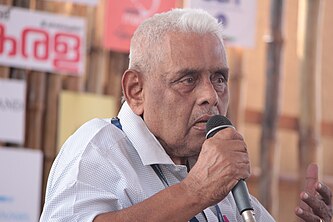
About M. G. S. Narayanan