Link Copied!
Klemens von Metternich Quotes (1773-1859)
President
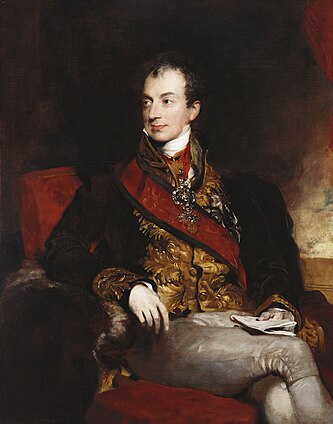

About Klemens von Metternich
Klemens Wenzel Nepomuk Lothar, Prince of Metternich-Winneburg zu Beilstein (15 May 1773 – 11 June 1859), was an Austrian diplomat who was at the center of European affairs for three decades as the Austrian Empire's foreign minister from 1809 and Chancellor from 1821 until the liberal Revolutions of 1848 forced his resignation.
Best Klemens von Metternich Quotes
Shortest
Earliest
Explore our curated collection of the most famous and impactful Klemens von Metternich quotes.
“Italy is only a geographical expression.”


“There is a wide sweep about my mind. I am always above and beyond the preoccupation of most public men; I cover a ground much vaster than they can see. I cannot keep myself from saying about twenty times a day: 'How right I am, and how wrong they are.'”
“Among the causes of the tremendous confusion characterising present-day Europe is the transplantation of British institutions to the Continent where they are in complete contradiction to existing conditions, so that their application becomes either illusory or distorted. The so-called "British school" has been the cause of the French Revolution, and the consequences of this revolution, so anti-British in tendency, devastate Europe today. The concepts of freedom and order are so inseparable in the British mind that the last stable-boy would laugh in the face of the reformers if they appeared by preaching his freedom.”

Klemens von Metternich Quotes by Topic
Find exactly what you are looking for by browsing this categorized list of Klemens von Metternich quotes by topic.
Klemens von Metternich on Policy
“[Policy] is like a play in many acts, which unfolds inevitably once the curtain is raised. To declare then that the performance will not take place is an absurdity. The play will go on, either by means of the actors … or by means of the spectators who mount the stage…. Intelligent people never consider this the essence of the problem, however. For them it lies in the decision whether the curtain is to be raised at all, whether the spectators are to be assembled and in the intrinsic quality of the play.”

What Klemens von Metternich Said About Others
Discover personal opinions Klemens von Metternich shared regarding contemporaries.
Klemens von Metternich on Robert Stewart, Viscount Castlereagh 2 quotes
“It is a great misfortune. The man is irreplaceable, especially for me... Castlereagh was the only person in his country who had experience in foreign affairs.”
Quotes About Klemens von Metternich
Gain deeper perspective through quotes about Klemens von Metternich from others.
Henry Kissinger on Klemens von Metternich
“Most people associate me with Metternich. And that is childish. My only connection with Metternich is a book I wrote: It was to be the first volume in a lengthy study of the construction and disintegration of international order in the 19th century. The series was to cover the whole period up to World War I, that's all.”

Lord Palmerston on Klemens von Metternich
“Prince Metternich thinks he is a conservative, in clinging obstinately to the status quo in Europe; we think ourselves conservative in preaching and advising everywhere concessions, reforms and improvements, where public opinion demands them; you on the contrary refuse them.”
A. J. P. Taylor on Klemens von Metternich
“Just as the fall of the Bastille launched the great French revolution, so the central European revolutions of 1848 were launched by a fall, in this case the fall of a single man, Prince Metternich, Chancellor of Austria since 1821 and the symbol of reaction and repression. On 13 March 1848 discontented aristocrats persuaded the Emperor to dismiss Metternich, and with this the conservative order collapsed.”

About Klemens von Metternich
Klemens Wenzel Nepomuk Lothar, Prince of Metternich-Winneburg zu Beilstein (15 May 1773 – 11 June 1859), was an Austrian diplomat who was at the center of European affairs for three decades as the Austrian Empire's foreign minister from 1809 and Chancellor from 1821 until the liberal Revolutions of 1848 forced his resignation.