Link Copied!
John of the Cross Quotes (1542-1591)
Poet
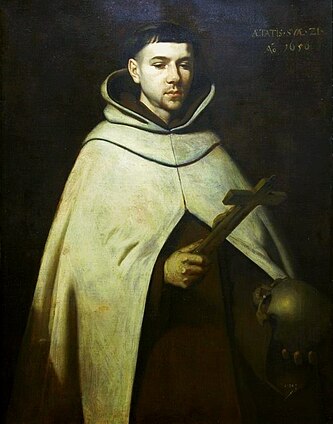

About John of the Cross
Saint John of the Cross, or San Juan de la Cruz (24 June 1542 – 14 December 1591) was a Spanish Carmelite mystic and poet.
Best John of the Cross Quotes
Shortest
Earliest
Explore our curated collection of the most famous and impactful John of the Cross quotes.
“If you wish to attain holy recollection, you will do so not by receiving but by denying.”
“Love consists not in feeling great things but in having great detachment and in suffering for the Beloved.”

“Blessed are they who, setting aside their own pleasure and inclination, consider things according to reason and justice before doing them.”

“Not all the faculties and senses have to be employed in things, but only those that are required; as for the others, leave them unoccupied for God.”
“Although you perform many works, if you do not deny your will and submit yourself, losing all solicitude about yourself and your affairs, you will not make progress.”
“We shall go at once
To the deep caverns of the rock
Which are all secret,
There we shall enter in
And taste of the new wine of the pomegranate. ~ 37”
To the deep caverns of the rock
Which are all secret,
There we shall enter in
And taste of the new wine of the pomegranate. ~ 37”
“The little white dove
Has returned to the ark with the bough;
And now the turtle-dove
Its desired mate
On the green banks has found. ~ 34”
Has returned to the ark with the bough;
And now the turtle-dove
Its desired mate
On the green banks has found. ~ 34”
John of the Cross Quotes by Topic
Find exactly what you are looking for by browsing this categorized list of John of the Cross quotes by topic.
John of the Cross on Religious views on love 11 quotes
“My sole occupation is love.”
John of the Cross on Appetite
“Those who let their appetites take hold of them suffer torture and affliction like an enemy held prisoner.”
John of the Cross on Virtue
“The appetites weaken a person's virtue because they are like shoots burgeoning about a tree, sapping its strength, and causing it to be fruitless.”
John of the Cross on Son of God
“I have said that God is pleased with nothing but love; but before I explain this, it will be as well to set forth the grounds on which the assertion rests. All our works, and all our labours, how grand soever they may be, are nothing in the sight of God, for we can give Him nothing, neither can we by them fulfil His desire, which is the growth of our soul. As to Himself He desires nothing of this, for He has need of nothing, and so, if He is pleased with anything it is with the growth of the soul; and as there is no way in which the soul can grow but in becoming in a manner equal to Him, for this reason only is He pleased with our love. It is the property of love to place him who loves on an equality with the object of his love. Hence the soul, because of its perfect love, is called the bride of the Son of God, which signifies equality with Him. In this equality and friendship all things are common, as the Bridegroom Himself said to His disciples: I have called you friends, because all things, whatsoever I have heard of my Father, I have made known to you.”
John of the Cross on Depression
“In this arid and dark night wherein He sets the soul, God has restrained its concupiscence and curbed its desire so that the soul cannot feed upon any pleasure or sweetness of sense, whether from above or from below; and this He continues to do after such manner that the soul is subjected, reformed and repressed with respect to concupiscence and desire. It loses the strength of its passions and concupiscence and it becomes sterile, because it no longer consults its likings. Just as, when none is accustomed to take milk from the breast, the courses of the milk are dried up, so the desires of the soul are dried up. And besides these things there follow admirable benefits from this spiritual sobriety, for, when desire and concupiscence are quenched, the soul lives in spiritual tranquillity and peace; for, where desire and concupiscence reign not, there is no disturbance, but peace and consolation of God. ... Finally, inasmuch as the soul is now purged from the affections and desires of sense, it obtains liberty of spirit, whereby in ever greater degree it gains the twelve fruits of the Holy Spirit. Here, too, it is wondrously delivered from the hands of its three enemies—devil, world and flesh; for, its pleasure and delight of sense being quenched with respect to all things, neither the devil nor the world nor sensuality has any arms or any strength wherewith to make war upon the spirit.”

Quotes About John of the Cross
Gain deeper perspective through quotes about John of the Cross from others.
Edgar Allison Peers on John of the Cross
“It is perhaps not an exaggeration to say that the verse and prose works combined of St. John of the Cross form at once the most grandiose and the most melodious spiritual canticle to which any one man has ever given utterance. The most sublime of all the Spanish mystics, he soars aloft on the wings of Divine love to heights known to hardly any of them. . . . True to the character of his thought, his style is always forceful and energetic, even to a fault. When we study his treatises — principally that great composite work known as the Ascent of Mount Carmel and the Dark Night — we have the impression of a mastermind that has scaled the heights of mystical science; and from their summit looks down upon and dominates the plain below and the paths leading upward.… Nowhere else, again, is he quite so appealingly human; for, though he is human even in his loftiest and sublimest passages, his intermingling of philosophy with mystical theology; makes him seem particularly so. These treatises are a wonderful illustration of the theological truth that grace far from destroying nature, ennobles and dignifies it, and of the agreement always found between the natural and the supernatural — between the principles of sound reason and the sublimest manifestations of Divine grace.”
Loreena McKennitt on John of the Cross
“May, 1993 — Stratford... have been reading through the poetry of 15th century Spain, and I find myself drawn to one by the mystic writer and visionary St. John of the Cross; the untitled work is an exquisite, richly metaphoric love poem between himself and his god. It could pass as a love poem between any two at any time … His approach seems more akin to early Islamic or Judaic works in its more direct route to communication to his god... I have gone over three different translations of the poem, and am struck by how much a translation can alter our interpretation. Am reminded that most holy scriptures come to us in translation, resulting in a diversity of views.”

Abbot on John of the Cross
“St John of the Cross is like a sponge full of Christianity: you can squeeze it all out and the full mystical theory remains. Consequently, for fifteen years or so I hated St. John of the Cross and called him a Buddhist. I loved St. Theresa and read her again and again. She is first a Christian, only secondarily a mystic. Then I found that I had wasted fifteen years so far as prayer was concerned.”
About John of the Cross
Saint John of the Cross, or San Juan de la Cruz (24 June 1542 – 14 December 1591) was a Spanish Carmelite mystic and poet.