Link Copied!
J. B. S. Haldane Quotes (1892-1964)
Scientist

About J. B. S. Haldane
John Burdon Sanderson Haldane (5 November 1892 – 1 December 1964) was a British geneticist and evolutionary biologist.
Best J. B. S. Haldane Quotes
Shortest
Earliest
Explore our curated collection of the most famous and impactful J. B. S. Haldane quotes.
“An inordinate fondness for beetles.”




“I have no doubt that in reality the future will be vastly more surprising than anything I can imagine.”
“I do not propose to argue the case for evolution, which I regard as being quite as well proven as most other historical facts, but to discuss its possible causes, which are certainly debatable.”
“At Oxford, the young Haldane was frequently asked whether he was related to the "famous John Scott Haldane", his father, and he would answer "That depends on whether you consider identity to be a relationship."”
“The conservative has little to fear from the man whose reason is the servant of his passions, but let him beware of him in whom reason has become the greatest and most terrible of passions. These are the wreckers of outworn empires.”

“You can drop a mouse down a thousand-yard mine shaft; and, on arriving at the bottom, it gets a slight shock and walks away. A rat would probably be killed, though it can fall safely from the eleventh story of a building; a man is killed, a horse splashes.”
“I suppose the process of acceptance will pass through the usual four stages:
(i) this is worthless nonsense;
(ii) this is an interesting, but perverse, point of view;
(iii) this is true, but quite unimportant;
(iv) I always said so.”
(i) this is worthless nonsense;
(ii) this is an interesting, but perverse, point of view;
(iii) this is true, but quite unimportant;
(iv) I always said so.”

“The change from one stable equilibrium to the other may take place as the result of the isolation of a small unrepresentative group of the population, a temporary change in the environment which alters the relative viability of different types, or in several other ways...”

“Now if we want poets to interpret physical science as Milton and Shelley did (Shelley and Keats were the last English poets who were at all up-to-date in their chemical knowledge), we must see that our possible poets are instructed, as their masters were, in science and economics.”

“The conservative has but little to fear from the man whose reason is the servant of his passions, but let him beware of him in whom reason has become the greatest and most terrible of the passions. These are the wreckers of outworn empires and civilisations, doubters, disintegrators, deiciders.”
“Now, my own suspicion is that the universe is not only queerer than we suppose, but queerer than we can suppose.....I suspect that there are more things in heaven and earth than are dreamed of, or can be dreamed of, in any philosophy. That is the reason why I have no philosophy myself, and must be my excuse for dreaming.”
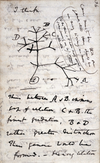
“We must... carefully distinguish between two quite different doctrines which Darwin popularised, the doctrine of evolution, and that of natural selection. It is quite possible to hold the first and not the second. Similarly with regard to the doctrines of Darwin's great contemporary Marx, it is possible to adopt socialism but not historical materialism.”
“It seems to me immensely unlikely that mind is a mere by-product of matter. For if my mental processes are determined wholly by the motions of atoms in my brain I have no reason to suppose that my beliefs are true. They may be sound chemically, but that does not make them sound logically. And hence I have no reason for supposing my brain to be composed of atoms.”
“While the geneticists were disproving many of Darwin's ideas, the palaeontologists were determining the actual historical facts of evolution. ...they were able to verify the law of succession, first explicitly given by Darwin's colleague Wallace. "Every species has come into existence coincident, both in time and space, with a pre-existing closely allied species."”

“Unaided common sense may indicate an equilibrium, but rarely, if ever, tells us whether it is stable. If much of the investigation here summarised has only proved the obvious, the obvious is worth proving when this can be done. And if the relative importance of selection and mutation is obvious, it has certainly not always been recognised as such.”
“My practice as a scientist is atheistic. That is to say, when I set up an experiment I assume that no god, angel, or devil is going to interfere with its course; and this assumption has been justified by such success as I have achieved in my professional career. I should therefore be intellectually dishonest if I were not also atheistic in the affairs of the world.”

“Comparative parasitology supports the evolutionary hypothesis. If two animals have a common ancestor, their parasites are likely to be descended from those of the ancestor. This principle has been applied with considerable effect to the classification of frogs and other groups.”
“If human evolution is to continue along the same lines as in the past, it will probably involve a still greater prolongation of childhood and retardation of maturity. Some of the characters distinguishing adult man will be lost. It was not an embryologist or palaeontologist who said, "Except ye . . . become as little children, ye shall not enter into the kingdom of heaven."”
“If the only available genes produce rather large changes, disadvantageous one at a time, then it seems to me probable that evolution will not occur in a random mating population. In a self-fertilised or highly inbred species it may do so if several mutations useful in conjunction, but separately harmful, occur simultaneously. Such an event is rare, but must happen reasonably often in wheat...”
“Liquid hydrogen is weight for weight the most efficient known method of storing energy, as it gives about three times as much heat per pound as petrol. ...[I]t is very light, and bulk for bulk has only one third of the efficiency of petrol. This will not, however, detract from its use in aeroplanes, where weight is more important than bulk.”
J. B. S. Haldane Quotes by Topic
Find exactly what you are looking for by browsing this categorized list of J. B. S. Haldane quotes by topic.
J. B. S. Haldane on Beetles
“An inordinate fondness for beetles.”
J. B. S. Haldane on Reality
J. B. S. Haldane on Science
“The tendency of applied science is to magnify injustices until they become too intolerable to be borne, and the average man whom all the prophets and poets could not move turns at last and extinguishes the evil at its source.”

J. B. S. Haldane on Sacrosanct
“The time has gone by when a Huxley could believe that while science might indeed remould traditional mythology, traditional morals were impregnable and sacrosanct to it. We must learn not to take traditional morals too seriously.”

J. B. S. Haldane on Christianity
“Christian mythology incorporated the cosmological theories current eighteen centuries ago. Dante found it a slight strain to combine this mythology with the facts known in his own day. Milton found it harder. Mr. Lewis finds it impossible.”

J. B. S. Haldane on Mental process
“It seems to me immensely unlikely that mind is a mere by-product of matter. For if my mental processes are determined wholly by the motions of atoms in my brain I have no reason to suppose that my beliefs are true. They may be sound chemically, but that does not make them sound logically. And hence I have no reason for supposing my brain to be composed of atoms.”
J. B. S. Haldane on Creationism
“I have given my reasons for thinking that we can probably explain evolution in terms of the capacity for variation of individual organisms, and the selection exercised on them by their environment. ... The most obvious alternative to this view is to hold that evolution has throughout been guided by divine power. There are two objections to this hypothesis. Most lines of descent end in extinction, and commonly the end is reached by a number of different lines evolving in parallel. This does not suggest the work of an intelligent designer, still less of an all mighty one. But the moral objection is perhaps more serious. A very large number of originally free-living Crustacea, worms, and so on, have evolved into parasites. In doing so they have lost, to a greater or less extent, their legs, eyes, and brains, and have become in many cases the cause of considerable and prolonged pain to other animals and to man. If we are going to take an ethical point of view at all (and we must do so when discussing theological questions), we are, I think, bound to place this loss of faculties coupled with increased infliction of suffering in the same class as moral breakdown in a human being, which can often be traced to genetical causes. To put the matter in a more concrete way, Blake expressed some doubt as to whether God had made the tiger. But the tiger is in many ways an admirable animal. We have now to ask whether God made the tapeworm. And it is questionable whether an affirmative answer fits in either with what we know about the process of evolution or what many of us believe about the moral perfection of God.”

What J. B. S. Haldane Said About Others
Discover personal opinions J. B. S. Haldane shared regarding contemporaries.
J. B. S. Haldane on Percy Bysshe Shelley
“Now if we want poets to interpret physical science as Milton and Shelley did (Shelley and Keats were the last English poets who were at all up-to-date in their chemical knowledge), we must see that our possible poets are instructed, as their masters were, in science and economics.”

Quotes About J. B. S. Haldane
Gain deeper perspective through quotes about J. B. S. Haldane from others.
Eric Hoffer on J. B. S. Haldane
“J. B. S. Haldane counts fanaticism among the only four really important inventions made between 3000 B.C and 1400 A.D. It was a Judaic-Christian invention. And it is strange to think that in receiving this malady of the soul the world also received a miraculous instrument for raising societies and nations from the dead—an instrument of resurrection.”

Jeffrey H. Schwartz on J. B. S. Haldane
“Although Haldane accepted the earlier and incorrect paleontological interpretation of the fossil record of Gryphaea, in his overall belief that the pace of evolution was rapid and seemingly discontinuous, rather than slow and continuous, he anticipated, at least in part and by three decades, the model of punctuated equilibria, which was proposed by... Niles Eldredge and Stephen Jay Gould.”
About J. B. S. Haldane
John Burdon Sanderson Haldane (5 November 1892 – 1 December 1964) was a British geneticist and evolutionary biologist.