John Maynard Keynes on Isaac Newton
← Back to Isaac Newton Profile
“Newton was not the first of the age of reason. He was the last of the magicians, the last of the Babylonians and Sumerians, the last great mind that looked out on the visible and intellectual world with the same eyes as those who began to build our intellectual inheritance rather less than 10,000 years ago. [...] [H]e looked on the whole universe and all that is in it as a riddle, as a secret which could be read by applying pure thought to certain evidence, certain mystic clues which God had laid about the world to allow a sort of philosopher's treasure hunt to the esoteric brotherhood. He believed that these clues were to be found partly in the evidence of the heavens and in the constitution of elements[...], but also partly in certain papers and traditions handed down by the brethren in an unbroken chain back to the original cryptic revelation in Babylonia.”
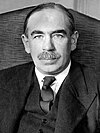
“In vulgar modern terms Newton was profoundly neurotic of a not unfamiliar type, but... a most extreme example. His deepest instincts were occult, esoteric, semantic — with profound shrinking from the world, a paralyzing fear of exposing his thoughts, his beliefs, his discoveries, in all nakedness to the inspection and criticism of the world. ...Until the second phase of his life, he was a wrapt, consecrated solitary, pursuing his studies by intense introspection.”
“His peculiar gift was the power of holding continuously in his mind a purely mental problem until he had seen straight through it. I fancy his pre-eminence is due to his muscles of intuition being the strongest and most enduring with which a man has ever been gifted. ... I believe that Newton could hold a problem in his head for hours and days and weeks until it surrendered to him its secret. Then being a supreme mathematical technician he could dress it up, how you will, for the purposes of exposition, but it was his intuition that was pre-eminently extraordinary.”