Cunningham's observations made in 1871/72 should be taken even more seriously because his impartiality would be beyond doubt. There would be no bias as between the Hindu and Muslim viewpoints . In the ASI report of those years he has written that the tomb of Sultan Chari, with its domes of overlapping courses, appears to be pre-Muhammadan, but when to this feature we add the other Hindu features, both of construction and ornamentation, the stones set without cement in the walls, the appearance of wear or weathering of the stones, greater even than in the Kutb, though similar in material, and the fact that the inner cell was originally finished in granite, but afterwards cased with marble, it becomes extremely probable that this is, like the Kutb, a Hindu building appropriated by the Muhammandans, and the probability is rendered almost a certainty by the existence of the central cell, which is a construction adapted to some Hindu forms of worship, the Saivic, but which is an anomaly in Muhammadan architecture.
What It Means
This is a placeholder explanation generated by the low-overhead model. It interprets "Cunningham's observations made in 1871/72 should be taken even more seriously because his impartiality would be beyond doubt. There would be no bias as between the Hindu and Muslim viewpoints . In the ASI report of those years he has written that the tomb of Sultan Chari, with its domes of overlapping courses, appears to be pre-Muhammadan, but when to this feature we add the other Hindu features, both of construction and ornamentation, the stones set without cement in the walls, the appearance of wear or weathering of the stones, greater even than in the Kutb, though similar in material, and the fact that the inner cell was originally finished in granite, but afterwards cased with marble, it becomes extremely probable that this is, like the Kutb, a Hindu building appropriated by the Muhammandans, and the probability is rendered almost a certainty by the existence of the central cell, which is a construction adapted to some Hindu forms of worship, the Saivic, but which is an anomaly in Muhammadan architecture." in the context of "Cunningham quoted from Goradia, P. (2002). Hindu masjids." to mean that wisdom is timeless.

Tags
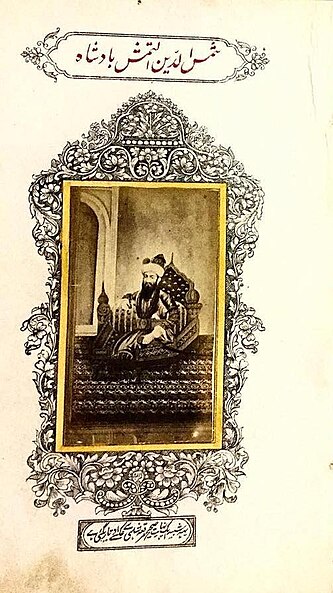
About Iltutmish