Iamblichus on Pythagoras
← Back to Iamblichus Profile
“Those who dwelt in the common auditorium adopted this oath: "I swear by the discoverer of the Tetraktys, which is the spring of all our wisdom; The perennial fount and root of Nature."”
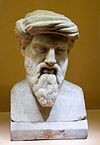
“No one will deny that the soul of Pythagoras was sent to mankind from Apollo's domain, having either been one of his attendants, or more intimate associates, which may be inferred both from his birth, and his versatile wisdom.”
“Pythagoras conceived that the first attention that should be given to men should be addressed to the senses, as when one perceives beautiful figures and forms, or hears beautiful rhythms and melodies. Consequently he laid down that the first erudition was that which subsists through music's melodies and rhythms, and from these he obtained remedies of human manners and passions, and restored the pristine harmony of the faculties of the soul.”
“The tetrad was called by the Pythagoreans every number, because it comprehends in itself all the numbers as far as to the decad, and the decad itself; for the sum of 1, 2, 3, and 4, is 10. Hence both the decad and the tetrad were said by them to be every number; the decad indeed in energy, but the tetrad in capacity. The sum likewise of these four numbers was said by them to constitute the tetractys, in which all harmonic ratios are included. For 4 to 1, which is a quadruple ratio, forms the symphony bisdiapason; the ratio of 3 to 2, which is sesquialter forms the symphony diapente; 4 to 3, which is sesquitertian, the symphony diatessaron; and 2 to 1, which is a duple ratio, forms the diapason.”
“After his father's death, though he was still but a youth, his aspect was so venerable, and his habits so temperate that he was honored and even reverenced by elderly men, attracting the attention of all who saw and heard him speak, creating the most profound impression. That is the reason that many plausibly asserted that he was a child of the divinity. Enjoying the privilege of such a renown, of an education so thorough from infancy, and of so impressive a natural appearance he showed that he deserved all these advantages by deserving them, by the adornment of piety and discipline, by exquisite habits, by firmness of soul, and by a body duly subjected to the mandates of reason. An inimitable quiet and serenity marked all his words and actions, soaring above all laughter, emulation, contention, or any other irregularity or eccentricity; his influence at Samos was that of some beneficent divinity. His great renown, while yet a youth, reached not only men as illustrious for their wisdom as Thales at Miletus, and Bias at Prione, but also extended to the neighboring cities. He was celebrated everywhere as the "long-haired Samian," and by the multitude was given credit for being under divine inspiration.”