Link Copied!
Hans Reichenbach Quotes (1891-1953)
Philosopher

About Hans Reichenbach
Hans Reichenbach (26 September 1891 – 9 April 1953) was a leading philosopher of science, educator and proponent of logical positivism.
Best Hans Reichenbach Quotes
Shortest
Earliest
Explore our curated collection of the most famous and impactful Hans Reichenbach quotes.
“...the order of betweenness does not depend on mutual distances... betweenness is purely a relational order.”
“This fact... proves that space measurements are reducible to time measurements. Time is therefore logically prior to space.”
“Once a definition of congruence is given, the choice of geometry is no longer in our hands; rather, the geometry is now an empirical fact.”
“Light signals alone provide the metrical structure of the four-dimensional space-time continuum. The construction may be called light axioms.
§ 29”

“We must... maintain that mathematical geometry is not a science of space insofar as we understand by space a visual structure that can be filled with objects - it is a pure theory of manifolds.”
“"If along the path of truth, success (which was often near-failure unnoticed) is subjected to the same scrutiny and desire for improvement as failure, we may find ourselves in closer proximity to trees."”

“...the mathematician uses an indirect definition of congruence, making use of the fact that the axiom of parallels together with an additional condition can replace the definition of congruence.”

“Occasionally one speaks... of signals or signal chains. It should be noted that the word signal means the transmission of signs and hence concerns the very principle of causal order...
§ 22”
“If the definition of simultaneity is given from a moving system, the spherical surface will result when Einstein's definition with є = 1/2 is used, since it is this definition which makes the velocity of light equal in all directions.”
“The concept of congruence in Euclidean geometry is not exactly the same as that in non-Euclidean geometry. ..."Congruent" means in Euclidean geometry the same as "determining parallelism," a meaning which it does not have in non-Euclidean geometry.”
“We can... treat only the geometrical aspects of mathematics and shall be satisfied in having shown that there is no problem of the truth of geometrical axioms and that no special geometrical visualization exists in mathematics.
§ 16”

“...the differential element of non-Euclidean spaces is Euclidean. This fact, however, is analogous to the relations between a straight line and a curve, and cannot lead to an epistemological priority of Euclidean geometry, in contrast to the views of certain authors.”
“Common to the two geometries is only the general property of one-to-one correspondence, and the rule that this correspondence determines straight lines as shortest lines as well as their relations of intersection.”
“...absolute time would exist in a causal structure for which the concept indeterminate as to time order lends to a unique simultaneity, i.e., for which there is no finite interval of time between the departure and return of a first-signal...
§ 25”
“For the Lorentz transformation spatial measurements are also changed, because they are obtained relative to a moving system. In our example only time was transformed, while the distances between points at rest remained the same; the spatial coordinates, therefore, retain their identity.
§ 27”
“Clocks are inherently four-dimensional instruments, since the endpoints of their unit distances are events. Measuring rods, on the other hand, are three-dimensional measuring instruments; their end points are space points and they can be changed into four-dimensional measuring instruments only if events are produced at their end points according to a special rule.
§ 31”
“If we wish to express our ideas in terms of the concepts synthetic and analytic, we would have to point out that these concepts are applicable only to sentences that can be either true of false, and not to definitions. The mathematical axioms are therefore neither synthetic nor analytic, but definitions. ...Hence the question of whether axioms are a priori becomes pointless since they are arbitrary.”
“Why is Einstein's theory better than Lorentz's theory? It would be a mistake to argue that Einstein's theory gives an explanation of Michelson's experiment, since it does not do so. Michelson's experiment is simply taken over as an axiom.
§ 32”

“Perceptual space is not a special space in addition to physical space, but physical space which we endow with a special subjective metric. ...apart from the definition of congruence in physics and that based on perception, there is no third one derived from pure visualization. Any such third definition is nothing but the definition of physical congruence to which our normative function has adjusted the subjective experience of congruence.”
“We define: any two events which are indeterminate as to their time order may be called simultaneous. ...Simultaneity means the exclusion of causal connection. ...Yet we must not commit the mistake of attempting to derive from it the conclusion that this definition coordinates to any given event at a given different place. This would be the case only for a special form of causal structure, a form that does not conform to physical reality.”
“Although it is admitted that certain differences cannot be verified by experiment, we should not infer from this fact that they do not exist. ...we are accused of having confused subjective inability with objective indeterminacy.
§ 12”

“We are frequently faced with the necessity of looking for the picture required for the visualization of an object, not in the perception of this particular object, but in a different perceptual image. ...we can assert the discrepancy between the perceived picture and the objective state. This discrepancy... proves absolutely nothing against the fact that all visualizations are merely sense qualities of the perceptual space. ...If the parallelism is ...to be visualized, we must supplement our assertion by the description of certain qualities with which we are familiar from perceptual space.”
“...the relation of betweenness on the torus is undetermined for curves that cannot be contracted to a point [e.g., circles around a doughnut hole], i.e., for three of such curves it is not uniquely determined which of them lies between the other two. ..This indeterminateness... has the consequence that such a curve [alone] does not divide the surface of the torus into two separate domains; between points to the "right" and to the "left" of the line.
§ 13”
“...introduce the auxiliary concept of first-signal...defined as the fastest message carrier between any two points in space. We now send a first-signal from P, calling the event of departure E1... The event of its arrival at P' is called E'. Simultaneously with the arrival of this signal, another first signal is sent from P'. The arrival of this signal at P is the event E2. ...the time interval between E1 and E2 is coordinated to the event E', [E1 is earlier than E' and E2 is later than E'] and every event of this time interval except for the endpoints is inderterminate as to the time order relative to E'.”
Hans Reichenbach Quotes by Topic
Find exactly what you are looking for by browsing this categorized list of Hans Reichenbach quotes by topic.
Hans Reichenbach on Definition 3 quotes
“Once a definition of congruence is given, the choice of geometry is no longer in our hands; rather, the geometry is now an empirical fact.”
Hans Reichenbach on Geometry 2 quotes
“Visual forms are not perceived differently from colors or brightness. They are sense qualities, and the visual character of geometry consists in these sense qualities.”
Hans Reichenbach on Visualization 2 quotes
“We are frequently faced with the necessity of looking for the picture required for the visualization of an object, not in the perception of this particular object, but in a different perceptual image. ...we can assert the discrepancy between the perceived picture and the objective state. This discrepancy... proves absolutely nothing against the fact that all visualizations are merely sense qualities of the perceptual space. ...If the parallelism is ...to be visualized, we must supplement our assertion by the description of certain qualities with which we are familiar from perceptual space.”
Hans Reichenbach on Holism
“Finiteness is a holistic property. The sphere as a whole has a character different from that of a plane. A spherical surface made from rubber, such as a balloon, can be twisted so that its geometry changes. ...but it cannot be distorted in such a way as that it will cover a plane. All surfaces obtained by distortion of the rubber sphere possess the same holistic properties; they are closed and finite.”

Hans Reichenbach on Image
“We are frequently faced with the necessity of looking for the picture required for the visualization of an object, not in the perception of this particular object, but in a different perceptual image. ...we can assert the discrepancy between the perceived picture and the objective state. This discrepancy... proves absolutely nothing against the fact that all visualizations are merely sense qualities of the perceptual space. ...If the parallelism is ...to be visualized, we must supplement our assertion by the description of certain qualities with which we are familiar from perceptual space.”

Hans Reichenbach on Philosophy of science
“The scientist who discovers a theory is usually guided to his discovery by guesses; he cannot name a method by means of which he found the theory and can only say that it appeared plausible to him, that he had the right hunch, or that he saw intuitively which assumptions would fit the facts. Some philosophers have misunderstood this psychological description of discovery as proving that there exists no logical relation leading from the facts to the theory... These philosophers do not see that the same scientist who discovered his theory through guessing presents it to others only after he sees that his guess is justified by the facts. ...The inductive inference is employed not for finding a theory but for justifying it in terms of observational data.”
Hans Reichenbach on Singularity
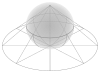
“...the stereographic projection of the spherical surface. From the north pole P we draw radial lines to project every point of the surface of the sphere upon the horizontal plane [below, perpendicular to a line joining it to P and the sphere's center]. In general this transformation is unique and continuous , although the metrical relations are distorted; for the point P, however, it shows a singularity. Point P is mapped upon the infinite; i.e., no finitely located point of the plane corresponds to it. It can be shown that every transformation possesses a singularity in at least one point. The surface of the sphere is therefore called topologically different from the plane. Only a "sphere without a north pole" [point] would be topologically equivalent to a plane. ...such a sphere has a point-shaped hole without a boundary and is no longer a closed surface.”
Hans Reichenbach on Speed of light
“* The principle of the limiting character of the velocity of light. This statement... is not an arbitrary assumption but a physical law based on experience. In making this statement, physics does not commit the fallacy of regarding absence of knowledge as evidence for knowledge to the contrary. It is not absence of knowledge of faster signals, but positive experience which has taught us that the velocity of light cannot be exceeded. For all physical processes the velocity of light has the property of an infinite velocity. In order to accelerate a body to the velocity of light, an infinite amount of energy would be required, and it is therefore physically impossible for any object to obtain this speed. This result was confirmed by measurements performed on electrons. The kinetic energy of a mass point grows more rapidly than the square of its velocity, and would become infinite for the speed of light.”

About Hans Reichenbach
Hans Reichenbach (26 September 1891 – 9 April 1953) was a leading philosopher of science, educator and proponent of logical positivism.