a waggon load of money will scarcely purchase a waggon load of provision." - Meaning and context.">
Letter to John Jay, 23 April 1779, Founders Online, National Archives. Source: The Papers of George Washington, Revolutionary War Series, vol. 20, 8 April–31 May 1779, ed. Edward G. Lengel. Charlottesville: University of Virginia Press, 2010, p. 177. Also found in The Life John Jay With Selections from His Correspondence and Miscellaneous Papers. by His Son, William Jay in Two Volumes, Vol. II., 1833

In the last place, though first in importance I shall ask—is there any thing doing, or that can be done to restore the credit of our currency? The depreciation of it is got to so alarming a point—that a waggon load of money will scarcely purchase a waggon load of provision.

— George Washington

What It Means

This is a placeholder explanation generated by the low-overhead model. It interprets "In the last place, though first in importance I shall ask—is there any thing doing, or that can be done to restore the credit of our currency? The depreciation of it is got to so alarming a point—that a waggon load of money will scarcely purchase a waggon load of provision." in the context of "Letter to John Jay, 23 April 1779, Founders Online, National Archives. Source: The Papers of George Washington, Revolutionary War Series, vol. 20, 8 April–31 May 1779, ed. Edward G. Lengel. Charlottesville: University of Virginia Press, 2010, p. 177. Also found in The Life John Jay With Selections from His Correspondence and Miscellaneous Papers. by His Son, William Jay in Two Volumes, Vol. II., 1833" to mean that wisdom is timeless.

Source: Wikiquote: "George Washington" (Quotes, 1770s) The 'What it means' explanation text was generated by Google Gemini Flash (accessed February 05, 2026). https://gemini.google.com/app
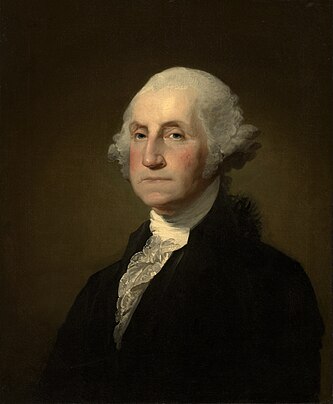
George Washington

About George Washington

George Washington (22 February 1732 – 14 December 1799) was an American military officer, statesman, and Founding Father who served as the first president of the United States from 1789 to 1797. Appointed by the Second Continental Congress as commander of the Continental Army in June 1775, Washington led Patriot forces to victory in the American Revolutionary War and then served as president of the Constitutional Convention in 1787, which drafted and ratified the Constitution of the United States and established the American federal government. Washington has thus been called the "Father of his Country".