Omar Bradley on George S. Patton
← Back to George S. Patton Profile
“I have attempted to write of my long association with George Patton as fairly and as honestly as I could. General Patton was one of my staunchest friends and the most unhesitatingly loyal of my commanders. He was a magnificent soldier, one whom the American people can admire not only as a great commander but as a unique and remarkable man. In recollecting our experiences together, I may offend those who prefer to remember Patton not as a human being but as a heroic-size statue in a public park. I prefer to remember Patton as a man, as a man with all the frailties and faults of a human being, as a man whose greatness is therefore all the more of a triumph.”
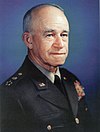
“Precisely at 7 Patton boomed in to breakfast. His vigor was always infectious, his wit barbed, his conversation a mixture of obscenity and good humor. He was at once stimulating and overbearing. George was a magnificent soldier.”
“Like Eisenhower, Patton ordinarily messed with a group of inmates from his headquarters. Breakfast was spirited and talkative. Patton picked up the GI holster in which I carried my 30-year-old Colt .45. "Hell, Brad," he said, "what you need is a social gun. You can't carry that cannon with you everywhere you go."”
“"Gentlemen," he said, looking about the dimly lighted room, "tomorrow we attack. If we are not victorious, let no one come back alive." With that, George excused himself and retired alone to his room to pray. These contradictions in Patton's character continued to bewilder his staff. For while he was profane, he was also reverent. And while he strutted imperiously as a commander, he knelt humbly before his God. And while that last appeal for victory even at the price of death was looked upon as a hammy gesture by his corps staff, it helped to make it more clearly apparent to them that to Patton war was a holy crusade.”
“I still could not accustom myself, however, to the vulgarity with which Patton skinned offenders for relatively minor infractions in discipline. Patton believed that profanity was the most convincing medium of communication to his troops. But while some chuckled delightedly over the famed expletives he employed with startling originality, the majority, it seemed to me, were more often shocked and offended. At times I felt like Patton, however successful he was as a corps commander, had not learned to command himself. The techniques of command vary, of course, with the personality of the commander. While some men prefer to lead by suggestion and example and other methods, Patton chose to drive his subordinates by bombast and by threats. Those mannerisms achieved spectacular results. But they were not calculated to win affection among his officers or men.”
“The September restrictions that we had applied to operations of the Third Army were more confining than those with which we later jacketed Hodges. To a man who abhorred defensive warfare with the scorn of George Patton, the shutdown came as a bitter and crushing blow. Until he died Patton never recanted on his contention that had priority in supply been given him instead of Monty and Hodges, Third Army could have broken through the Star defenses to the Rhine. At the same time Monty's proposal that Third Army be halted permanently on the Moselle while he tramped on to Berlin did nothing to appease Patton's unconcealed dislike for the British field marshal. Complete inactivity, however, proved too much to expect of Patton.”
“During this period Patton was uneasy and fretful; he padded about his Army like a caged tiger. When a corps commander whom he had disliked as a result of some earlier altercation bivouacked his command in the Third Army sector, George stomped over to the CP for a preliminary inspection. The more he saw of the new headquarters the angrier he became. While making his way through the schoolhouse CP, George tripped over the inert form of a dozing GI. Awakened by Patton's boot in his side, the soldier spluttered in the darkness. "Dammit you blockhead, watch your step. Can't you see I'm trying to sleep?" Patton caught his breath and roared, "Well you're the first silly sonuvabitch around this place that knows what he's trying to do."”