Link Copied!
Galen Quotes (129-216)
Writer, King


About Galen
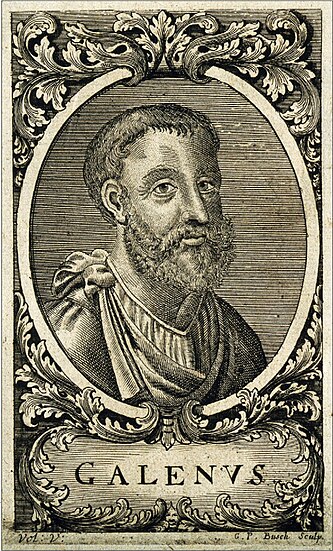
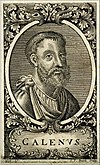
Claudius Galenus of Pergamum (129–c. 200/c. 216), better known as Galen, was a Greek physician and a writer on medicine and philosophy. His theories dominated European medicine for well over a millennium. Galen was the first physician/physiologist to ever announce that blood moves.
Best Galen Quotes
Shortest
Earliest
Explore our curated collection of the most famous and impactful Galen quotes.
“Quod optimus medicus sit quoque philosophus.”
“Employment is Nature's physician, and is essential to human happiness.”

“Triste est omne animale post coitum, praeter mulierem gallumque”
“That which is, grows, while that which is not, becomes.”
“Diogenes compared them to fig-trees growing over precipices; for their fruit was devoured by daws and crows, not by men.”


“Diogenes received an invitation to dine with one whose house was splendidly furnished, in the highest order and taste, and nothing therein wanting. Diogenes, hawking, and as if about to spit, looked in all directions, and finding nothing adapted thereto, spat right in the face of the master. He, indignant, asked why he did so? "Because," Diogenes, "I saw nothing so dirty and filthy in all your house. For the walls were covered with pictures, the floors of the most precious tessellated character — and ranged with the various images of gods, and other ornamental figures."”

“Diogenes the Cynic, it is related, was mighty of all people in regard to everything from self-control to endurance. He indulged in sexual lusts, not associating it with pleasure, an attractive good thing to some, but because of the harm that the retention of semen would cause if he avoided the habit of releasing it. When a prostitute who promised to visit him was delayed for some time, he rubbed his genitals with his hand, ejecting semen. After the whore arrived, he sent her away, saying: "my hand celebrated the wedding-hymn first." But it is clearly correct that, likewise, the disciplined man does not on account of pleasure indulge in lusts, but in order to relieve the hindrance acting as if this was not associated with pleasure.”

“A god, as I have said, commanded me to tell the first use also, and he himself knows that I have shrunk from its obscurity. He knows too that not only here but also in many other places in these commentaries, if it depended on me, I would omit demonstrations requiring astronomy, geometry, music, or any other logical discipline, lest my books should be held in utter detestation by physicians. For truly on countless occasions throughout my life I have had this experience; persons for a time talk pleasantly with me because of my work among the sick, in which they think me very well trained, but when they learn later on that I am also trained in mathematics, they avoid me for the most part and are no longer at all glad to be with me. Accordingly, I am always wary of touching on such subjects, and in this case it is only in obedience to the command of a divinity, as I have said, that I have used the theorems of geometry”

“It would be better, I think, for the man who really seeks the truth not to ask what the poets say; rather, he should first learn the method of finding the scientific premises that I discussed in the second book; then he should train and exercise himself in this method; and when his training is sufficiently advanced, then, as he approaches each particular problem, he should enquire into the premise needed for proving it, which premise he should take from simple sense-perception, which from experience, whether drawn from life or from the arts, which from the truths clearly apprehended by the mind, in order to draw out from them the desired conclusion.
• Galen, On the Doctrines of Hippocrates and Plato,: PHP III 8.35.1-11 translation: De Lacy, Phillip (1978- 1984) Galen, On the Doctrines of Hippocrates and Plato, Berlin. p. 233; cited in: Christopher Jon Elliott. "Galen, Rome and the Second Sophistic." p. 147-8.”
• Galen, On the Doctrines of Hippocrates and Plato,: PHP III 8.35.1-11 translation: De Lacy, Phillip (1978- 1984) Galen, On the Doctrines of Hippocrates and Plato, Berlin. p. 233; cited in: Christopher Jon Elliott. "Galen, Rome and the Second Sophistic." p. 147-8.”
Galen Quotes by Topic
Find exactly what you are looking for by browsing this categorized list of Galen quotes by topic.
Galen on Consciousness
“... the having is the knowing: Having conscious experience is knowing what it is. You don’t have to think about it (it’s really much better not to). You just have to have it. It’s true that people can make all sorts of mistakes about what is going on when they have experience, but none of them threaten the fundamental sense in which we know exactly what experience is just in having it.”

What Galen Said About Others
Discover personal opinions Galen shared regarding contemporaries.
Galen on Diogenes of Sinope 3 quotes
“Diogenes compared them to fig-trees growing over precipices; for their fruit was devoured by daws and crows, not by men.”


Galen on Clemens August Graf von Galen
“I encouraged them, each who was able, to serve the Fatherland...I have done this [volunteered] because I believe I must be a good example for my community.”

Quotes About Galen
Gain deeper perspective through quotes about Galen from others.
Francis Bacon on Galen
“This misplacing hath caused a deficience, or at least a great improficience in the sciences themselves. For the handling of final causes, mixed with the rest in physical inquiries, hath intercepted the severe and diligent inquiry of all real and physical causes, and given men the occasion to stay upon these satisfactory and specious causes, to the great arrest and prejudice of further discovery. For this I find done not only by Plato, who ever anchoreth upon that shore, but by Aristotle, Galen, and others which do usually likewise fall upon these flats of discoursing causes.”

Robert Boyle on Galen
“Galen himself, who was not unacquainted with Moses's writings, and with christianity, fancy'd the earth had a certain soul or mind imparted to it by the superior bodies.”

Maimonides on Galen
“Galen, in the third section of his book, "The Use of the Limbs," says correctly that it would be in vain to expect to see living beings formed of the blood of menstruous women and the semen virile, who will not die, will never feel pain, or will move perpetually, or shine like the sun. This dictum of Galen is part of the following more general proposition:—Whatever is formed of matter receives the most perfect form possible in that species of matter; in each individual case the defects are in accordance with that individual matter.”

William Hardy McNeill on Galen
“The laws of nature, as analyzed mathematically and descriptively by Ptolemy and Galen, bore an interesting, and perhaps not entirely accidental similarity to the law of nations and of nature, as discerned by a long succession of Roman jurists. ...The concept of an objective law applicable to human affairs, yet operating in accord with Nature and Reason and apart both from divine revelation and from human whim or passion, was peculiar to Rome and societies descended from Rome.”
Andrew Solomon on Galen
“The Roman physician Galen claimed that women could not conceive in rape—could not, in fact, conceive without an orgasm based in pleasure and consent.”

About Galen
Claudius Galenus of Pergamum (129–c. 200/c. 216), better known as Galen, was a Greek physician and a writer on medicine and philosophy. His theories dominated European medicine for well over a millennium. Galen was the first physician/physiologist to ever announce that blood moves.