In: p. 216.
“
Some birds flew with his only garment. He resolved to abandon his wife in the hope that she would return to her father’s court, so he divided her sole remaining garment while she slept and left her.
— Damayanti
What It Means
This is a placeholder explanation generated by the low-overhead model. It interprets "Some birds flew with his only garment. He resolved to abandon his wife in the hope that she would return to her father’s court, so he divided her sole remaining garment while she slept and left her." in the context of "In: p. 216." to mean that wisdom is timeless.
Source: Wikiquote: "Damayanti" (Quotes, A Classical Dictionary of Hindu Mythology and Religion, Geography, History, and Literature: John Dowson in:A Classical Dictionary of Hindu Mythology and Religion, Geography, History, and Literature, Trübner & Company, 1870)
The 'What it means' explanation text was generated by Google Gemini Flash (accessed January 18, 2026). https://gemini.google.com/app
About Damayanti
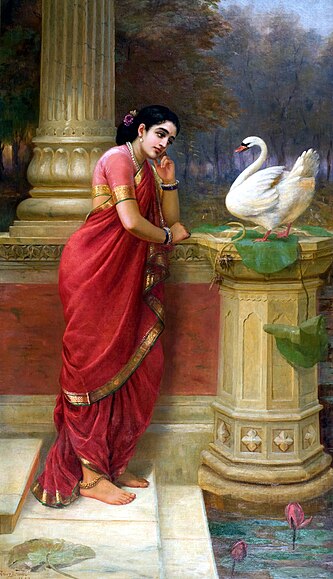
Damayanti (दमयंती), a character in Hindu mythology, was the princess of Vidarbha Kingdom, who married king Nala, of Nishadha Kingdom, and their story is told in the Mahabharata. Damayanti was a princess of Vidarbha Kingdom. She was of such beauty and grace that even the gods could not stop from admiring her. She fell in love with Nala simply from hearing of his virtues and accomplishments from a golden swan.
View all quotes →