Colin Wilson in Rudolf Steiner: The Man and His Vision , p. 87
“
The rather more dubious side of Nietzsche's 'evolutionism' is his glorification of the warrior -- particularly when, as an exemplification of the warrior-hero, he chooses an archetypal 'spoilt brat' like Cesare Borgia.
— Colin Wilson
What It Means
This is a placeholder explanation generated by the low-overhead model. It interprets "The rather more dubious side of Nietzsche's 'evolutionism' is his glorification of the warrior -- particularly when, as an exemplification of the warrior-hero, he chooses an archetypal 'spoilt brat' like Cesare Borgia." in the context of "Colin Wilson in Rudolf Steiner: The Man and His Vision , p. 87" to mean that wisdom is timeless.

Source: Wikiquote: "Cesare Borgia" (Quotes about Cesare Borgia)
The 'What it means' explanation text was generated by Google Gemini Flash (accessed January 18, 2026). https://gemini.google.com/app
Tags
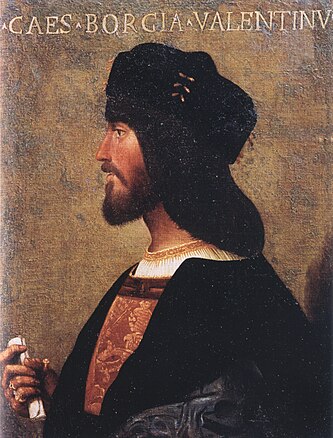
About Cesare Borgia
Cesare Borgia (September 13, 1475 – March 12, 1507), Duke of Valentinois, was an Italian condottiero, nobleman, politician, and cardinal, whose fight for power was a major inspiration for The Prince by Machiavelli, who was his adviser. He was the illegitimate son of Pope Alexander VI (r. 1492–1503) (Rodrigo Borgia) and his long-term mistress Vannozza dei Cattanei. He was the brother of Lucrezia Borgia; Giovanni Borgia (Juan), Duke of Gandia; and Gioffre Borgia (Jofré in Valencian), Prince of Squillace. He was half-brother to Don Pedro Luis de Borja (1460–88) and Girolama de Borja, children of unknown mothers.
View all quotes →