Our general arithmetic, so far surpassing in extent the geometry of the ancients, is entirely the creation of modern times. Starting originally from the notion of absolute integers, it has gradually enlarged its domain. To integers have been added fractions, to rational quantities the irrational, to positive the negative and to the real the imaginary. This advance, however, has always been made at first with timorous and hesitating step. The early algebraists called the negative roots of equations false roots, and these are indeed so when the problem to which they relate has been stated in such a form that the character of the quantity sought allows of no opposite. But just as in general arithmetic no one would hesitate to admit fractions, although there are so many countable things where a fraction has no meaning, so we ought not to deny to negative numbers the rights accorded to positive simply because innumerable things allow no opposite. The reality of negative numbers is sufficiently justified since in innumerable other cases they find an adequate substratum. This has long been admitted, but the imaginary quantities—formerly and occasionally now, though improperly, called impossible—as opposed to real quantities, are still rather tolerated than fully naturalized, and appear more like an empty play upon symbols to which a thinkable substratum is denied unhesitatingly by those who would not depreciate the rich contribution which this play upon symbols has made to the treasure of the relations of real quantities. The author has for many years considered this highly important part of mathematics from a different point of view, where just as objective an existence may be assigned to imaginary as to negative quantities, but hitherto he has lacked opportunity to publish these views. In the present paper the outlines are given briefly; they consist of the following: Positive and negative numbers can only find an application when the thing counted has an opposite which when conceived of as united with it has the effect of destroying it. Accurately speaking, this supposition can only be made where the things enumerated are not substances (objects thinkable in themselves) but relations between any two objects. It is postulated that these objects are arranged after a definite fashion in a series e.g., A, B, C, D,... and that the relation of A to B can be regarded as equal to that of B to C, etc. The notion of opposition involves nothing further than the interchange of the terms of the relation so that if the relation of (or transition from) A to B is considered as +1 the relation of B to A must be represented by -1. So far then as such a series is unlimited on both sides, every real integer represents the relation of a term arbitrarily taken as origin to a definite term of the series. If, however, the objects are of such a kind that they cannot be arranged in one series, even though unlimited, but only in series of series, or, what amounts to the same thing, they form a manifoldness of two dimensions; if there is the same connection between the relations of one series to another, or the transitions from one to another, as in the case of the transition from one term of a series to another term of the same series, we shall evidently need for the measurement of the transition from one term of the system to another, besides the previous units +1 and -1, two others opposite in character +i and -i. Obviously we must also postulate that the unit i shall always mark the transition from a given term of the one series to a definite term of the immediately adjacent series. In this way the system can be arranged in a two-fold manner in series of series. The mathematician leaves entirely out of consideration the nature of the objects and the content of their relations. He has simply to do with the enumeration and comparison of the relations. So far as he has assigned sameness of nature to the relations designated by +1 and -1, considered in themselves, he is warranted in extending such sameness to all four elements, +1, -1, +i, -i. ...We see further that if we wish to take +1 for the relation previously expressed by +i, we must necessarily take +i for the relation previously expressed by -1. In the language of mathematicians this means that +i is a mean proportional between +1 and -1, or corresponds to the symbol sqrt{-1}. We say purposely not the mean proportional because -i has just as good a right to that designation. Here then the demonstrability of an intuitive signification of sqrt{-1} has been fully justified and nothing more is necessary to bring this quantity into the domain of objects of arithmetic.
What It Means
This is a placeholder explanation generated by the low-overhead model. It interprets "Our general arithmetic, so far surpassing in extent the geometry of the ancients, is entirely the creation of modern times. Starting originally from the notion of absolute integers, it has gradually enlarged its domain. To integers have been added fractions, to rational quantities the irrational, to positive the negative and to the real the imaginary. This advance, however, has always been made at first with timorous and hesitating step. The early algebraists called the negative roots of equations false roots, and these are indeed so when the problem to which they relate has been stated in such a form that the character of the quantity sought allows of no opposite. But just as in general arithmetic no one would hesitate to admit fractions, although there are so many countable things where a fraction has no meaning, so we ought not to deny to negative numbers the rights accorded to positive simply because innumerable things allow no opposite. The reality of negative numbers is sufficiently justified since in innumerable other cases they find an adequate substratum. This has long been admitted, but the imaginary quantities—formerly and occasionally now, though improperly, called impossible—as opposed to real quantities, are still rather tolerated than fully naturalized, and appear more like an empty play upon symbols to which a thinkable substratum is denied unhesitatingly by those who would not depreciate the rich contribution which this play upon symbols has made to the treasure of the relations of real quantities. The author has for many years considered this highly important part of mathematics from a different point of view, where just as objective an existence may be assigned to imaginary as to negative quantities, but hitherto he has lacked opportunity to publish these views. In the present paper the outlines are given briefly; they consist of the following: Positive and negative numbers can only find an application when the thing counted has an opposite which when conceived of as united with it has the effect of destroying it. Accurately speaking, this supposition can only be made where the things enumerated are not substances (objects thinkable in themselves) but relations between any two objects. It is postulated that these objects are arranged after a definite fashion in a series e.g., A, B, C, D,... and that the relation of A to B can be regarded as equal to that of B to C, etc. The notion of opposition involves nothing further than the interchange of the terms of the relation so that if the relation of (or transition from) A to B is considered as +1 the relation of B to A must be represented by -1. So far then as such a series is unlimited on both sides, every real integer represents the relation of a term arbitrarily taken as origin to a definite term of the series. If, however, the objects are of such a kind that they cannot be arranged in one series, even though unlimited, but only in series of series, or, what amounts to the same thing, they form a manifoldness of two dimensions; if there is the same connection between the relations of one series to another, or the transitions from one to another, as in the case of the transition from one term of a series to another term of the same series, we shall evidently need for the measurement of the transition from one term of the system to another, besides the previous units +1 and -1, two others opposite in character +i and -i. Obviously we must also postulate that the unit i shall always mark the transition from a given term of the one series to a definite term of the immediately adjacent series. In this way the system can be arranged in a two-fold manner in series of series. The mathematician leaves entirely out of consideration the nature of the objects and the content of their relations. He has simply to do with the enumeration and comparison of the relations. So far as he has assigned sameness of nature to the relations designated by +1 and -1, considered in themselves, he is warranted in extending such sameness to all four elements, +1, -1, +i, -i. ...We see further that if we wish to take +1 for the relation previously expressed by +i, we must necessarily take +i for the relation previously expressed by -1. In the language of mathematicians this means that +i is a mean proportional between +1 and -1, or corresponds to the symbol sqrt{-1}. We say purposely not the mean proportional because -i has just as good a right to that designation. Here then the demonstrability of an intuitive signification of sqrt{-1} has been fully justified and nothing more is necessary to bring this quantity into the domain of objects of arithmetic." in the context of "Carl Friedrich Gauss, in Göttingische gelehrte Anzeigen (April 23, 1831) an account of his paper Theoria residuorum biquadraticorum, Commentatio secunda, as quoted in Science, Vol. 6 (Jul-Dec, 1897) ed., John Michels, pp. 304-305." to mean that wisdom is timeless.

Tags
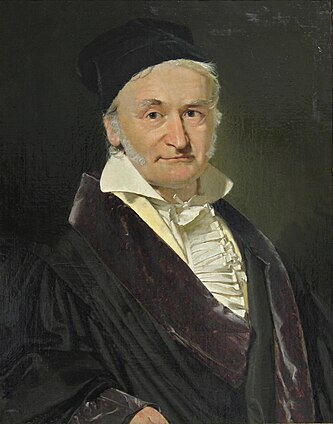
About Carl Friedrich Gauss