Calvin Coolidge on United States Declaration of Independence
← Back to Calvin Coolidge Profile
“We live in an age of science and abounding accumulation of material things. These did not create the Declaration. Our Declaration created them. The things of the spirit come first. Unless we cling to that, all of our material prosperity, overwhelming though it may appear, will turn to a barren scepter in our grasp. If we are to maintain the great heritage bequeathed to us, we must be like minded as the Founders who created. We must not sink into a pagan materialism. We must cultivate the reverence which they had and for the things that are holy. We must follow the spiritual and moral leadership which they showed. We must keep replenished, that they may glow with a more compelling flame, the altar fires before which they worshipped.”
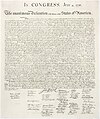
“About the Declaration there is a finality that is exceedingly restful. It is often asserted that the world has made a great deal of progress since 1776 — that we have had new thoughts and new experiences which have given us a great advance of the people of that day and that we may therefore very well discard their conclusions for something more modern. But, that reasoning cannot be applied to the great charter... No advance, no progress can be made beyond these propositions. If anyone wishes to deny their truth or their soundness, the only direction in which he can proceed historically is not forward, but backward toward a time when there was no equality, no rights of the individual, no rule of the people. Those who wish to proceed in that direction cannot lay claim to progress. They are reactionary. Their ideas are not more "modern," but more ancient than those of our Revolutionary ancestors.”
“July 4, 1776 was the historic day on which the representatives of three millions of people vocalized Concord, and Lexington, and Bunker Hill, which gave notice to the world that they proposed to establish an independent nation on the theory that all men are created equal, that they are endowed by their creator with certain inalienable rights, that among these are life, liberty, and the pursuit of happiness. The wonder and glory of the American people is not the ringing Declaration of that day, but the action then already begun, and in the process of being carried out, in spite of every obstacle that war could interpose, making the theory of freedom and equality a reality... The doctrine of the Declaration of Independence predicated upon the glory of man and the corresponding duty to society that the rights of citizens ought to be protected with every power and resource of the state, and a government that does any less is false to the teachings of that great document — false to the name American.”
“Great ideas do not burst upon the world unannounced. They are reached by a gradual development over a length of time usually proportionate to their importance. This is especially true of the principles laid down in the Declaration of Independence. Three very definite propositions were set out in its preamble regarding the nature of mankind and therefore of government. These were the doctrine that all men are created equal, that they are endowed with certain inalienable rights, and that therefore the source of the just powers of government must be derived from the consent of the governed. If no one is to be accounted as born into a superior station, if there is to be no ruling class, and if all possess rights which can neither be bartered away nor taken from them by any earthly power, it follows as a matter of course that the practical authority of the Government has to rest on the consent of the governed. While these principles were not altogether new in political action, and were very far from new in political speculation, they had never been assembled before and declared in such a combination... In its main features the Declaration of Independence is a great spiritual document. It is a declaration not of material but of spiritual conceptions. Equality, liberty, popular sovereignty, the rights of man — these are not elements which we can see and touch. They are ideals. They have their source and their roots in the religious convictions. They belong to the unseen world. Unless the faith of the American people in these religious convictions is to endure, the principles of our Declaration will perish. We can not continue to enjoy the result if we neglect and abandon the cause... If all men are created equal, that is final. If they are endowed with inalienable rights, that is final. If governments derive their just powers from the consent of the governed, that is final.”