Brian Greene on Spacetime
← Back to Brian Greene Profile
“Much as Kaluza found that a universe with five spacetime dimensions provided a framework for unifying electromagnetism and gravity, and much as string theorists found that a universe with ten spacetime dimensions provided a framework for unifying quantum mechanics and general relativity, Witten found that a universe with eleven spacetime dimensions provided a framework for unifying all string theories.”
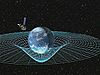
“In a paper he sent to Einstein in 1919, Kaluza made an astounding suggestion. He proposed that the spatial fabric of the universe might possess more than the three dimensions... it provided an elegant and compelling framework for weaving together Einstein's general relativity and Maxwell's electromagnetic theory into a single, unified conceptual framework. ...implicit in Kaluza's work and subsequently made explicit and refined by... Oskar Klein in 1926... the spatial fabric of our universe may have both extended and curled-up dimensions. ... Einstein had formulated general relativity in the familiar setting of a universe with three spatial dimensions and one time dimension. The mathematical formalism... however, could be extended fairly directly to write down analogous equations for a universe with additional space dimensions. Under the "modest" assumption of one additional space dimension, Kaluza... derived the new equations. ...Kaluza found extra equations... those Maxwell had written down in the 1880s for deriving the electromagnetic force! ...Kaluza had united Einstein's theory of gravity with Maxwell's theory of light.”
“Einstein proclaimed that all objects in the universe are always traveling through spacetime at one fixed speed—that of light. ...this one fixed speed can be shared between the different ...space and time dimensions ...If an object is sitting still ...all of the object's motion is used to travel through one dimension ...time ...all objects that are at rest ...age—at exactly the same rate or speed. If an object does move through space... some of the previous motion through time must be diverted. ...its clock will tick more slowly if it moves through space. ...The speed of an object through space is thus merely a reflection of how much of its motion through time is diverted. ...the maximum speed through space occurs if all of an object's motion through time is diverted to motion through space. But having used up all of its motion through time, this is the fastest speed through space ...something traveling at light speed through space will have no speed left for motion through time. Thus light does not get old; a photon that emerged from the big bang is the same age today as it was then. There is no passage of time at light speed.”