Link Copied!
Bernard Harcourt Quotes (1963-)
Director


About Bernard Harcourt
Bernard Harcourt (January 28, 1963) is a leading critical theorist with a specialization in the area of punishment and political economy. He is the Isidor and Seville Sulzbacher Professor of Law and Director of the Columbia Center for Contemporary Critical Thought at Columbia University.
Best Bernard Harcourt Quotes
Shortest
Earliest
Explore our curated collection of the most famous and impactful Bernard Harcourt quotes.
“The different strands of radical thought seek to lift a veil from our eyes in order to emancipate us from domination, cowardice, or repression. They unmask in order to liberate.”
“Faith in natural order and market efficiency forecloses a full normative assessment of market outcomes. ... It effectively depoliticizes the market itself and its outcomes. It is only when the illusion of natural order is lifted that a real problem arises: that of the justice of the organizational rules and their distributional consequences.”
“The idea of natural order, in effect, masks the state’s role. ... Robert Hale ... demonstrated the extent to which the distribution of income and wealth is the product of legal rules we choose to impose. Hale trained our attention on the foundational rules of property and contract law, showing how free, voluntary, compensated exchange is in fact a product of the legal coercion that the government establishes through its role in defining property rights.”

“The doctrine of laissez-faire in the mid-nineteenth century essentially allowed three functions for the government: first, maintaining the external defense of the country; second, providing for the internal order and security of persons; and third, possibly, providing for minimal public amenities. ... Criminalization and punishment became, undisputedly, the most legitimate and competent task of the government. There, for sure, government intervention was proper, necessary, legitimate, and competent. There, natural orderliness had to be replaced by governmental ordering.”

“At what price have so many of us come to believe that the economy is the realm of natural order and that the legitimate and competent sphere of policing—of administration and government—lies elsewhere? What flows from that sharp dichotomy between orderliness in the market and ordering in the penal sphere? At what price do we embrace these categories? And here, the answer is equally clear: at the price, first, of naturalizing the market and thereby effectively shielding from normative assessment the regulatory mechanisms in our contemporary markets and the wealth distributions that occur daily; and at the price, second, of easing, facilitating, and enabling the massive expansion of our penal sphere, or, to be more provocative, of making possible mass incarceration today.”
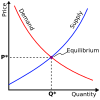
“The notion that human interaction could spontaneously and autonomously achieve a stable, orderly, self-sustaining form of equilibrium in the absence of government intervention—what François Quesnay and the first school of économistes dubbed un ordre naturel in the late 1750s—has facilitated a conception of the market as a self-regulating system that could only prosper by purging itself of the prejudicial meddling of governments and politics. In the face of this new conception of an orderly market, governance would be relegated outside that autonomous space, charged with the responsibility of policing and punishing those who deviate—those who do not see the natural laws or, in more technical jargon, who bypass the market.”
“By an odd amalgam of liberal economic theory and Beccaria on punishment, nineteenth-century thinkers would replicate this exceptional relationship between markets and punishment: natural orderliness in the economic sphere, but government intervention in the penal realm. This is most evident in Jeremy Bentham’s work. The contrast between Bentham’s presumption of quietism in economic matters and his arch-interventionism in the penal domain effectively reproduced and reiterated the Physiocratic duality of economy and police. On the public economy side, Bentham tended toward Adam Smith’s liberalism. His Manual of Political Economy, written in the mid-1790s, rehearsed a presumption of governmental quietism based on his stringent belief in the superiority of individuals’ information and self-interest. But on the punishment side, Bentham embraced Beccaria’s philosophy whole cloth—especially Beccaria’s notion that policing is a sphere of human activity that must be shot through with government intervention. In fact, the criminal code, for Bentham, was precisely a “grand catalogue of prices” by means of which the government set the value of deviance. The penal code was a menu of fixed prices—the polar opposite of laissez-faire.”

Bernard Harcourt Quotes by Topic
Find exactly what you are looking for by browsing this categorized list of Bernard Harcourt quotes by topic.
Bernard Harcourt on Market
“Faith in natural order and market efficiency forecloses a full normative assessment of market outcomes. ... It effectively depoliticizes the market itself and its outcomes. It is only when the illusion of natural order is lifted that a real problem arises: that of the justice of the organizational rules and their distributional consequences.”
Bernard Harcourt on Free market
“Faith in natural order and market efficiency forecloses a full normative assessment of market outcomes. ... It effectively depoliticizes the market itself and its outcomes. It is only when the illusion of natural order is lifted that a real problem arises: that of the justice of the organizational rules and their distributional consequences.”

Bernard Harcourt on Punishment
“By an odd amalgam of liberal economic theory and Beccaria on punishment, nineteenth-century thinkers would replicate this exceptional relationship between markets and punishment: natural orderliness in the economic sphere, but government intervention in the penal realm. This is most evident in Jeremy Bentham’s work. The contrast between Bentham’s presumption of quietism in economic matters and his arch-interventionism in the penal domain effectively reproduced and reiterated the Physiocratic duality of economy and police. On the public economy side, Bentham tended toward Adam Smith’s liberalism. His Manual of Political Economy, written in the mid-1790s, rehearsed a presumption of governmental quietism based on his stringent belief in the superiority of individuals’ information and self-interest. But on the punishment side, Bentham embraced Beccaria’s philosophy whole cloth—especially Beccaria’s notion that policing is a sphere of human activity that must be shot through with government intervention. In fact, the criminal code, for Bentham, was precisely a “grand catalogue of prices” by means of which the government set the value of deviance. The penal code was a menu of fixed prices—the polar opposite of laissez-faire.”
What Bernard Harcourt Said About Others
Discover personal opinions Bernard Harcourt shared regarding contemporaries.
Bernard Harcourt on Adolf Hitler
“This year will go down in history! For the first time, a civilized nation has full gun registration! Our streets will be safer, our police more efficient, and the world will follow our lead into the future!”

About Bernard Harcourt
Bernard Harcourt (January 28, 1963) is a leading critical theorist with a specialization in the area of punishment and political economy. He is the Isidor and Seville Sulzbacher Professor of Law and Director of the Columbia Center for Contemporary Critical Thought at Columbia University.