Link Copied!
Barry Eichengreen Quotes (1952-)
About Barry Eichengreen
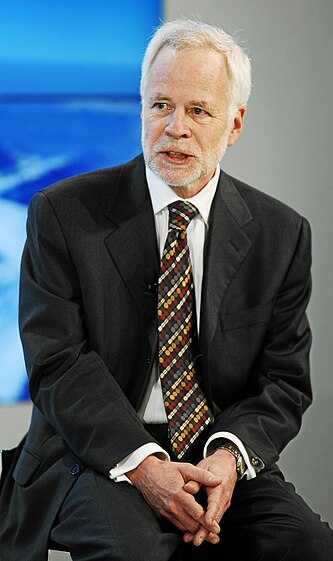
Barry Eichengreen (born 1952) is an American economist and Professor of Economics and Political Science at the University of California, Berkeley.
Best Barry Eichengreen Quotes
Shortest
Earliest
Explore our curated collection of the most famous and impactful Barry Eichengreen quotes.
“The international monetary system is the glue that binds national economies together.”
“Neither the current state nor the future prospects of this evolving order can be understood without an appreciation of its history.”
“Any account of the development of the international monetary system is also necessarily an account of the development of international capital markets.”
“What was critical for the maintenance of pegged exchange rates, I argue in this book, was protection for governments from pressure to trade exchange rate stability for other goals.”
“Given the network-externality characteristic of international monetary arrangements, reforming them is necessarily a collective endeavor. But the multiplicity of countries creates negotiating costs.”
“Progress in economics is said to take place through a cumulative process in which scholars build on the work of their predecessors. In an age when graduate syllabi contain few references to books and articles written as many as ten years ago, this is too infrequently the case.”
“Aside from Yugoslavia, experiments with decentralization did not extend to planning innovation, the greatest weakness of the socialist economies. Even where markets were allowed to exert more influence over current production, the state was still responsible for planning the future. And state socialism provided only weak incentives for innovation. The Schumpeterian pressure that forced capitalist firms to innovate or die was not present in the planned economy.”

“This history of the international monetary system is short in two senses of the word. First, I concentrate on a short period: the century and a half from 1850 to today. Many of the developments I describe have roots in earlier eras, but to draw out their implications I need only consider this relatively short time span. Second, I have sought to write a short book emphasizing thematic material rather than describing international monetary arrangements in exhaustive detail.”
“Both the existence of these parallels and their tragic nature would not have escaped Charles Kindleberger, whose World in Depression, 1929-1939 was published exactly 40 years ago, in 1973. Where Kindleberger’s canvas was the world, his focus was Europe. While much of the earlier literature, often authored by Americans, focused on the Great Depression in the US, Kindleberger emphasised that the Depression had a prominent international and, in particular, European dimension. It was in Europe where many of the Depression’s worst effects, political as well as economic, played out. And it was in Europe where the absence of a public policy authority at the level of the continent and the inability of any individual national government or central bank to exercise adequate leadership had the most calamitous economic and financial effects.”

“Writing in 1944, the year of the Bretton Woods Conference, Polanyi suggested that the extension of the institutions of the market over the course of the nineteenth century aroused a political reaction in the form of associations and lobbies that ultimately undermined the stability of the market system. He gave the gold standard a place of prominence among the institutions of laissez faire in response to which this reaction had taken place. And he suggested that the opening of national economic decision making to parties representing working-class interests had contributed to the downfall of that international monetary system. In a sense, this book asks whether Polanyi’s thesis stands the test of time. Can the international monetary history of the second half of the twentieth century be understood as the further unfolding of Polanyian dynamics, in which democratization again came into conflict with economic liberalization in the form of free capital mobility and fixed exchange rates? Or do recent trends toward floating rates and monetary unification point to ways of reconciling freedom and stability in the two domains?”
Barry Eichengreen Quotes by Topic
Find exactly what you are looking for by browsing this categorized list of Barry Eichengreen quotes by topic.
Barry Eichengreen on Exchange rate 2 quotes
“What was critical for the maintenance of pegged exchange rates, I argue in this book, was protection for governments from pressure to trade exchange rate stability for other goals.”

Barry Eichengreen on International monetary systems
“The international monetary system is the glue that binds national economies together.”
Barry Eichengreen on Democratization
“Can the international monetary history of the second half of the twentieth century be understood as the further unfolding of Polanyian dynamics, in which democratization again came into conflict with economic liberalization in the form of free capital mobility and fixed exchange rates? Or do recent trends toward floating rates and monetary unification point to ways of reconciling freedom and stability in the two domains?”
Barry Eichengreen on Planned economy
“Aside from Yugoslavia, experiments with decentralization did not extend to planning innovation, the greatest weakness of the socialist economies. Even where markets were allowed to exert more influence over current production, the state was still responsible for planning the future. And state socialism provided only weak incentives for innovation. The Schumpeterian pressure that forced capitalist firms to innovate or die was not present in the planned economy.”

What Barry Eichengreen Said About Others
Discover personal opinions Barry Eichengreen shared regarding contemporaries.
Barry Eichengreen on Joseph Schumpeter
“Aside from Yugoslavia, experiments with decentralization did not extend to planning innovation, the greatest weakness of the socialist economies. Even where markets were allowed to exert more influence over current production, the state was still responsible for planning the future. And state socialism provided only weak incentives for innovation. The Schumpeterian pressure that forced capitalist firms to innovate or die was not present in the planned economy.”

Barry Eichengreen on Karl Polanyi
“Writing in 1944, the year of the Bretton Woods Conference, Polanyi suggested that the extension of the institutions of the market over the course of the nineteenth century aroused a political reaction in the form of associations and lobbies that ultimately undermined the stability of the market system. He gave the gold standard a place of prominence among the institutions of laissez faire in response to which this reaction had taken place. And he suggested that the opening of national economic decision making to parties representing working-class interests had contributed to the downfall of that international monetary system. In a sense, this book asks whether Polanyi’s thesis stands the test of time. Can the international monetary history of the second half of the twentieth century be understood as the further unfolding of Polanyian dynamics, in which democratization again came into conflict with economic liberalization in the form of free capital mobility and fixed exchange rates? Or do recent trends toward floating rates and monetary unification point to ways of reconciling freedom and stability in the two domains?”

About Barry Eichengreen
Barry Eichengreen (born 1952) is an American economist and Professor of Economics and Political Science at the University of California, Berkeley.