Link Copied!
Barbara Smith Quotes (1946-)

About Barbara Smith
Barbara Smith (born November 16, 1946) is an American lesbian feminist and socialist who has played a significant role in Black feminism in the United States.
Best Barbara Smith Quotes
Shortest
Earliest
Explore our curated collection of the most famous and impactful Barbara Smith quotes.
“this country functions with white supremacy as its engine, an engine that runs so many aspects — banking, healthcare, education. All these disparities that we see, it would take quite a bit to say, “I think, you know, we need to get rid of that.””
“when you think about the issues of — the issue of white supremacy, it’s absolutely entwined — again, much like racial capitalism — it’s entwined with patriarchy and with homophobia and transphobia. So, you can’t really address one without the other.”

“you can’t talk about race in the United States without talking about class, and you can’t talk about class without talking about race. Racism, white supremacy, capitalism are absolutely intertwined. You know, it’s like a vine that has wrapped itself around a tree or another plant.”
“it’s important for people to know that I was born under Jim Crow. I was born in 1946, so Jim Crow was the law of the land during that time, during my growing-up years. And the reason it’s important, I think, is because it shaped very much who I was and my perspective on this project of U.S. democracy, that we’re still trying to improve.”
“For those of you who are tired of hearing about racism, imagine how much more tired we are of experiencing it. ... The degree to which it is hard or uncomfortable for you to have the issue raised is the degree to which you know inside of yourself that you aren't dealing with the issue. ... I want to say right here that this is not a "guilt trip." It's a fact trip.”

“And that’s where we are now. Do we have the political will to actually eradicate white supremacy, or do we just want to kind of nip around the edges of it and do cosmetic things? You know? Taking down the Confederate statues, very, very important, very glad that’s happening, but it doesn’t necessarily get to the material conditions of people who live under this system, nor does it address the incredible violent racism that results in people like a Jacob Blake being shot seven times in front of his tiny children at point-blank range.”
“what The Combahee River Collective is most known for is that we wrote a statement, the Combahee River Collective Statement, in 1977. It was actually for a book that was edited by the wonderful antiracist and feminist scholar Zillah Eisenstein. And the book was titled Capitalist Patriarchy and the Case for Socialist Feminism. So, we wrote something for the book, that she asked us to do, and the something turned out to be the Combahee River Collective Statement, which, seemingly, has stood the test of time. And many people still read it, refer to it. And, in fact, the Black Lives Matter and Movement for Black Lives, those movements actually say that they have relied upon the kinds of ideas of black women’s liberation that were in that statement.”
“We have to look at our international situation. We have to look at our relationship to the rest of the world. We export white supremacy. Your previous guest was talking about the incredible repercussions of the United States’ ongoing so-called foreign policy, which is really war policy, and that, I think he said, there were only 11 years in the entire history of the country when we weren’t involved in warfare. What does that say about what kind of nation we are? And so much of that has been racialized. And particularly, you know, I would say, since World War II, the skirmishes, and not — I mean, they’re bigger than skirmishes — the military adventures that this nation engages in just always seems to be against populations of people of color.”

“I started writing about white supremacy earlier this summer, after George Floyd was lynched. I was so full of rage and pain, because I’ve been dealing with this ever since Emmett Till was lynched in 1955. I was 8 years old when that happened, so, of course, I could not fully understand what had actually transpired. I just knew that the people in my family, who were all from the Deep South — I grew up in Cleveland, Ohio, because they were part of the Great Migration — I just knew they were very, very upset about someone named Emmett Till, and that this person was also a child, like my twin sister Beverly and me. So, as I said, I’ve been dealing with this for quite a long time, 1955 until the spring of 2020 and beyond. So, I just thought, “I’ve got to write.” I’m a writer. I just thought, “I’ve got to write about this.” What motivated me was the fact that when people were talking about these issues, either in print or in media, visual media, etc., that they never really talked about white supremacy. They would talk about race relations. They would talk about implicit bias. They would talk about needing to reform and change the culture of policing. All well and good, but they never talked about where all this mess comes from. And that’s what I wanted to write about.”
“("Could you speak to young activists who work around issues of identity politics, and what advice would you give them?") Well, the first thing I would say is, you’ve got to work in coalition. You cannot be so — what’s the word? — so immersed in your own particular experiences, your wonderful, multilayered, complex experiences of your identity. You can’t be so immersed in that, that you cannot look out at that person across the room, across the street, in another neighborhood, in another nation, around the globe. You cannot be so immersed in what you are experiencing that you cannot see that wider arc of a need to work for justice and do it in coalition and in solidarity with others. And I think that’s what has been lost. I think that because identity politics and black feminism and some of the things that I have actually helped to establish in academic context, I think that sometimes when they’re talked about in academic context, people don’t understand that, no, what we’re really talking about is positioning ourselves so that we can build a mass movement for positive political change and for justice. So, when people think that the only people we’re talking to are people who have the exact same list of identities that they have, I always say, “Why would I want to work with people who are just like me? That would be boring.” So, that would be my major advice, is take that risk. Take that risk of joining in coalitions, doing work on the ground where you live. Like, if you live in a city, there’s probably — there are a lot of issues, but one of the issues might likely be gun violence. Another one might be poverty or poor housing. Another one might be schools that are not of sufficient quality so that everybody has great opportunities as they grow up and become adults and get into life. See what it would be like to walk into a school board meeting. Do you see what I’m saying? Maybe you do. I bet you do, Amy. But it’s just really so important that we stretch and that we work for justice across the board. And that doesn’t mean that we can’t be in our own — you know, our own safe spaces, in our own kind of home kind of environments. We can do both.”
Barbara Smith Quotes by Topic
Find exactly what you are looking for by browsing this categorized list of Barbara Smith quotes by topic.
Barbara Smith on Racism
“For those of you who are tired of hearing about racism, imagine how much more tired we are of experiencing it. ... The degree to which it is hard or uncomfortable for you to have the issue raised is the degree to which you know inside of yourself that you aren't dealing with the issue. ... I want to say right here that this is not a "guilt trip." It's a fact trip.”
What Barbara Smith Said About Others
Discover personal opinions Barbara Smith shared regarding contemporaries.
Barbara Smith on Ilhan Omar
“Four of the most dynamic women of color in Congress – representatives Pramila Jayapal, Alexandria Ocasio-Cortez, Ilhan Omar and Rashida Tlaib”

Barbara Smith on Alexandria Ocasio-Cortez
“Four of the most dynamic women of color in Congress – representatives Pramila Jayapal, Alexandria Ocasio-Cortez, Ilhan Omar and Rashida Tlaib”

Barbara Smith on Rashida Tlaib
“Four of the most dynamic women of color in Congress – representatives Pramila Jayapal, Alexandria Ocasio-Cortez, Ilhan Omar and Rashida Tlaib”

Barbara Smith on Pramila Jayapal
“Four of the most dynamic women of color in Congress – representatives Pramila Jayapal, Alexandria Ocasio-Cortez, Ilhan Omar and Rashida Tlaib – have endorsed Bernie.”

Barbara Smith on Donald Trump
“Before the 2016 election I dreaded a return to the Jim Crow era signaled by the slogan “Make America Great Again”, which obviously meant white. Tragically that is exactly what happened. Four more years is unthinkable. That is why I am working to elect President Bernie Sanders.”

Barbara Smith on Ella Baker
“I idolize Fannie Lou Hamer and Ella Baker. And they are supreme examples of what being freedom fighters, principled, fearless — or at least courageous. There’s a difference between being fearless and being courageous. Courageous is actually better, because everyone should have some fear about what might actually harm them...Ella Baker, of course, she was a person — among so many other things, she worked for all of the major civil rights organizations at some time. So she had experience across organizations. She also was doing that grassroots, very, very dangerous organizing in the Jim Crow South, in little towns, in rural areas. But she is probably best known for the person who inspired and made possible the founding of the Student Nonviolent Coordinating Committee, which is SNCC.”

Barbara Smith on Fannie Lou Hamer
“I idolize Fannie Lou Hamer and Ella Baker. And they are supreme examples of what being freedom fighters, principled, fearless — or at least courageous. There’s a difference between being fearless and being courageous. Courageous is actually better, because everyone should have some fear about what might actually harm them. And, of course, Fannie Lou Hamer paid a huge price for wanting to do something as seemingly ordinary as vote. But in the Jim Crow South of that era, Black people, virtually none of them were allowed to vote. She paid a permanent price because of the beating that she received. And I just found out yesterday, if you can believe it, after all these years, that she actually was blinded in one eye. She is known for having worked with SNCC, doing voter organizing and other kinds of antiracist organizing during that Jim Crow era, and then, of course, speaking out so powerfully at the 1964 Democratic convention about what went on in Mississippi, and asking the very, very, very relevant question: “Is this America?”...I actually had the great, great pleasure and honor of meeting Fannie Lou Hamer when I was a teenager in Cleveland in 1965 and was very involved in the civil rights movement as a young person.”

Barbara Smith on Student Nonviolent Coordinating Committee
“I idolize Fannie Lou Hamer and Ella Baker. And they are supreme examples of what being freedom fighters, principled, fearless — or at least courageous. There’s a difference between being fearless and being courageous. Courageous is actually better, because everyone should have some fear about what might actually harm them. And, of course, Fannie Lou Hamer paid a huge price for wanting to do something as seemingly ordinary as vote. But in the Jim Crow South of that era, Black people, virtually none of them were allowed to vote. She paid a permanent price because of the beating that she received. And I just found out yesterday, if you can believe it, after all these years, that she actually was blinded in one eye. She is known for having worked with SNCC, doing voter organizing and other kinds of antiracist organizing during that Jim Crow era, and then, of course, speaking out so powerfully at the 1964 Democratic convention about what went on in Mississippi, and asking the very, very, very relevant question: “Is this America?”...I actually had the great, great pleasure and honor of meeting Fannie Lou Hamer when I was a teenager in Cleveland in 1965 and was very involved in the civil rights movement as a young person.”

Barbara Smith on Melanie Kaye/Kantrowitz
“I met Melanie because of the women’s movement, specifically that part of the women’s movement where radical, anti-racist, Lesbian feminists were doing revolutionary work and carving out a place to survive. A lot of us here know how tough it was to be out as a Lesbian in the 1970’s...There is an untold history of feminists who challenged white supremacy, who did anti-racist organizing often in places where we were far from welcome. Our political activism and practice formed the roots of intersectionality, before the word was invented. Melanie was at the forefront of this work, which is embodied in both her beautiful writing and activism...Her inclusive political vision was nowhere more clear than in her leadership of Jews for Racial and Economic Justice. Look at the name of that organization. It says, Jewish people are challenging racism and class oppression. It says that Non-Jews can too! People of color and Jews can work together. There are Jews who are people of color and people of color who are Jewish. Melanie was far more than an ally. She was an incomparable co-conspirator... There’s so much integrity and courage that Melanie embodies and always will. We need to share that with others who think that it may have been easy and who don’t necessarily know the streets that we walked and the battles that we fought.”
Barbara Smith on Bernie Sanders
“I am supporting Bernie Sanders for president because I believe that his campaign and his understanding of politics complements the priorities that women of color defined decades ago...At the same time that I was growing up in Cleveland, Bernie Sanders, who was a few years older, was growing up in Brooklyn. He noticed some of the same paradoxes and injustices that I did and came to a similar conclusion: that he needed to get involved...Sanders has devoted most of his life to social movements. He has shaped them and been shaped by them. He understands that the most substantial and meaningful change comes from the bottom up, not the top down...Sanders has said that as president he will be “organizer-in-chief”. He is committed to fighting for regular working people, which is most of us, and he has the advantage of connection with an existing broad-based social movement. As president he can implement policies that give those who are most harmed by the current system full access to opportunity and a decent human life...In 2016 I served on the LGBTQ steering committee for the Sanders campaign. I am even more excited to support him now...Four of the most dynamic women of color in Congress – representatives Pramila Jayapal, Alexandria Ocasio-Cortez, Ilhan Omar and Rashida Tlaib – have endorsed Bernie...The stakes could not be higher. Before the 2016 election I dreaded a return to the Jim Crow era signaled by the slogan “Make America Great Again”, which obviously meant white. Tragically that is exactly what happened. Four more years is unthinkable. That is why I am working to elect President Bernie Sanders.”

Quotes About Barbara Smith
Gain deeper perspective through quotes about Barbara Smith from others.
Joyce Antler on Barbara Smith
“Smith's chapter in Yours in Struggle, "Between a Rock and a Hard Place: Relationships between Black and Jewish Women," acknowledged that addressing anti-Semitism set her up to look like a "woman of color overly concerned about 'white' issues." She confessed that her experiences with Jewish women had been "terrorizing" and admitted that she was anti-Semitic, largely because she had been brought up to be suspicious of whites. But Smith charged that in Jewish women's efforts to combat anti-Semitism, they had exercised racism toward black women. She urged black women to understand that they shared commonalities with Jewish women, included being oppressed by the white majority.”
Gloria E. Anzaldúa interview on Barbara Smith
“My association with Aunt Lute Books began with Borderlands. I was in Minnesota for the Great Midwestern Book Show, on a panel with several writers discussing whether the writer should be an engaged writer. A couple of black male writers on the panel attacked Alice Walker and other black women writers, accusing them of emasculating black men in their writings. Then they turned on me, and the facilitator, who was inexperienced, didn't intervene. From the audience, Barbara Smith, writer and cofounder of Kitchen Table Press, spoke up on behalf of Alice Walker and all the other people. She was great.”
Bettina Aptheker on Barbara Smith
“Insisting upon an integrated analysis and politics that recognizes that the major systems of oppression are interlocking, Barbara Smith observed that "the concept of simultaneity of oppression is... the crux of a Black feminist understanding of political reality and, I believe, one of the most significant ideological contributions of Black feminist thought."”

Marilyn Chin on Barbara Smith
“I learned a lot from the black arts movement. I loved reading black feminist thinkers on my own (outside of academia)—Audre Lorde, Barbara Smith, Angela Davis, June Jordan, bell hooks, etc.”

Cheryl Clarke on Barbara Smith
“I became more firmly committed to feminism when I met Barbara Smith in 1975 at the Socialist Feminist Conference at Antioch College. We ran into each other as we were both leaving a session where some Marxist women were making quite homophobic statements about lesbians. I asked her, “Are you gay?” She said, “Yes.” I said, “So am I. This conference is sickening.” Anyway, I learned a great deal from Barbara in terms of her outspokenness and her courage to say, “I have such a deep commitment to feminism.” And as I began to meet other black feminists through Smith, my commitment became deeper as well.”
Amy Goodman on on Barbara Smith
“the legendary African-American feminist scholar Barbara Smith, founder of the Combahee River Collective and of Kitchen Table: Women of Color Press.”
Robin Kelley on Barbara Smith
“Today's mic-hogging, fast-talking, contentious young (and old) lefties continue to hawk little books and pamphlets on revolution, always with choice words or documents from Marx, Mao, even Malcolm. But I've never seen a broadside with "A Black Feminist Statement or even the writings of Angela Davis or June Jordan or Barbara Omolade or Flo Kennedy or Audre Lorde or bell hooks or Michelle Wallace, at least not from the groups who call themselves leftist. These women's collective wisdom has provided the richest insights into American radicalism's most fundamental questions: How can we build a multiracial movement? Who are the working class and what do they desire? How do we resolve the Negro Question and the Woman Question? What is freedom? Barbara Smith, one of the founding members of the Combahee River Collective, is among the radical voices that have addressed these questions. Since the heyday of the civil rights movement, she has been telling white people that fighting racism is necessary for their own survival and liberation, not some act of philanthropy to help the downtrodden Negroes of the ghetto. She has been telling black activists that fighting homophobia is their issue because the policing of sexuality, no matter to whom it is directed, affects everyone. And she has been sharply critical of lesbian and movements for the narrowness of their political agendas. She knows what it will take to win freedom. "As a socialist and an alert Black woman, it is clear to me that it is not possible to achieve justice, especially economic justice, and equality under capitalism because capitalism was never designed for that to be the case. The assaults from the present system necessitate that most activists work for reforms, but those of us who are radicals understand that it is possible to do so at the very same time that we work for fundamental change-a revolution."”

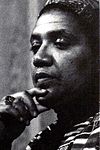
About Barbara Smith
Barbara Smith (born November 16, 1946) is an American lesbian feminist and socialist who has played a significant role in Black feminism in the United States.