Link Copied!
Baba Amte Quotes (1914-2008)
Leader
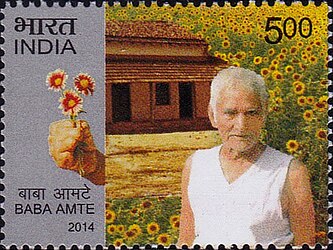
About Baba Amte
Dr Murlidhar Devidas Amte (December 26, 1914 – February 9, 2008) was a highly dedicated Indian social worker for the cause of rehabilitation and empowerment of poor people, particularly those suffering from leprosy. He gave up all his luxurious way of living. He gave up his wealth and established three ashrams for treatment and rehabilitation of leprosy patients, disabled people, and people from marginalized sections of the society in Maharashtra, India, of which Anandwan was the precursor. He also adopted non-violent means to fight the Indian government for independence, along with Mahatma Gandhi, and was also imprisoned in the 1942 Quit India movement. He was the recipient of many international and national awards of which the most prominent are: The Ramon Magsaysay Award; the Padma Vibhushan, the highest civilian honour of the Government of India; and the Gandhi Peace Prize.
Best Baba Amte Quotes
Shortest
Earliest
Explore our curated collection of the most famous and impactful Baba Amte quotes.
“Joy is more infectious than leprosy.”

“Compassion has no utopia, party or ideology.”

“Those who do monumental work don't need monuments.”


“When leprosy patients touched the soil, they transformed it into gold, but the politicians did that and made it into dirt.”

“There is a certain callousness in families like mine. They put up strong barriers so as not to see the misery in the world outside and I rebelled against it.”
“A client would admit that he had committed rape, and I was expected to obtain an acquittal. And worse still, when I succeeded, I was expected to attend the celebration party.”

“Those who indulge in history cannot create new history. You cannot legislate national integration unless political work is done constructively and there is a lifestyle for life.”

“I was charging fifty rupees for arguing for fifteen minutes while a labourer was getting only three-quarters of a Rupee for twelve hours of toil. That was what was eating into me.”
“Our governance is by a gerontocracy. This cataract of history can only be removed by youth. In this common man's century, only the common man can change the profile of this country.”

“Our governance is by a gerontocracy. This cataract of history can only be removed by youth. In this common man's century, only the common man can change the profile of this country.”
“I believe as a society we have to evolve, through experimentation, a system which combines the principles of individual freedom and common ownership. And this is what we have tried, basically with success, in all our projects, involving leprosy patients, tribal people and the so-called 'disabled' persons.”

“That microscopic look at village life taught me to hear the heart-beat of reality. To me the common man’s society is a maskless society. He does not carry that thick mask which the professional people, the upper classes, wear so that they might look nice and beautiful. Very often they do not dare to say what they really think and feel.”

“[A balanced economic system is one which provides] sufficiency for all and superfluity for some. The MNCs have entered the country like nomads. The majority doesn't need Pepsi or Coke, they want water. You can have your skyscrapers and Cokes but before this you must ensure that that tribal girl defecating in the open has the privacy of a toilet.”
“I am upset I am very much disappointed when I see within myself a wrong image of myself.... A man can live without fingers, but he cannot live without self-respect....That is why I took up leprosy work. Not to help anyone but to overcome that fear in my life. That it worked out good for others is a byproduct. But the fact is I did it to overcome fear.”
“I rushed across and started putting such handful of coins into the tin which he held out to me that it almost fell from his hand with the weight. ‘I am only a beggar, young sir, don’t put stones into my bowl'. 'These are not stones but coins. Count them if you wish’. I said. He sat and counted and then recounted sorting out the coins on that tattered cloth. He just could not believe it. He went on counting and feeling the coins. It made me so sad. I ran home in tears.”
“The new leadership in India is taking shape quietly, without any drum beating through the newspapers. … Various centers, the centers of energy and strength in the life of society are gaining tremendous momentum. May be, the surging new generation of today appears to have lost its bearing, to have lost its soul. But it is absolutely certain that one day it will have its own leader and prophet.... I am absolutely confident that the phoenix of a new leadership is rising from the ashes of all its failure. Soon the world will witness the lightning hidden in its beak and the storm hidden in its wings.”

“Consider the honey-bee. Its treasure is nectar, obtained even from the chilly plant. It is not at the cost of the flower. In fact, its act of extracting honey contributes to the progress of the flowers. You need not learn from Kahlil Gibran, Marx or Gorbachev, not even from Gandhiji. Choose instead to learn your lesson from the honey bees as your silent partners: they will show you how to develop without destroying.”

“We all felt happy and excited because it was Diwali. My mother had saved lot of small coins from her shopping and gave them to me to buy crackers Stuffed full with sweets and feeling that life was grand I ran towards the market. Then I saw a blind beggar. He sat in the hot sun by the edge of the unpaved road while gusts of wind raised clouds of dust and rubbish over him. ‘Andhalalya paisa dey, Bhagwan’, he kept on saying to the passers , ‘Give one paisa to this blind man, oh! Bhagwan.’ In front of him there was a rusty cigarette tin. It struck me alongside my bright happy world there was a world of misery and pain.”
“I have never been frightened of anything. Because I fought British tommies to save the honor of an Indian lady, Gandhiji called me abhay sadhak, a fearless seeker of truth. When the sweepers of Warora challenged me to clean gutters, I did so. But that same person who fought goondas and British bandits quivered in fright when he saw the living corpse of TuIshiram, no fingers, no clothes, with maggots all over. That is why I took up leprosy work. Not to help anyone, but to overcome that fear in my life. That it worked out good for others was a by-product. But the fact is I did it to overcome fear.”
“I haven't the arrogance to say I can carry the mighty load of His Cross, but I do try to walk in its shadow. He wants to carve your life like a crucifix. Every calamity is a crucifixion, crucifying your ambition, your lust. Each is a tiny lesson, and then the imprint of the crucifixion is on your life. What is your plan of sacrifice today? You and I, petty souls, sacrifice for our children. Christ sacrificed for tomorrow's whole world. Whenever I see slum-dwellers, with their hunger and poverty, that obscene poverty, I feel He is crucified like that. When I come across a person suffering from leprosy, foul smelling, ulcerous, I can see the imprint of His lips, His kiss. What did they not do to sufferers of leprosy in His time, yet the carpenter's son cared for them and touched them. That hand is an emblem for me, that hand which cared for the loneliest and the lost. The Christian is … he who not only lights the darkest corner in the world but also the darkest corner in his own heart.”
Quotes About Baba Amte
Gain deeper perspective through quotes about Baba Amte from others.
Observation by the Marathi writer P.L. Deshpande who witnessed a cultural programme of on Baba Amte
By Sadhanatai Amte on Baba Amte 2 quotes
“He came to be known as Baba not because he is a saint or any such thing, but because his parents addressed him by that name.”
About Baba Amte
Dr Murlidhar Devidas Amte (December 26, 1914 – February 9, 2008) was a highly dedicated Indian social worker for the cause of rehabilitation and empowerment of poor people, particularly those suffering from leprosy. He gave up all his luxurious way of living. He gave up his wealth and established three ashrams for treatment and rehabilitation of leprosy patients, disabled people, and people from marginalized sections of the society in Maharashtra, India, of which Anandwan was the precursor. He also adopted non-violent means to fight the Indian government for independence, along with Mahatma Gandhi, and was also imprisoned in the 1942 Quit India movement. He was the recipient of many international and national awards of which the most prominent are: The Ramon Magsaysay Award; the Padma Vibhushan, the highest civilian honour of the Government of India; and the Gandhi Peace Prize.