The Kalingas were conquered by His Sacred Majesty the King when he had been consecrated for eight years. One hundred and fifty thousand persons were thence carried away captive, and one hundred thousand were there slain, and many times that number perished. Directly after the annexation of the Kalingas, began his Sacred Majesty's zealous protection of Dharma, his love of Dharma, and his giving instruction in that. Thus arose His Sacred Majesty's remorse for having conquered the Kalingas, because the conquest of a country previously unconquered involves the slaughter, death, and carrying away captive of the people. That is a matter of profound sorrow and regret to His Sacred Majesty." - Meaning and context.">
in V.A. Smith 2009: 171) quoted from Malhotra, R., & Infinity Foundation (Princeton, N.J.). (2018). Being different: An Indian challenge to western universalism.
“

Although Ashoka was victorious in this horrific and gruesome war, he felt remorse for all the suffering he had caused and hence turned to Buddhism. He wrote in his Edict Thirteen that:
The Kalingas were conquered by His Sacred Majesty the King when he had been consecrated for eight years. One hundred and fifty thousand persons were thence carried away captive, and one hundred thousand were there slain, and many times that number perished. Directly after the annexation of the Kalingas, began his Sacred Majesty's zealous protection of Dharma, his love of Dharma, and his giving instruction in that. Thus arose His Sacred Majesty's remorse for having conquered the Kalingas, because the conquest of a country previously unconquered involves the slaughter, death, and carrying away captive of the people. That is a matter of profound sorrow and regret to His Sacred Majesty.

— Ashoka

What It Means

This is a placeholder explanation generated by the low-overhead model. It interprets "Although Ashoka was victorious in this horrific and gruesome war, he felt remorse for all the suffering he had caused and hence turned to Buddhism. He wrote in his Edict Thirteen that:
The Kalingas were conquered by His Sacred Majesty the King when he had been consecrated for eight years. One hundred and fifty thousand persons were thence carried away captive, and one hundred thousand were there slain, and many times that number perished. Directly after the annexation of the Kalingas, began his Sacred Majesty's zealous protection of Dharma, his love of Dharma, and his giving instruction in that. Thus arose His Sacred Majesty's remorse for having conquered the Kalingas, because the conquest of a country previously unconquered involves the slaughter, death, and carrying away captive of the people. That is a matter of profound sorrow and regret to His Sacred Majesty." in the context of "in V.A. Smith 2009: 171) quoted from Malhotra, R., & Infinity Foundation (Princeton, N.J.). (2018). Being different: An Indian challenge to western universalism." to mean that wisdom is timeless.
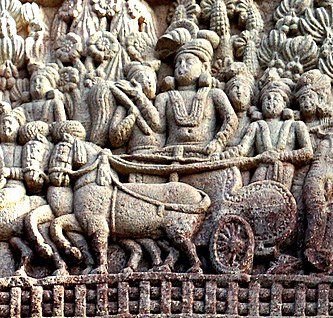
Source: Wikiquote: "Ashoka" (Quotes, Edicts of Ashoka (c. 257 BC): Using primarily Girnar version of the edicts, issued in 257 B.C.) The 'What it means' explanation text was generated by Google Gemini Flash (accessed January 18, 2026). https://gemini.google.com/app
Ashoka

About Ashoka

Ashoka the Great (Devanagari: अशोक; IAST transliteration: Aśoka, 304 BCE – 232 BCE), known also as Piyadasi (Pali. Sanskrit: Priyadarśin – meaning 'good looking'), and Devanaŋpiya (Pali. Sanskrit: Devānāmpriya meaning 'beloved of the Gods'), was the emperor of the Mauryan Empire from 273 BCE to 232 BCE. After a number of military conquests, Ashoka reigned over most of South Asia and beyond, from present-day Afghanistan to Bengal and as far south as Mysore. An early supporter of Buddhism, Ashoka established monuments marking several significant sites in the life of Shakyamuni Buddha, and according to Buddhist tradition was closely involved in the preservation and transmission of Buddhism. The name "Ashoka" means "without sorrow" in Sanskrit. Ashoka was the first ruler of ancient Bharatavarsha (India), after the famed Mahabharata rulers, to unify such a vast territory under his empire, which exceeds the boundaries of the present-day Republic of India.