Link Copied!
Angelica Balabanoff Quotes (1878-1965)
Activist, Leader

About Angelica Balabanoff
Angelica Balabanoff (or Balabanov, Balabanova; Russian: Анжелика Балабанова – Anzhelika Balabanova; 4 August 1878 – 25 November 1965) was a Russian-Italian communist and social democratic activist of Jewish origin. She served as secretary of the Comintern from 1919 to 1920, and later became a political party leader in Italy.
Best Angelica Balabanoff Quotes
Shortest
Earliest
Explore our curated collection of the most famous and impactful Angelica Balabanoff quotes.
“The path of least resistance can very easily become a trap and the price one pays for taking it may ultimately come too high. This has certainly been the case with Russia. The trials and executions of the past two years which have dishonoured not only Russia but the entire revolutionary movement, may cancel in the memory of mankind the gigantic social and technical achievements of the Revolution. These crimes did not begin with Stalin. They are links in a chain that had been forged by 1920. They were implicit in the development of the Bolshevik method-a method which Stalin has merely amplified to incredible proportions and used for his own non-revolutionary ends. (page 185)”

“My first realization of inequality and injustice grew out of these experiences in my early childhood. I saw that there were those who commanded and those who obeyed, and probably because of my own rebellion against my mother, who ruled my life and who for me personified all despotism, I instinctively sided with the latter. Why, I asked myself, should mother be able to rise when she pleased, while the servants had to rise at an early hour to carry out her orders? After she had raged at them for some mistake, I would implore them not to endure such treatment, not realizing that necessity held them as tightly to our home as it had held the peasants to the feudal landlords. (page 4)”
“After reading this chronicle of my collaboration with the international labour movement in its periods of victory and defeat, the reader is entitled to ask where I stand now. At sixty I am drawing conclusions from those experiences. My belief in the necessity for the social changes advocated by that movement and for the realization of its ideals has never been more complete than it is now when victory seems so remote. I am more than ever persuaded that a militant international labour movement must be the instrument of those changes. The experience of over forty years has only intensified my Socialist convictions, and if I had my life to live over again, I would dedicate it to the same objective. This does not mean that I do not recognize my own mistakes or those of the groups in which I have worked. (page 314)”
“Our conference [Women's Congress in Bern] had two tasks to perform: to publicize the fact that in spite of the vetoes of their governments and the opposition of the labour leaders, women had met and worked together for peace and for Socialism; our second task was to formulate slogans for this struggle and to publish a leaflet for women to whom the reaction to the war marked a first approach to social problems, to explain the causes and consequences of the war and the manner in which they could be abolished. Our appeal to them began: "Where are your husbands, your brothers, your sons? Why must they destroy one another and all that they have created? Who benefits by this bloody nightmare? Only a minority of war profiteers...Since the men cannot speak, you must. Workingwomen of the warring countries, unite!" (page 131)”

“If a new world war-which can no more make the world safe for democracy than did the last-does not plunge us into a new nightmare within the next few years, I believe that the international labour movement can be built again, and that in this movement and its courage and solidarity lies the only hope for humanity. Such a movement will have learnt from its past defeats at the hands of Fascism and from the mistakes and the betrayals of the Russian experiment. A new world war, with the inevitable rise of totalitarianism of various sorts within the democratic countries, can very well kill the possibility of such international action for decades to come. I am proud to have lived and worked with the artisans of a new social order. Many of them are now dead or defeated-in exile or in their own countries. But a new generation will take their place-to build more wisely and more successfully on the foundations we have laid. (page 319)”

“It is this that kills the spirit of the labour movement-not only in Russia, but throughout the world: that an Idea which has inspired whole generations to matchless heroism and enthusiasm has become identified with the methods of a régime based upon corruption, extortion and betrayal; and last, but not least, that the sycophants and assassins of this régime have infected the world labour movement. In this, Bolshevism identifies itself more and more with the methods of Fascism. I am among the few people who have not been surprised at the various abrupt changes in the tactics of the Communist International. I knew that its tactics were always imposed, rather than accepted, and as they never corresponded to conviction, there has been no need of any psychological adaptation. These changes have been the result of bargains, or the failure of bargains, between Stalin and the military and diplomatic authorities of other countries. (page 319)”
Angelica Balabanoff Quotes by Topic
Find exactly what you are looking for by browsing this categorized list of Angelica Balabanoff quotes by topic.
Angelica Balabanoff on World War I
“In retrospect, Jean Jaurès and Rosa Luxemburg seem to me the only delegates who, like Adler, realized fully the inevitability of the World War and the horrors it entailed.”

What Angelica Balabanoff Said About Others
Discover personal opinions Angelica Balabanoff shared regarding contemporaries.
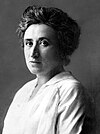
Angelica Balabanoff on Rosa Luxemburg 3 quotes
“In retrospect, Jean Jaurès and Rosa Luxemburg seem to me the only delegates who, like Adler, realized fully the inevitability of the World War and the horrors it entailed.”
Angelica Balabanoff on Clara Zetkin 2 quotes
“Clara had been so affected by the failure of the German Social Democracy, to which she had dedicated the best years of her life, that I felt she would never recover from the shock.”

Angelica Balabanoff on Alexander Berkman 2 quotes
“Shortly after my return to Kiev from Odessa I became involved in a situation which was to provide one of the most serious shocks to my Bolshevik illusions-the Pirro incident which Alexander Berkman later described at some length in his book, The Bolshevik Myth.”

Angelica Balabanoff on Vladimir Lenin 2 quotes
“He was concerned always with their historical importance. Even after the Russian Revolution had endowed him with tremendous power and responsibility, much of his thought and energy were absorbed by the old internal factional disputes between the Bolsheviks and the Mensheviks.”

Angelica Balabanoff on Karl Marx
“I looked up to these Russians who could discuss by the hour the theories of Marx and Bakunin, who had participated in demonstrations and other revolutionary activity.”

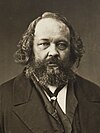
Angelica Balabanoff on Mikhail Bakunin
“I looked up to these Russians who could discuss by the hour the theories of Marx and Bakunin, who had participated in demonstrations and other revolutionary activity.”
Angelica Balabanoff on John Reed (journalist)
“I was probably the only person with whom she (Louise Bryant) talked freely and bitterly of Jack's experiences in Russia and his disillusion. She was convinced that this disillusion had robbed him of that will to live which might have saved his life.”

Angelica Balabanoff on Maxim Gorky
“It was typical of hundreds held throughout Italy. In no other country was sympathy with the victims of Tsarism so widespread. After 1905, when Maxim Gorki, already one of the world's most famous literary figures, was delegated to raise funds in the United States for the Russian victims, his total collections amounted to one-third of what I obtained among the Italian workers and peasants who lived under conditions which would have seemed unbearable to most American workers. Gorki's mission was marked with sensational incidents. He was refused admission to a New York hotel where he attempted to register with the Russian actress, Andreyeva, with whom he had been living for some time, and American conservatives started a vicious scandal-mongering campaign against him. A relationship which was accepted as a matter of course in Europe placed too much strain upon the American bourgeois conscience. Even Mark Twain joined the chorus against him, a chorus which was answered by the many radicals and intellectuals who rallied to his defence.”

Angelica Balabanoff on Alexandra Kollontai
“Within the Russian Party itself, the first organized opposition to the policies of both Lenin and Trotsky was led by a woman-Alexandra Kollontai. Alexandra was not an Old Bolshevik, but she had joined the Bolshevik Party even before Trotsky had done so and much earlier than I. During these first few years of the Revolution she was a frequent source of both personal and political annoyance to the Party leaders. On more than one occasion the Central Committee had wanted me to substitute for her in the leadership of the women's movement, thus facilitating the campaign against her and isolating her from the women of the masses. Fortunately, I understood this intrigue and refused these offers, emphasizing that no one could do this work so well as she, and trying to augment her prestige and create sympathy for her whenever possible. By the Ninth Congress of the Russian Party, the last vestiges of trade-union autonomy and workers' control in industry was swept away to be replaced by the control of the political had become the leader of the "Workers' Opposition," a protest missars over the trade unions and the workers' soviets. Kollantai movement against the bureaucratic suffocation of the labour unions and the democratic rights of the workers. As there was no possibility, even at that time, of publicly criticizing the Central Committee or of placing an unofficial opinion before the Party rank and file, she was courageous enough to have a pamphlet secretly printed for distribution to the delegates at the Party Convention. I have never seen Lenin so angry as when one of these pamphlets was handed to him at the Convention-in spite of the fact that "opposition" within the Party itself was still supposed to be legitimate. Taking the platform, he denounced Kollontai as the Party's worst enemy, a menace to its unity. He went so far in his attack as to make allusions to certain episodes in Kollontai's intimate life that had nothing whatever to do with the issue. It was the kind of polemic which did no credit to Lenin, and it was on this occasion that I realized the lengths to which Lenin would go in the pursuit of his strategic aims, his opposition to a party opponent. I admired Kollontai for the calm and self-control with which she answered Lenin's attack. Among the examples she quoted of the methods which were used by the Central Committee against Party "rebels" was the attempt of the "Central Committee to send Angelica Balabanoff to Turkestan to eat peaches." Like many other rebellious members of the Party, she was sent away soon after on a diplomatic mission. For old revolutionists like Kollontai it was a punishment to be separated from the field of revolutionary activity, but after years in Norway, Mexico, and Sweden as Soviet ambassador, she seemed to become reconciled to her position and to fall completely into line.”

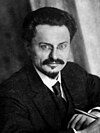
Angelica Balabanoff on Leon Trotsky
“Trotsky's own tragic fate was to illustrate all that I felt and thought about my own inability either to work with or compete with the Comintern leaders on their own ground. If, after the Soviet Republic was consolidated and the factional struggle first began against him, after the Central Committee decided that the time had come to lessen the popularity and self-confidence of the former Menshevik, Trotsky had shown his own superiority to the Jesuitry of his rivals, by refusing to use their methods, how different his fate might have been! It is far more likely that when the moment of disillusion with the bureaucracy came, he would have become the leader of a revolutionary labour movement throughout the world, and that the authority and the number of his disciples would be many times greater than they are now. If from the beginning, he had defended party democracy, fought the repression of honest dissent, the calumny of political opponents by the Party machine, how much more sympathy and solidarity he would have found in Russia from the first day of his persecution to the last shameful campaign against him! But to have denounced those methods consistently, Trotsky should have fought them from the very beginning when he was most powerful, when he was a part of the bureaucracy, and when the Russians themselves were still convinced that the country could not be saved without him. He could not have eradicated the disease, perhaps-this was too inherent in Bolshevism itself-but he could have avoided some of its most monstrous applications and he could have protested far more successfully and aroused others to protest-when he himself became the victim. But not only was Trotsky himself, after 1917, a good Bolshevist, a hundred-per-cent "Leninist," he was also too weak and too self-conscious to have made such a fight while still part of the ruling group. "Too weak?" How can I use that word to describe a man whom I consider one of the most powerful intellects of our time-a man who has done for Russia what no other modern statesman has done for his country (because none has had to work, to destroy and reconstruct under such complicated and unprecedented conditions); who has faced danger and death without hesitation, endured heroically persecution on an unprecedented scale? Yet, there are different ways of being courageous, or rather of being indifferent to what may come. One may defy death but be unable to face reproach or a threat to one's popularity. This was, and still is, the case with Trotsky. He was daring enough, with Lenin, to face the hostile opinion of the whole world. But he was not sufficiently independent to fight those tendencies exemplified in Lenin's puppet, Zinoviev, nor to refuse an alliance with Zinoviev even after the latter had first capitulated to and become the puppet of Stalin. He was afraid of being thought less "revolutionary" than those who attacked him and in the field of demagogy and political shrewdness he was no match for Zinoviev, Stalin, and the whole party apparatus. This fear of being suspected of not having wholly abnegated his original sin-Menshevism-and his immeasurable self-confidence, have continuously projected themselves like a shadow between this brilliant man and the situations in which he is personally involved, so that he has failed to apply to his own movement the criteria he applies to others. It is as though history and logic and the laws of causality which he understands and knows how to handle so well, stopped short before his own personality. It is an attitude which was encouraged, of course, by his matchless success in the early years of the Revolution, the overwhelming popularity he enjoyed. He was so sure in those days that, whatever might be the fate of others, whatever the dangers of popularity and success, for him-Leon Trotsky-life would make an exception. Instead, he has become the foremost victim of the perversion of the Revolution!”
Quotes About Angelica Balabanoff
Gain deeper perspective through quotes about Angelica Balabanoff from others.
Joyce Antler on Angelica Balabanoff
“Alix Kates Shulman's narrator quotes the real memoir of revolutionary socialist Angelica Balabanoff: "the experience of the individual in relation to historic events does not belong to oneself alone."”
Emma Goldman on Angelica Balabanoff
“The two leading Communist women of Russia proved the greatest contrast. Angelica Balabanoff lacked what Kollontay possessed in abundance: the latter's fine figure, good looks, and youthful litheness, as well as her worldly polish and sophistication. But Angelica had something that far outweighed the external attributes of her handsome comrade. In her large sad eyes there shone profundity, compassion, and tenderness. The tribulations of her people, the birth-pangs of her native land, the suffering of the downtrodden she had served her whole life were deeply graven on her pallid face…I left the dear little woman with mixed feelings. Soothed and comforted by her rich fount of love, I at the same time disapproved of her acquiescence in the evils and abuses about her. I had known of her as a fighter, always firm and unflinching in her stand. What had made her so passive now, I wondered. Communists enjoyed the right of criticism, as I had learned from the Bolshevik press. Why, then, did Angelica not use her pen and voice in and out of the party? It kept worrying me and I sought an opportunity to speak to her woman comrade who had served us tea. From her I learned that Angelica had been secretary of the Third International. In that capacity she had fought determinedly against the growing bureaucracy of the clique led by Zinoviev, Radek, and Bukharin. As a result she was most unceremoniously kicked out and denied all responsible work. [...] Her mental state was due to the methods employed by her party, including the wide-spread suffering, the terror, and the cheapness of human life. Angelica could not face them…she suffered more than most of her comrades from the latest somersault of her idol Ilich. To see constantly the hungry crowds around the bakeries and pastry-shops was torture to one who, like Angelica, felt guilty to accept the gift of even a few biscuits from her Swedish friends. It was a purgatory which only we, who knew her well, could appreciate.”

Milly Witkop on Angelica Balabanoff
“Angelica Balabanoff paid us a visit last week, and brought us personal greetings from [[Emma|Emma Goldman. The poor soul changed a lot since I have seen her in Berlin last: she looks so old! But not only physical (sic) she has changed, she seems to be so pessimistic and depressed. Her lectures are not very successful we are told, and if not for the Italians it would be worse still. She is envying Emma that she can be active in England, just the country where she would love to be. And Emma enrages her that she is in the states: that how it is, nobody can have ones choice, even not in the most elementary and simplest things these days, it is a miserable state of things.”

Source on Angelica Balabanoff 16 quotes
“Angelica Balabanoff was the last great representative of the nineteenth century revolutionary tradition in Russia. Her emphasis upon ethical values, her thrust for liberty and equality, and her deep concern for the poor of all countries put her squarely in the sentimental socialist movement which appeared first in the 1830's and 1840's in Western Europe. She was a romantic idealist, in many ways an anarchist, and a true European and internationalist. Thus, she was one of the first of the old socialists to recognize that Lenin and his Bolshevik colleagues, who were riding the storm of the Russian Revolution and creating the new Soviet State, were cynical, ruthless, and self-interested. She therefore left Moscow and the Third International in 1921 and was expelled from the Communist Party a few years later for placing her ideals and integrity above the demands of the Party, even of Lenin.”
About Angelica Balabanoff
Angelica Balabanoff (or Balabanov, Balabanova; Russian: Анжелика Балабанова – Anzhelika Balabanova; 4 August 1878 – 25 November 1965) was a Russian-Italian communist and social democratic activist of Jewish origin. She served as secretary of the Comintern from 1919 to 1920, and later became a political party leader in Italy.