Alexander Grothendieck: (1970), Actes du Congrès international des mathématiciens 1 chapter: Travaux de Heisouké Hironaka sur la résolution des singularités, pages: 7–9 (quote from p. 8, vol. 1, pdf)
“
trans.: The theorems demonstrated using Hironaka's theorem are countless. For the most part, one has the impression that the resolution of singularities is really at the heart of the problem, and cannot be avoided by resorting to different methods.
— Alexander Grothendieck on Heisuke Hironaka
What It Means
This is a placeholder explanation generated by the low-overhead model. It interprets "trans.: The theorems demonstrated using Hironaka's theorem are countless. For the most part, one has the impression that the resolution of singularities is really at the heart of the problem, and cannot be avoided by resorting to different methods." in the context of "Alexander Grothendieck: (1970), Actes du Congrès international des mathématiciens 1 chapter: Travaux de Heisouké Hironaka sur la résolution des singularités, pages: 7–9 (quote from p. 8, vol. 1, pdf)" to mean that wisdom is timeless.

Source: Wikiquote: "Heisuke Hironaka" (Quotes about Heisuke Hironaka)
The 'What it means' explanation text was generated by Google Gemini Flash (accessed January 18, 2026). https://gemini.google.com/app
Tags
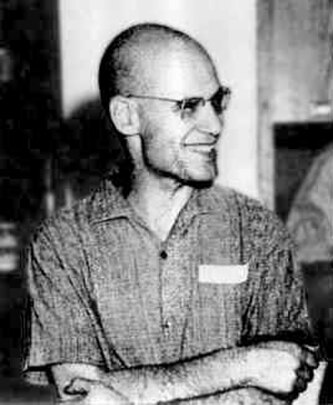
About Alexander Grothendieck
Alexander Grothendieck (28 March 1928 – 13 November 2014) was a German-born French mathematician who became the leading figure in the creation of modern algebraic geometry. His research extended the scope of the field and added elements of commutative algebra, homological algebra, sheaf theory and category theory to its foundations, while his so-called "relative" perspective led to revolutionary advances in many areas of pure mathematics.
View all quotes →