Appendix VI : A few principal rituals – Liber Reguli
“
A parabola is bound by one law which fixes its relations with two straight lines at every point; yet it has no end short of infinity, and it continually changes its direction. The Initiate who is aware Who he is can always check is conduct by reference to the determinants of his curve, and calculate his past, his future, his bearings, and his proper course at any assigned moment; he can even comprehend himself as a simple idea.
— Aleister Crowley
What It Means
This is a placeholder explanation generated by the low-overhead model. It interprets "A parabola is bound by one law which fixes its relations with two straight lines at every point; yet it has no end short of infinity, and it continually changes its direction. The Initiate who is aware Who he is can always check is conduct by reference to the determinants of his curve, and calculate his past, his future, his bearings, and his proper course at any assigned moment; he can even comprehend himself as a simple idea." in the context of "Appendix VI : A few principal rituals – Liber Reguli" to mean that wisdom is timeless.
Source: Wikiquote: "Aleister Crowley" (Quotes, Magick Book IV : Liber ABA: A work in four parts, first published between 1911 and 1936., Part III : Magick in Theory and Practice (1929): Magick in Theory and Practice)
The 'What it means' explanation text was generated by Google Gemini Flash (accessed January 18, 2026). https://gemini.google.com/app
Tags
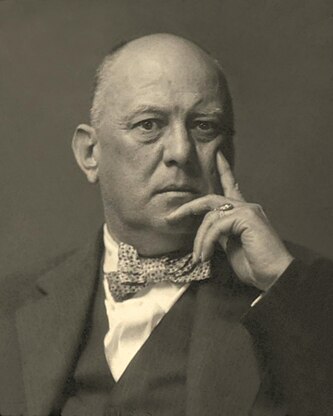
About Aleister Crowley
Aleister Crowley (12 October 1875 – 1 December 1947), born Edward Alexander Crowley, was a British occultist, mystic, poet, and social provocateur, famous for his development of the philosophical system called Thelema, and his concepts of magic, which he called Magick.
About Aleister Crowley
Aleister Crowley (12 October 1875 – 1 December 1947), born Edward Alexander Crowley, was a British occultist, mystic, poet, and social provocateur, famous for his development of the philosophical system called Thelema, and his concepts of magic, which he called Magick.
View all quotes →