Other variants:
• The eternally incomprehensible thing about the world is its comprehensibility.
• In the endnotes to Einstein: His Life and Universe by Walter Isaacson, note 46 on p. 628 says that "Gerald Holton says that this is more properly translated" as the variant above, citing Holton's essay "What Precisely is Thinking?" on p. 161 of Einstein: A Centenary Volume edited by Anthony Philip French.
• The most incomprehensible thing about the world is that it is comprehensible.
• This version was given in Einstein: A Biography (1954) by Antonina Vallentin, p. 24, and widely quoted afterwards. Vallentin cites "Physics and Reality" in Journal of the Franklin Institute (March 1936), and is possibly giving a variant translation as with Holton.
• The most incomprehensible thing about the world is that it is at all comprehensible.
• As quoted in Speaking of Science (2000) by Michael Fripp
• The eternal mystery of the world is its comprehensibility … The fact that it is comprehensible is a miracle.
• As quoted in Einstein: His Life and Universe by Walter Isaacson, p. 462. In the original essay "The fact that it is comprehensible is a miracle" appears at the end of the paragraph that follows the paragraph in which "The eternal mystery of the world is its comprehensibility" appears.
One may say "the eternal mystery of the world is its comprehensibility."
What It Means
This is a placeholder explanation generated by the low-overhead model. It interprets "One may say "the eternal mystery of the world is its comprehensibility."" in the context of "Albert Einstein, from the article "Physics and Reality" (March 1936), reprinted in Out of My Later Years (1956). The quotation marks may just indicate that he wants to present this as a new aphorism, but it could possibly indicate that he is paraphrasing or quoting someone else — perhaps Immanuel Kant, since in the next sentence he says "It is one of the great realizations of Immanuel Kant that the setting up of a real external world would be senseless without this comprehensibility."
Other variants:
• The eternally incomprehensible thing about the world is its comprehensibility.
• In the endnotes to Einstein: His Life and Universe by Walter Isaacson, note 46 on p. 628 says that "Gerald Holton says that this is more properly translated" as the variant above, citing Holton's essay "What Precisely is Thinking?" on p. 161 of Einstein: A Centenary Volume edited by Anthony Philip French.
• The most incomprehensible thing about the world is that it is comprehensible.
• This version was given in Einstein: A Biography (1954) by Antonina Vallentin, p. 24, and widely quoted afterwards. Vallentin cites "Physics and Reality" in Journal of the Franklin Institute (March 1936), and is possibly giving a variant translation as with Holton.
• The most incomprehensible thing about the world is that it is at all comprehensible.
• As quoted in Speaking of Science (2000) by Michael Fripp
• The eternal mystery of the world is its comprehensibility … The fact that it is comprehensible is a miracle.
• As quoted in Einstein: His Life and Universe by Walter Isaacson, p. 462. In the original essay "The fact that it is comprehensible is a miracle" appears at the end of the paragraph that follows the paragraph in which "The eternal mystery of the world is its comprehensibility" appears." to mean that wisdom is timeless.
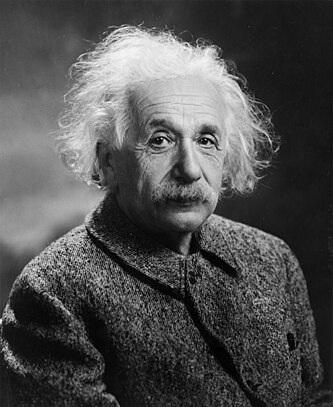
About Albert Einstein