Harold Macmillan on Adolf Hitler
← Back to Adolf Hitler Profile
“[T]he British people found it difficult, when they first heard of him, to take Hitler too seriously, with his Charlie Chaplin moustache and his everlasting raincoat. Naturally, nobody had bothered to read Mein Kampf. Nor could anybody see below the apparent insignificance of his appearance the deep, cunning, malignant brain. Here was concealed a combination of deceit and wickedness under a certain guise of plausibility, which can only now be fully grasped, when all the documents have been published and the whole evil story fully displayed to the world.”
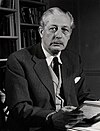
“Beneš made one further concession. On 4 September [1938], in the hope of reaching a settlement, he offered to accept the demands of the Sudeten Germans; that is to say, complete local autonomy... What would happen now? Hitler's speech at Nuremberg, due to take place on 12 September, would perhaps give us the answer... We had in 1938 some kind of radio set... [N]o listener could fail to grasp the import of the venomous insulting sentences hissed out by the orator—raucous, maniacal, almost inhuman—and of the roars of "Sieg Heil!" from the frenzied audience, bawled out like the battle-cry of a horde of savages.”
“[T]he very decency of ordinary men and women in Britain was a handicap. In our insularity, we neither read Hitler's gospel, Mein Kampf, nor understood the nature of his movement, or the scale of his ambitions. We shut our eyes to the character of his internal régime and comforted ourselves that if Germany had become a police State, it was no worse than Russia. We did not realise the difference. One country was slowly emerging from, the other relapsing into, barbarism. In any event, Germany was then the immediate threat to Britain and to Europe. Hitler had, or so it would appear, an almost mesmeric effect upon many of his visitors of very different types and backgrounds. Chamberlain was only the last of a long series of dupes who, having made the pilgrimage to Berchtesgaden, unexpectedly fell under his spell for varying periods of time. After his first meeting at Berchtesgaden, Chamberlain got the impression "that here was a man who could be relied upon when he had given his word". All failed to realise his extraordinary methods as a negotiator; the depths of deceit which he would practise; and the infamies to which he would sink... Hitler was notoriously guilty of dishonest breaches of faith time after time; yet, for some strange reason, he continued to be believed.”